
Colostrum Supplements: The Complete Guide to Bovine Colostrum in 2026
What Bovine Colostrum Actually Is — And Whether It Deserves the Hype
Colostrum has gone from a niche bodybuilder supplement to a social media sensation almost overnight, with claims ranging from gut healing to immune superpowers to anti-aging effects. Some of those claims are grounded in real biology. Others are marketing filling in where the evidence runs out. This guide will tell you which is which — what bovine colostrum contains, what the clinical trials have actually shown, what’s genuinely uncertain, and what standards matter when you’re buying it.
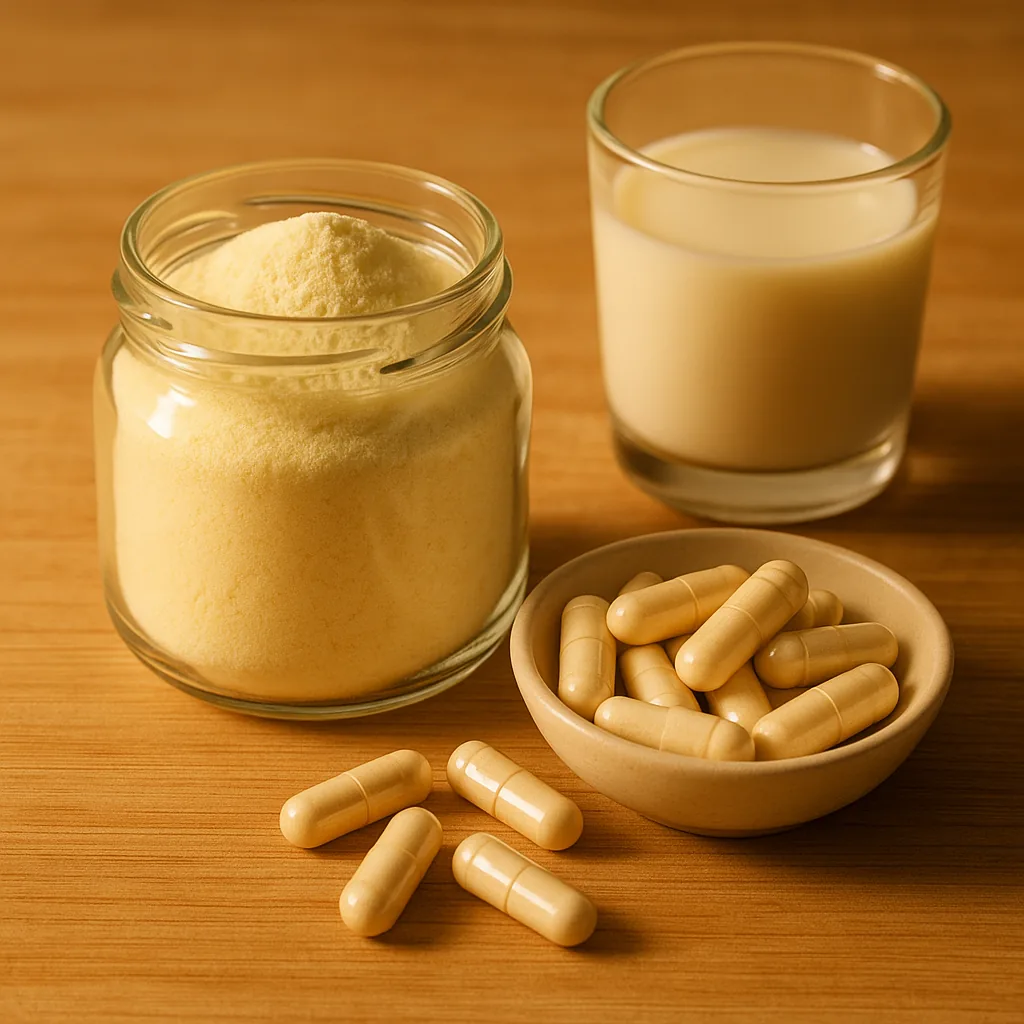
!Bovine colostrum supplement powder in a jar with a glass of milk 
Quick Answer: Bovine colostrum is the first milk produced by cows after calving, rich in immunoglobulins, lactoferrin, and growth factors. The strongest human evidence supports gut lining protection and modest immune support. Athletic performance benefits exist but are smaller than often claimed. Quality varies enormously — first-milking, low-heat processing, and pasture-raised sourcing matter. Safe for most people at 10–20 g/day; not suitable for dairy allergies.
What Bovine Colostrum Actually Contains
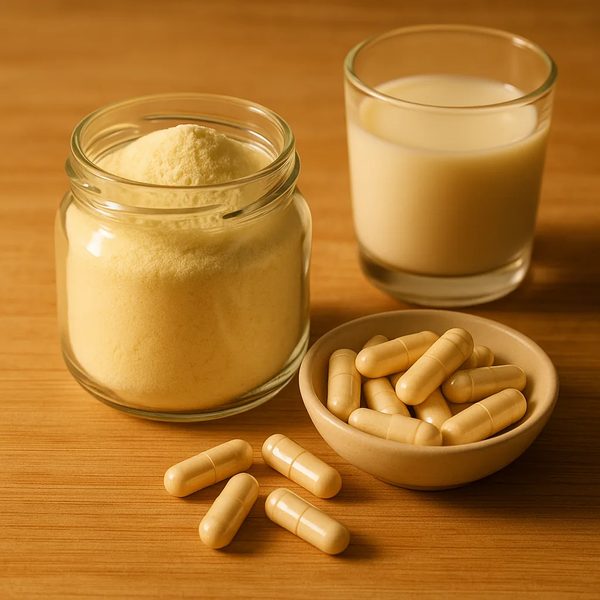
Colostrum is not regular milk. In the first 24–48 hours after a calf is born, the mother’s mammary glands produce a substance dramatically different from mature milk — higher in protein, far lower in lactose, and loaded with bioactive compounds that the calf needs to get its immune system and gut functioning.
Bovine colostrum collected for supplement use is typically the first one to two milkings post-calving. After that window closes, the composition shifts toward regular milk. This timing matters enormously for supplement quality, and we’ll come back to it.
The Key Bioactives
Immunoglobulins (IgG, IgA, IgM) are the immune proteins that give colostrum much of its functional identity. Bovine colostrum is exceptionally rich in IgG — typically 20–25% of its protein content. These are the antibodies the calf uses to build passive immunity before its own immune system comes online. In humans, these bovine antibodies are not absorbed systemically in meaningful quantities (our digestive system breaks them down), but they may exert local protective effects in the gut lumen. This distinction — local vs. systemic activity — is important for understanding what colostrum can and can’t do.
Lactoferrin is an iron-binding glycoprotein with antimicrobial, antiviral, and anti-inflammatory properties. Unlike immunoglobulins, lactoferrin is partially resistant to digestion and can survive to exert effects in the gut. It also shows some systemic absorption, which is why it’s studied for immune effects beyond the digestive tract. Bovine lactoferrin concentrations in colostrum are substantially higher than in mature milk.
Growth factors including IGF-1 (insulin-like growth factor 1), IGF-2, EGF (epidermal growth factor), and TGF-β (transforming growth factor beta) are present in colostrum at notably higher concentrations than in mature milk. These growth factors are implicated in tissue repair, gut epithelial maintenance, and muscle protein synthesis. The question of whether they survive oral digestion and exert systemic effects is actively debated — IGF-1, for example, is a protein and largely digested before systemic absorption. Local gut effects, however, are more plausible.
Proline-rich polypeptides (PRPs) are small signaling molecules that appear to modulate immune responses — upregulating a suppressed immune system or downregulating an overactive one. This bidirectional “immunomodulatory” effect is an interesting property but is based largely on in vitro and animal data so far.
Whey proteins, casein, and other nutrients round out the composition. Bovine colostrum is also a meaningful source of vitamins A, D, and E, though at the doses typically supplemented, it’s not a primary source of these nutrients.
Gut Health: The Most Credible Claim
The strongest human evidence for bovine colostrum centers on the gut, and specifically on gut barrier integrity. This is where the biology makes the most mechanistic sense and where the human trials are most convincing.
The Gut Barrier Problem
“Leaky gut” is a term that gets overused in wellness circles, but the underlying biology — increased intestinal permeability — is real and measurable. The gut lining is a single layer of epithelial cells held together by tight junction proteins. When these junctions weaken, larger molecules can pass through into the bloodstream, triggering immune activation. This is associated with inflammatory bowel conditions, celiac disease, certain autoimmune conditions, and is a feature (though not necessarily a cause) of many metabolic disorders.
The question is whether bovine colostrum can help maintain or restore this barrier.
What the Trials Show
Marchbank et al. (American Journal of Physiology, 2011) conducted a double-blind crossover trial in healthy volunteers using a challenging protocol: subjects were given indomethacin (an NSAID known to damage gut permeability) alongside either bovine colostrum or placebo. Colostrum significantly attenuated the permeability increase compared to placebo, as measured by lactulose/mannitol ratio — a validated measure of gut leakiness. The authors attributed this primarily to the growth factors (specifically EGF and IGF-1) and possibly lactoferrin acting on gut epithelial cells.
Playford et al. (Gut, 2001) published an earlier trial showing that bovine colostrum reduced gut permeability increases induced by NSAIDs in a dose-dependent manner. This research group was rigorous and the findings have been relatively consistent.
A systematic review by Rathe et al. (American Journal of Clinical Nutrition, 2014) examined the evidence base and concluded that bovine colostrum supplementation showed “promising results” for gut barrier function, particularly in the context of mucosal damage. They noted the evidence was preliminary and called for larger trials, which is an honest assessment that remains accurate today.
The practical takeaway: if you’re an athlete taking NSAIDs regularly, someone on long-term acid suppression, or simply dealing with gut permeability issues, the gut lining evidence for colostrum is among the more credible in the supplement world.
See the dedicated piece: Bovine Colostrum for Gut Health and Leaky Gut
Immune Support: Real but Nuanced
Bovine colostrum’s immune effects are frequently overstated but not entirely manufactured. Here’s where reality lies.
What the IgG Actually Does
Because bovine immunoglobulins are largely degraded in the human digestive system rather than absorbed systemically, they can’t deliver the “bovine immunity” that marketing sometimes implies. What they can do is provide local protection in the gut — binding to pathogens and reducing colonization within the digestive tract. This is analogous to how breast milk protects infants: passive, local, and real, but not the same as generating systemic antibodies.
Lactoferrin and Systemic Effects
Lactoferrin has better evidence for systemic immune effects. It’s antimicrobial (it sequesters iron that pathogens need), modulates natural killer cell and macrophage activity, and has demonstrated antiviral activity against several pathogens in cell culture. Human trials on lactoferrin specifically (not always as part of whole colostrum) have shown reductions in the incidence of common respiratory infections in some populations, particularly children and the elderly (Ochoa et al., Journal of Pediatrics, 2013).
Upper Respiratory Tract Infections
A number of trials have examined whole bovine colostrum supplementation for prevention of respiratory tract infections in athletes, who are known to be at elevated risk for upper respiratory infections during heavy training periods.
Brinkworth & Buckley (European Journal of Nutrition, 2003) found that 60 days of colostrum supplementation reduced the number of upper respiratory illness episodes in cyclists compared to whey protein. Davison et al. (Nutrition, 2016) found similar trends in trail runners. These trials are interesting — athletes under high training load represent a population where immune support is genuinely relevant.
The caveat: many of these trials are small, and the comparison to whey protein rather than placebo makes attribution to colostrum-specific bioactives harder to establish.
See the full immune evidence breakdown: Bovine Colostrum for Immune Support
Athletic Performance and Recovery: Modest and Overstated
Colostrum is heavily marketed for performance and muscle building, largely because of its growth factor content. The evidence here is more sobering than the marketing suggests.
Growth Factors: What Survives Digestion?
IGF-1 in bovine colostrum does survive partially — bovine colostrum supplementation does appear to raise serum IGF-1 in some human trials. Antonio et al. (Journal of the International Society of Sports Nutrition, 2001) found that athletes supplementing bovine colostrum showed modestly higher IGF-1 levels compared to whey. Whether this modest elevation translates to meaningful muscle protein synthesis differences from what you’d achieve with quality protein alone is a different question.
Muscle Recovery
The gut health angle may actually be the most relevant for athlete performance. Exercise itself — particularly prolonged endurance exercise — increases gut permeability. If colostrum helps maintain gut barrier integrity during heavy training, it may indirectly support recovery by reducing exercise-induced endotoxin translocation and the systemic inflammation that follows.
Shing et al. (European Journal of Applied Physiology, 2006) found that colostrum supplementation improved performance on a 20-minute cycling test following fatiguing exercise compared to whey protein. This is a real finding, but the effect size was modest, and the study was not large.
Colostrum vs. Whey: The Bottom Line
Whey protein has dramatically more evidence for muscle protein synthesis and has been studied in far larger trials over decades. Colostrum is not a substitute for quality protein. At the same price, whey wins for muscle building. At a premium price — which colostrum commands — you’re paying for the immune and gut bioactives, not the protein. That’s a legitimate tradeoff if those effects are what you need; it’s a poor tradeoff if you’re just looking to build muscle.
Full comparison: Colostrum vs. Whey Protein for Athletes
Quality Markers: What Actually Matters When Buying
This is where the consumer gets hurt if they’re not paying attention.
First-Milking vs. Later Collections
True first-milking colostrum is collected within the first six hours post-calving and has the highest concentration of IgG and growth factors. Second and third milkings still qualify as colostrum but with declining bioactive concentrations. Some manufacturers blend multiple milkings and still label the product “colostrum.” Others specify “true first-milking” and can back it up with IgG percentage certificates. Look for products specifying IgG content — quality colostrum should be at least 25–30% IgG protein.
Pasture-Raised and Hormone-Free
Bovine growth hormone (rBGH) is used in some commercial dairy herds. While the safety of rBGH for consumers is debated, choosing USDA Organic or pasture-raised sourced colostrum avoids this question entirely. Pasture-raised cows also generally produce colostrum with richer lactoferrin profiles.
Processing Temperature
Colostrum’s bioactives are heat-sensitive. High-temperature spray drying — the cheapest processing method — can denature immunoglobulins and growth factors significantly. Look for manufacturers that specify low-temperature processing, flash pasteurization, or BioActive proteins preservation. Freeze-dried colostrum typically preserves bioactives better than spray-dried, though it commands a higher price.
Third-Party Testing
NSF, Informed Sport, or USP certification matters for athletes subject to drug testing, since some growth factors in colostrum can theoretically affect doping-test results (though the evidence for clinically meaningful IGF-1 elevation is limited). At minimum, look for third-party testing for heavy metals and microbial contamination.
Dosing and Safety
How Much to Take
Clinical trials have used a wide range, typically 10–60 grams per day. For general gut and immune support, 10–20 grams per day (often 2 servings of 5–10 g) is the most common studied dose. Athletic performance trials have used up to 60 grams, but this is expensive and the additional benefit over lower doses isn’t well established.
Timing: most people take it in the morning on an empty stomach or with a light meal. Some advocate for taking it away from large meals to reduce competition for absorption with other proteins, though this hasn’t been rigorously tested.
Safety Profile
Bovine colostrum is generally very well tolerated. The most common adverse effects are mild GI symptoms — bloating, loose stools — usually at higher doses. These tend to resolve as the gut adjusts.
Contraindications and cautions:
- Dairy allergy: Bovine colostrum is a dairy product. People with milk protein allergies should avoid it or test with extreme caution under medical supervision.
- Lactose intolerance: Most colostrum products are low in lactose, but trace amounts are present. Highly sensitive individuals may experience symptoms.
- Autoimmune conditions: The immunomodulatory effects are theoretically bidirectional. People with autoimmune conditions should consult a physician before supplementing.
- Pregnancy and breastfeeding: Insufficient evidence to recommend supplementation.
The Claims Worth Treating Skeptically
Some colostrum marketing makes claims that outrun the evidence.
“Heals the gut completely” — Colostrum may support gut barrier integrity, but “heal leaky gut” implies a level of therapeutic certainty the evidence doesn’t support. Gut permeability is one variable, and the trials showing colostrum effects are mostly short-term and in specific populations.
“Powerful anti-aging supplement” — The growth factor content has attracted anti-aging interest, but human anti-aging trials don’t exist. The cellular biology is interesting; the clinical evidence is not there yet.
“Better than vaccines for immunity” — This claim appears occasionally on social media and is not supported by any evidence. Bovine IgG does not confer systemic human immunity. Full stop.
“Works for everyone equally” — Response appears to vary with baseline gut health, training status, and dietary context. The people most likely to benefit measurably are those with compromised gut integrity, high training loads, or frequent respiratory infections — not healthy people with good gut function and low stress.
FAQ
Is bovine colostrum safe for adults who aren’t dairy farmers or athletes?
Yes, for most adults it’s safe. The key exclusions are dairy allergy, lactose intolerance (less commonly relevant at typical doses), and autoimmune conditions where medical guidance is appropriate.
Can colostrum raise IGF-1 levels dangerously?
The IGF-1 elevation in human trials is modest — not of a magnitude associated with harm in healthy adults. For people with conditions linked to IGF-1 sensitivity (e.g., acromegaly risk, some cancers), caution and medical guidance are appropriate.
Does colostrum need to be refrigerated?
Quality colostrum powder should be stored in a cool, dry place. Once opened, keep it sealed and away from moisture. Refrigeration after opening can extend shelf life but isn’t universally required — check manufacturer guidance.
Will colostrum show up on a doping test?
It theoretically could affect IGF-1 levels slightly, but the evidence for this being a meaningful concern in drug-tested athletes is limited. Athletes in competitive, tested sports should use Informed Sport certified products and consult with their sports organization’s banned substances advisor.
How does colostrum compare to probiotics for gut health?
They work through entirely different mechanisms. Probiotics introduce or support beneficial microbial populations; colostrum supports the gut barrier directly and provides local immune factors. They’re complementary, not interchangeable.
Sources
- Marchbank T, et al. The nutriceutical bovine colostrum truncates the increase in gut permeability caused by heavy exercise in athletes. American Journal of Physiology – Gastrointestinal and Liver Physiology. 2011;300(3):G477–G484.
- Playford RJ, et al. Bovine colostrum is a health food supplement which prevents NSAID induced gut damage. Gut. 2001;48(2):264.
- Rathe M, et al. Clinical applications of bovine colostrum therapy: a systematic review. Nutrition Reviews. 2014;72(4):237–254.
- Antonio J, et al. The effects of bovine colostrum supplementation on body composition and exercise performance in active men and women. Nutrition. 2001;17(3):243–247.
- Shing CM, et al. Bovine colostrum supplementation and exercise performance: potential mechanisms. Sports Medicine. 2006;36(7):571–582.
- Brinkworth GD & Buckley JD. Concentrated bovine colostrum protein supplementation reduces the incidence of self-reported symptoms of upper respiratory tract infection in adult males. European Journal of Nutrition. 2003;42(4):228–232.
- Davison G, et al. Bovine colostrum supplementation attenuates the decrease of sIgA in the saliva of cyclists. European Journal of Nutrition. 2016;55(3):1295–1303.
- Ochoa TJ, et al. Randomized double-blind controlled trial of bovine lactoferrin for prevention of diarrhea and respiratory tract illness in children attending daycare. Journal of Pediatrics. 2013;162(2):349–356.
- Uruakpa FO, et al. Colostrum and its benefits: a review. Nutrition Research. 2002;22(6):755–767.
- Mehra R, et al. Bioactive factors in bovine colostrum: implications for health and immunity. Food Reviews International. 2006;22(3):225–244.
Related Articles
- Best Colostrum Supplements in 2026: Gut, Immunity, Recovery
- Best Colostrum Supplements in 2026: Full Guide
- Bovine Colostrum for Immune Support
- Bovine Colostrum for Gut Health and Leaky Gut
- Colostrum vs. Whey Protein for Athletes



Leave a Reply