Best Supplements for Stress in 2026: Adaptogens, Magnesium, and Evidence-Based Options
Quick Answer: The best-evidenced supplements for stress target the HPA (hypothalamic-pituitary-adrenal) axis — the hormonal cascade that governs the stress response. Top options include ashwagandha KSM-66 (cortisol reduction and anxiety relief), rhodiola rosea (mental fatigue and stress resilience), L-theanine (calm focus without sedation), magnesium glycinate (nervous system regulation), and phosphatidylserine (cortisol blunting, especially post-exercise). No supplement eliminates chronic life stress, but several meaningfully reduce its physiological impact.
Stress is a physiological process before it’s a psychological one. When your brain perceives a threat — whether it’s a genuine predator or a passive-aggressive email from a boss — it activates the hypothalamic-pituitary-adrenal (HPA) axis, triggering a hormonal cascade that releases cortisol from the adrenal glands. Cortisol’s job is to mobilize resources for the immediate challenge: raise blood sugar, suppress digestion and reproduction (not immediately necessary), heighten alertness, and redirect blood flow to muscles.
Acutely, this is brilliant adaptive biology. Chronically, it’s destroying us. The HPA axis evolved for short-burst threats, not for sustained, low-grade stressors of modern life — financial pressure, relationship strain, work overload, social media — that never fully resolve and therefore never allow the cortisol signal to turn off. Chronically elevated cortisol produces a recognizable cluster of effects: disrupted sleep, increased abdominal fat deposition, impaired immune function, reduced cognitive performance, mood disturbance, and eventually burnout.
This is the context in which stress supplements are relevant. The most useful ones don’t simply sedate or numb — they work by modulating the HPA axis or by supporting the neurological substrate of stress resilience. Understanding which approach is most relevant to your situation determines which compounds are most worth your attention.
Ashwagandha KSM-66: The Most Clinically Validated Adaptogen
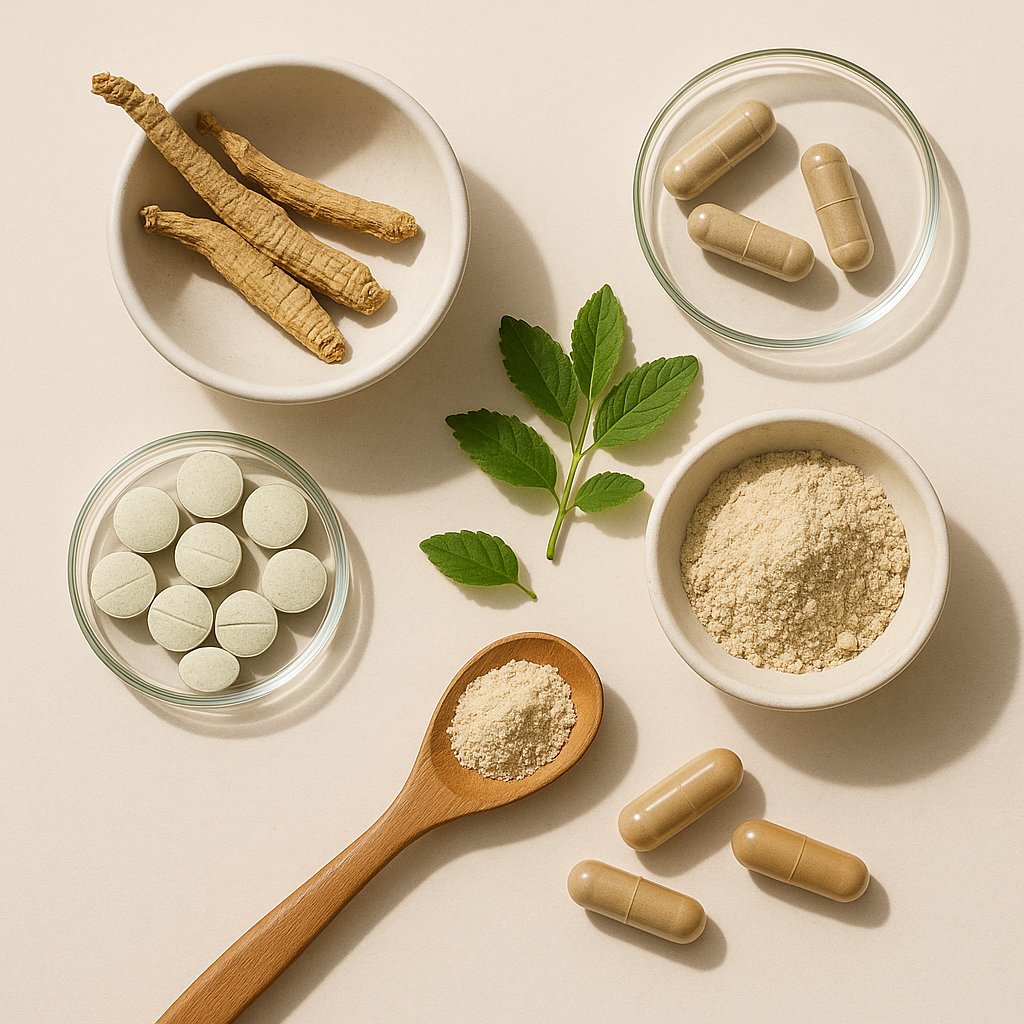
Ashwagandha (Withania somnifera) is an Ayurvedic herb that has more high-quality human clinical data than almost any other adaptogen on the market, particularly in its KSM-66 proprietary form (a full-spectrum root extract standardized to a specific withanolide profile).
The primary mechanism involves modulation of the HPA axis at multiple levels. Ashwagandha appears to reduce the stress-induced surge in cortisol by acting on hypothalamic receptors and reducing adrenal reactivity. It also influences GABAergic neurotransmission through compounds called withanolides, producing an anxiolytic effect independent of the cortisol pathway.
The clinical evidence is unusually strong for a botanical supplement. A landmark 2012 randomized double-blind trial published in the Indian Journal of Psychological Medicine found that 300 mg KSM-66 twice daily significantly reduced Perceived Stress Scale scores, cortisol levels, and anxiety scores compared to placebo over 60 days. The cortisol reduction was approximately 27.9% — not trivial. A 2019 trial found similar benefits at 240 mg/day of a related extract, confirming dose-response relationships.
Multiple subsequent trials have replicated these findings, with consistent effects on cortisol, self-reported stress, anxiety, sleep quality, and — in men — testosterone levels. A 2015 randomized trial found KSM-66 supplementation also significantly increased testosterone and sperm quality in men with stress-related infertility, which is mechanistically plausible since cortisol suppresses testosterone.
What distinguishes KSM-66 from generic ashwagandha extracts: KSM-66 uses a cold-water extraction process that preserves the full spectrum of withanolides and withanosides found in the root. Generic extracts vary widely in withanolide content and have inconsistent clinical profiles. For therapeutic use, KSM-66 (or Sensoril, another high-quality extract) is worth specifying over unbranded “ashwagandha extract.”
Dosing: 300–600 mg/day KSM-66, taken with meals. Many people split the dose (morning and evening). Effects build over 4–8 weeks. Safety profile is excellent; mild GI upset is the most common side effect. Ashwagandha should be used cautiously by people with thyroid conditions, as it may increase thyroid hormone levels.
Rhodiola Rosea: Stress Resilience and Mental Fatigue
Rhodiola (Rhodiola rosea) is an adaptogenic herb from high-altitude Arctic and mountainous regions. While ashwagandha tends to work more on anxiety and cortisol amplitude, rhodiola’s profile is somewhat different — it excels specifically at stress-related mental fatigue and cognitive performance under pressure.
The active compounds, rosavins and salidroside, influence serotonin and dopamine availability through MAO inhibition, modulate the stress protein Hsp70, and regulate cortisol through effects on the adrenal cortex. The net effect is reduced perception of fatigue under stress and maintained cognitive performance when stress and sleep deprivation would otherwise impair it.
A well-designed 2009 trial in Planta Medica found rhodiola significantly reduced fatigue, improved cognitive function, and lowered cortisol response to a standardized stress test in a group of physicians doing night shifts — a high-stress, sleep-deprived population. Other trials have found consistent benefits for stress-related fatigue in students, executives, and military recruits.
Rhodiola has a slightly stimulating character — people who are already anxious or “wired” may find it exacerbating rather than calming. In that profile, ashwagandha is often the better first choice. For people whose stress manifests as exhaustion, difficulty concentrating, and mental depletion rather than anxious rumination, rhodiola fits more naturally.
Dosing: 200–400 mg/day, standardized to 3% rosavins and 1% salidroside, taken in the morning (its mild stimulating effect can disrupt sleep if taken in the evening). Morning dosing on an empty stomach tends to produce faster and stronger effects.
L-Theanine: The Calm Without the Crash
L-theanine is an amino acid found in green tea that promotes a state of “calm alertness” — alpha brain wave activity that characterizes relaxed focus, as opposed to the anxious beta waves of stress or the delta waves of sleep. It achieves this without sedation, which distinguishes it from most anxiolytic compounds.
Mechanistically, L-theanine elevates GABA, serotonin, and dopamine in key brain regions while reducing excitatory glutamate activity. It blunts the cardiovascular response to acute stress (heart rate and blood pressure spikes), which partly explains why tea-drinkers in high-stress cultures report calm alertness rather than the jittery hyperawareness of coffee.
Multiple RCTs confirm L-theanine’s effects on acute stress. A 2019 randomized trial in Nutrients found 200 mg L-theanine significantly reduced stress response and salivary cortisol to a standardized stress task compared to placebo. Another trial specifically in people with high trait anxiety found L-theanine reduced anxiety scores and improved sleep quality over four weeks.
L-theanine pairs naturally with caffeine — their effects are complementary rather than contradictory. Caffeine sharpens focus but can increase anxiety and heart rate; L-theanine moderates these effects while extending the productive focus state. The 2:1 ratio (200 mg theanine to 100 mg caffeine) is a well-studied combination with consistent evidence for improved attention, reaction time, and reduced anxiety compared to caffeine alone.
For stress supplementation purposes, L-theanine is most useful as an acute intervention — taken when stress is high or before a stressful event — though regular use also shows cumulative benefits. It’s among the safest supplements on this list, with no known adverse effects at typical doses.
Dosing: 100–400 mg as needed, or 200 mg/day regularly for ongoing stress management.
Magnesium: The Mineral the Stress Response Depletes
Magnesium has a complex bidirectional relationship with the stress response. On one hand, the HPA axis stress response causes magnesium to be excreted in urine — chronic stress literally depletes your magnesium. On the other, low magnesium makes the stress response more reactive, creating a vicious cycle. Epidemiological data shows strong associations between low magnesium intake and anxiety, depression, and HPA axis dysregulation.
Magnesium’s role in stress physiology is broad: it acts as a physiological calcium antagonist (excess calcium excites neurons; magnesium calms them), modulates NMDA glutamate receptors (reducing excitatory neuronal activity), supports GABA neurotransmission, and is required for the synthesis of serotonin and melatonin.
Clinical evidence for magnesium in stress and anxiety is meaningful. A 2017 systematic review of 18 randomized trials found significant reductions in self-reported anxiety and stress with magnesium supplementation. Effects were most consistent in populations with sub-optimal magnesium status, which, given dietary patterns, encompasses a substantial portion of the population.
For stress specifically, magnesium glycinate (200–400 mg elemental magnesium at night) is the preferred form — high bioavailability, minimal laxative effect, and the added GABA-supporting effect of the glycine molecule. Magnesium malate is an alternative with energizing properties (malic acid is a Krebs cycle intermediate) that some prefer for morning dosing.
Phosphatidylserine (PS) is a phospholipid that is a structural component of all cell membranes and is particularly concentrated in brain cell membranes. It’s involved in cell signaling, neurotransmitter release, and cortisol clearance at the pituitary level.
The cortisol-blunting effect of phosphatidylserine is its most clinically interesting property for stress management. A landmark study published in Medicine & Science in Sports & Exercise found that 800 mg/day PS blunted the cortisol and ACTH response to intense exercise by approximately 20% — without impairing the anabolic testosterone response. This selective cortisol reduction makes PS particularly interesting for people who exercise intensely (high training stress) or who want to reduce the cortisol spike associated with acute stressors.
Subsequent trials have confirmed cortisol-blunting effects at doses of 400–800 mg/day, with cognitive benefits (improved working memory, attention) also appearing. PS crosses the blood-brain barrier and has well-documented evidence for reducing age-related cognitive decline, though this benefit appears most in people with early memory concerns.
Practical note: PS is one of the more expensive supplements on this list, and the cost of achieving the clinical doses (400–800 mg/day) can be significant. For people primarily concerned with exercise-induced cortisol and recovery, PS is highly relevant. For general stress management with budget constraints, ashwagandha and magnesium cover more ground per dollar.
Building a Practical Stress Supplement Stack
The most logical combinations, depending on your stress profile:
For high cortisol, anxiety, and sleep disruption: Ashwagandha KSM-66 (300 mg AM + 300 mg PM) + Magnesium glycinate (300–400 mg at bedtime). This addresses both the HPA axis amplitude and the nervous system substrate of stress. Add L-theanine (200 mg) during high-stress periods.
For mental fatigue and stress-related cognitive impairment: Rhodiola (300–400 mg AM) + L-theanine (200 mg with caffeine if desired). This targets the fatigue and cognitive performance side of stress rather than the anxiety side.
For athletes with training stress: Phosphatidylserine (400–800 mg/day) + Magnesium glycinate (300–400 mg at night). This specifically addresses exercise-induced cortisol while supporting sleep quality for recovery.
No supplement stack replaces stress reduction at its source — addressing sleep, workload, relationships, and physical activity. These compounds work best as support for a lifestyle approach, not as a replacement for it.
FAQ
Is ashwagandha safe for long-term use? Clinical trials up to 90 days show excellent safety. Long-term (>6 months) data is limited but without red flags in traditional use histories. Cycling ashwagandha (8–12 weeks on, 2–4 weeks off) is a common practice without strong clinical evidence supporting it but also without harm.
Can these supplements interact with antidepressants or anxiety medications? L-theanine is generally considered safe alongside SSRIs and SNRIs. Ashwagandha and rhodiola may theoretically interact with medications affecting serotonin or thyroid function. Phosphatidylserine has minimal known drug interactions. Always disclose supplements to prescribing physicians.
How quickly do stress supplements work? L-theanine and acute magnesium produce noticeable calming effects within 30–60 minutes. Ashwagandha and rhodiola typically require 2–4 weeks of consistent use for meaningful HPA axis modulation. Phosphatidylserine effects on cortisol appear within 2 weeks in most trials.
What’s the difference between an adaptogen and an anxiolytic? Adaptogens (ashwagandha, rhodiola, cordyceps) normalize stress responses — they modulate the HPA axis to keep the stress response proportionate. Anxiolytics (which include some supplements like L-theanine and GABA, and many medications) reduce anxiety more directly through GABA or related pathways. Many supplements do both to varying degrees.
Darbinyan, V., et al. (2007). Clinical trial of Rhodiola rosea for professional stress in physicians. Nordic Journal of Psychiatry, 61(5), 343–348. https://pubmed.ncbi.nlm.nih.gov/17990195/
Kimura, K., et al. (2007). L-Theanine reduces psychological and physiological stress responses. Biological Psychology, 74(1), 39–45. https://pubmed.ncbi.nlm.nih.gov/16930802/
Abbasi, B., et al. (2012). The effect of magnesium supplementation on primary insomnia in elderly. Journal of Research in Medical Sciences, 17(12), 1161–1169. https://pubmed.ncbi.nlm.nih.gov/23853635/
Monteleone, P., et al. (1992). Effects of phosphatidylserine on the neuroendocrine response to physical stress. Neuroendocrinology, 52(3), 243–248. https://pubmed.ncbi.nlm.nih.gov/1280798/
Boyle, N.B., et al. (2017). The effects of magnesium supplementation on subjective anxiety and stress. Nutrients, 9(5), 429. https://pubmed.ncbi.nlm.nih.gov/28445426/
This article is for informational purposes only and does not constitute medical advice. If you are experiencing chronic stress, anxiety disorders, or adrenal conditions, please consult a qualified healthcare provider. Do not discontinue prescription medications without medical guidance.
[…] For a complete overview of energy supplements and stress supplements separately, see our supplements for energy guide and supplements for stress guide. […]




Leave a Reply