PT-141 (Bremelanotide / Vyleesi) Guide 2026: FDA-Approved Peptide for Sexual Health
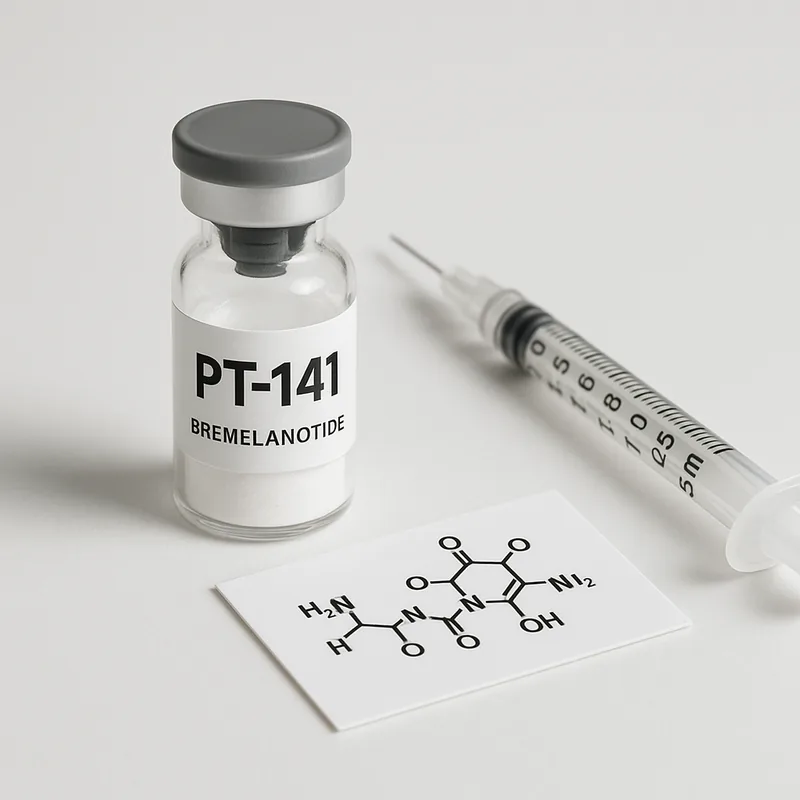
Quick Answer: PT-141, also known as bremelanotide and sold as Vyleesi, is a synthetic peptide that activates melanocortin receptors (MC3R and MC4R) in the brain to increase sexual desire. Unlike PDE5 inhibitors such as Viagra, it works centrally through the nervous system rather than on blood vessels. It was FDA-approved in 2019 for hypoactive sexual desire disorder (HSDD) in premenopausal women and is also used off-label in men. Common side effects include nausea (~40%), flushing, and transient blood pressure changes.
Sexual dysfunction is one of the most underreported and undertreated health concerns across both sexes. For decades, the pharmaceutical toolkit was largely limited to PDE5 inhibitors designed for men — drugs that improve blood flow but do nothing for the desire to have sex in the first place. PT-141 (bremelanotide) represents a fundamentally different approach: instead of working on plumbing, it works on the brain.
This guide covers the science behind PT-141, what the clinical data actually shows, how it compares to older treatments, the real cost picture, and why — despite being FDA-approved — it hasn’t become a household name yet.
What Is PT-141 (Bremelanotide)?
PT-141, formally known as bremelanotide, is a cyclic heptapeptide — a small, ring-shaped protein fragment — developed as a synthetic analog of alpha-melanocyte-stimulating hormone (α-MSH). It is derived from research on Melanotan II, a compound originally studied in the 1980s and 1990s for its ability to promote skin tanning by stimulating melanin production.
During Melanotan II research, scientists noticed something unexpected: test subjects (and later researchers in animal models) showed increases in sexual arousal. This side effect became the main event. Researchers at the University of Arizona isolated the mechanism, modified the compound for selectivity, and PT-141 emerged as a more refined, pharmacologically targeted derivative.
Palatin Technologies eventually developed PT-141 into a clinical drug candidate. In 2019, the FDA approved the subcutaneous injectable form under the brand name Vyleesi (bremelanotide injection, 1.75 mg), specifically for the treatment of hypoactive sexual desire disorder (HSDD) in premenopausal women. This made it only the second FDA-approved treatment for HSDD, after flibanserin (Addyi, 2015).
The Melanocortin System: A Brief Overview
To understand how PT-141 works, you need a basic grasp of the melanocortin system — one of the most evolutionarily conserved signaling networks in the body.
The melanocortin system consists of five G-protein coupled receptors (MC1R through MC5R) and two endogenous peptide families that activate them: the melanocyte-stimulating hormones (MSHs) and adrenocorticotropic hormone (ACTH). These receptors are distributed throughout the body and brain, where they regulate:
Skin pigmentation (MC1R)
Adrenal function / cortisol release (MC2R)
Energy balance, appetite, and sexual function (MC3R, MC4R)
Exocrine gland function (MC5R)
MC3R and MC4R are heavily expressed in the hypothalamus and other limbic brain regions. MC4R in particular plays a central role in regulating food intake, body weight, and — critically — sexual motivation and arousal. Mutations in the MC4R gene are the most common monogenic cause of severe obesity in humans, and MC4R knockout mice show profound reproductive dysfunction. This receptor sits at a crossroads between energy metabolism and reproductive drive.
PT-141 is a non-selective melanocortin receptor agonist with affinity primarily at MC3R and MC4R, which is where its pro-sexual effects originate.
Mechanism of Action: How PT-141 Works
When PT-141 is administered (typically subcutaneously, though nasal spray formulations have been studied), it crosses the blood-brain barrier and activates MC3R and MC4R receptors in the paraventricular nucleus (PVN) of the hypothalamus and related limbic structures.
MC4R activation in the PVN triggers downstream signaling that increases dopaminergic tone in the mesolimbic pathway — the brain’s reward and motivation circuit. This appears to elevate sexual motivation centrally, generating desire rather than simply facilitating physical arousal.
The mechanism is clearly distinct from PDE5 inhibitors like sildenafil (Viagra) or tadalafil (Cialis), which work peripherally by blocking phosphodiesterase type 5, thereby preserving cyclic GMP and relaxing smooth muscle in genital vasculature. PDE5 inhibitors improve the mechanics of arousal — they make erections physiologically easier. They do not, however, increase libido or desire. PT-141 addresses desire directly at the neurological level.
This distinction matters clinically. Many patients with sexual dysfunction — particularly women with HSDD — have adequate physical arousal capacity but experience low or absent sexual desire. For them, a vasodilator is the wrong tool entirely.
FDA Approval and the RECONNECT Trials
Vyleesi’s approval in June 2019 was based primarily on two Phase III randomized controlled trials known collectively as the RECONNECT trials (Reconsidering the Normal: Evaluating Compelling New Neuroactive Compounds to Treat [HSDD]).
RECONNECT Study Design:
Population: Premenopausal women with acquired, generalized HSDD (DSM-5 criteria)
Dosing: 1.75 mg bremelanotide subcutaneous injection, administered 45 minutes before anticipated sexual activity (not daily)
Key Results:
Women treated with bremelanotide showed statistically significant improvements in the Female Sexual Function Index desire domain compared to placebo
Significant reduction in the Female Sexual Distress Scale-Desire/Arousal/Orgasm (FSDS-DAO) score — a measure of how much sexual dysfunction affects quality of life
Approximately 25% of treated women reported a meaningful improvement in the number of satisfying sexual events per month compared to ~17% on placebo
The effect size was modest but clinically meaningful for responders
The nuance: Effect sizes in RECONNECT were real but not dramatic. Critics noted that the absolute difference in satisfying sexual events between bremelanotide and placebo was modest (roughly 0.5 additional satisfying events per month). Supporters counter that any validated improvement in a condition as complex and subjectively loaded as HSDD is clinically significant, especially in the absence of alternatives.
The FDA agreed that the benefit-risk profile supported approval, with a label that includes warnings about transient hypertension and a requirement that patients not use the drug more than once in 24 hours.
PT-141 vs. Melanotan II: Key Differences
Both PT-141 and Melanotan II are melanocortin receptor agonists derived from the same research lineage, but they are meaningfully different compounds.
Feature
PT-141 (Bremelanotide)
Melanotan II
Receptor profile
Primarily MC3R/MC4R
MC1R, MC3R, MC4R, MC5R (less selective)
Tanning effect
Minimal to none
Significant (MC1R activation)
FDA status
Approved (Vyleesi, 2019)
Not approved; unscheduled research compound
Half-life
~2.7 hours
~1–2 hours (varies)
Administration
Subcutaneous (approved); nasal (studied)
Typically subcutaneous (research use)
Nausea incidence
~40%
Higher (less refined)
Selectivity
Greater CNS selectivity
Broader peripheral effects
The key engineering achievement with PT-141 was removing the melanin-stimulating activity while preserving CNS receptor engagement. Melanotan II activates MC1R on melanocytes, causing skin darkening — a side effect most pharmaceutical developers and patients would prefer to avoid. PT-141’s reduced MC1R affinity largely eliminates this, making it pharmacologically cleaner for a sexual health indication.
Melanotan II remains available as a gray-market research chemical but has no regulatory status in any major market. Its broader receptor profile and less predictable sourcing make it significantly riskier than pharmaceutical-grade bremelanotide.
Off-Label Use in Men
PT-141 was studied in men during clinical trials and showed promising results — though regulatory approval was sought (and granted) only for the women’s HSDD indication due to market strategy and trial population focus.
In studies of men with erectile dysfunction, particularly those who did not respond adequately to PDE5 inhibitors, PT-141 demonstrated:
Increased penile erections in a dose-dependent manner in Phase I and II studies
Subjective increases in sexual desire — the mechanism that distinguishes it from Viagra
Potential utility in men whose ED has a significant psychogenic or central component rather than purely vascular etiology
Importantly, PT-141 does not require sexual stimulation to work (unlike PDE5 inhibitors, which depend on arousal-mediated nitric oxide release). It can initiate desire and arousal through central mechanisms alone — which is why it’s sometimes described as working “from the brain down” rather than “from the body up.”
Off-label prescribing in men exists but is not standardized. Compounding pharmacies in the United States produce bremelanotide formulations for prescribing clinicians, typically at doses ranging from 1–2 mg.
Side Effects: What to Expect
The side effect profile is the main practical limitation of PT-141 and a key driver of its slower-than-expected adoption.
Common side effects:
Nausea: Reported in approximately 40% of clinical trial participants; the most frequent reason for discontinuation
Flushing: Facial and body warmth/redness; reported in ~20% of users
Headache: Occurs in roughly 11% of patients
Injection site reactions: Pain, bruising, or local irritation at the subcutaneous injection site
Cardiovascular effects:
Transient blood pressure elevation: A meaningful concern — bremelanotide causes a transient increase in systolic blood pressure of approximately 6 mmHg and diastolic by approximately 4 mmHg, peaking within 12 minutes of injection and resolving within 12 hours
Heart rate decrease: Typically 4–5 bpm, likely a compensatory baroreceptor response
Contraindicated in patients with established cardiovascular disease or uncontrolled hypertension
Hyperpigmentation:
Focal darkening, typically of the face, gums, or breasts, has been reported with repeated use — a residual MC1R effect even at reduced potency. This is generally reversible but clinically notable.
The nausea is the dominant complaint. Pre-treating with ondansetron (Zofran) is sometimes used off-label to manage it, though this is not part of the official prescribing information.
Cost: Vyleesi vs. the Research Market
Pharmaceutical (Vyleesi):
The list price for Vyleesi is approximately $1,000 per single-dose autoinjector without insurance
Insurance coverage is highly variable; many plans do not cover it or require prior authorization
Palatin Technologies / AMAG Pharmaceuticals have offered patient assistance programs, but access remains limited
A manufacturer coupon has historically been available, bringing out-of-pocket costs down significantly for eligible patients — but this is not reliable long-term
Compounding pharmacies:
Compounded bremelanotide (typically in lyophilized powder form for reconstitution) is available through licensed compounding pharmacies with a valid prescription
Prices typically range from $80–$200 per vial containing multiple doses
Quality and dosing consistency vary by pharmacy; not all compounders are PCAB-accredited
Research/gray market:
Unlicensed PT-141 is sold online as a “research chemical” — often the same lyophilized vials used in the compounding market
Legal status is a gray area; the compound is not a controlled substance in the US, but selling it for human use without prescribing authority violates FDA regulations
Quality, purity, and sterility are unverified — significant safety risk
The cost disparity between brand-name Vyleesi and compounded alternatives is stark and explains much of where actual patient use falls.
Why Adoption Has Been Slower Than Expected
Despite being FDA-approved and addressing a genuinely prevalent condition (HSDD affects an estimated 8–15% of premenopausal women), Vyleesi has not achieved blockbuster status. Several factors contribute:
The nausea problem. A 40% nausea rate is a serious deterrent, particularly for a drug used in a recreational/intimate context. Taking an injection that makes you nauseous 45 minutes before sex is not a compelling consumer proposition.
Modest effect size. The clinical benefit, while real, is modest in absolute terms. Many patients and providers weigh the side effect burden against a half-event improvement per month and decide the math doesn’t work.
Injection delivery. A subcutaneous autoinjector is more complex and off-putting than a daily pill. While the injection itself is relatively simple, the barrier to entry is higher than oral medications.
Lack of insurance coverage. At $1,000 per dose without coverage, access is gatekept by cost for most patients.
Provider awareness and comfort. Female sexual dysfunction, including HSDD, is chronically under-addressed in clinical practice. Many primary care physicians are not trained to diagnose or treat it, and do not discuss it with patients.
Cultural and regulatory hesitancy. Sexual desire disorders in women have historically been under-recognized as legitimate medical conditions. The FDA actually rejected flibanserin (Addyi) twice before approving it in 2015, reflecting regulatory ambivalence that has chilled commercial confidence in this space.
The compound has a real mechanism, real clinical data, and FDA approval. The gap between what PT-141 is pharmacologically and how broadly it’s actually used reflects systemic failures in healthcare access, clinical education, and pharmaceutical economics more than any fundamental flaw in the science.
Who Might Benefit Most?
Based on current evidence, PT-141 / bremelanotide appears most appropriate for:
Premenopausal women with HSDD — the FDA-approved indication
Men with psychogenic ED or reduced desire not fully addressed by PDE5 inhibitors
Patients for whom libido/desire, not mechanics, is the primary complaint
Individuals who have trialed other approaches (counseling, hormonal evaluation, lifestyle) without adequate relief
It is not appropriate for people with cardiovascular disease, uncontrolled hypertension, or those who cannot tolerate a 40% nausea risk.
This article is for informational purposes only and does not constitute medical advice. PT-141 (bremelanotide/Vyleesi) is a prescription medication in the United States. Off-label use should only be undertaken under the supervision of a licensed healthcare provider. Do not use any peptide or pharmaceutical compound obtained from unverified sources. Always consult a qualified physician before starting any new treatment.







Leave a Reply