Inositol Beyond PCOS: Gestational Diabetes, Metabolic Syndrome, and Mental Health
Quick Answer: Inositol — particularly myo-inositol and D-chiro-inositol — has its strongest evidence in PCOS and insulin resistance, but compelling research extends to gestational diabetes prevention, panic disorder, OCD, and metabolic syndrome. The 40:1 myo:D-chiro ratio mirrors the body’s natural tissue ratio and appears optimal.
Inositol has become one of the most evidence-backed supplements in women’s metabolic and reproductive health, primarily known for its remarkable performance in PCOS clinical trials. But limiting the conversation to PCOS undersells a nutrient with diverse, well-mechanized applications across metabolic syndrome, pregnancy complications, psychiatric conditions, and cellular signaling. This guide covers the full picture.
What Is Inositol?
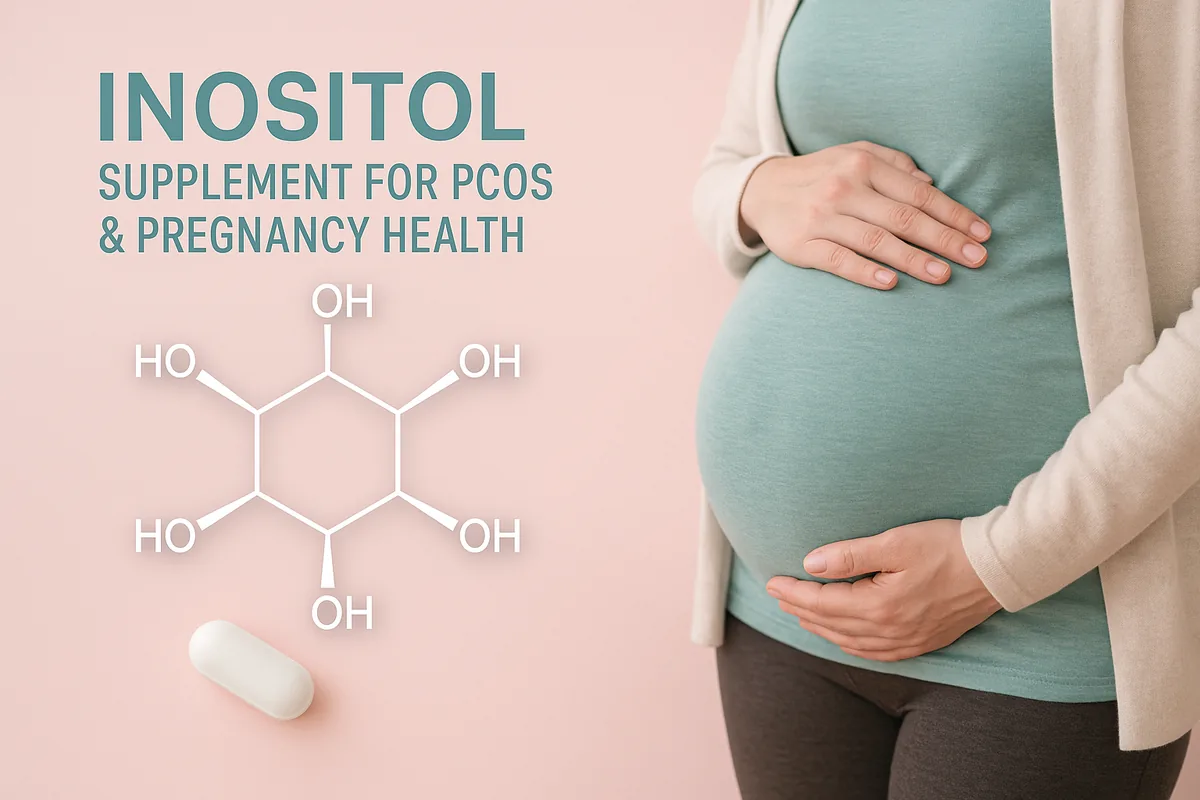
Inositol is a naturally occurring carbohydrate (technically a cyclitol, related to but not a true sugar) found in virtually all human cells. It exists in nine possible isomers; two are biologically dominant:
Myo-inositol (MI): The most abundant form (~95% of total inositol in the body). Acts as a second messenger in insulin signaling, FSH signaling, and cell membrane phospholipid synthesis. Brain has the highest tissue concentration of any organ.
D-chiro-inositol (DCI): A metabolite of myo-inositol (conversion is catalyzed by an enzyme called epimerase). Particularly active in insulin-mediated glucose disposal in muscle and fat tissue.
The ratio matters: Tissues maintain specific MI:DCI ratios that vary by tissue type. Ovaries naturally have a very high MI:DCI ratio (~100:1); liver and muscle have lower ratios. The blood-plasma physiological ratio is approximately 40:1 (MI:DCI). This ratio became clinically relevant when it was discovered that PCOS is associated with disrupted DCI metabolism.
The PCOS Evidence: The Foundation
PCOS (polycystic ovary syndrome) is the most common hormonal disorder in women of reproductive age, affecting 10-15% of women. It features insulin resistance, hyperandrogenism, and ovulatory dysfunction. Inositol’s role:
Mechanism: Inositol phosphoglycans (IPGs) are second messengers in the insulin signaling cascade. MI-IPGs and DCI-IPGs work in different downstream pathways. In PCOS, there’s a defect in converting MI to DCI in certain tissues AND an excess of DCI in the ovaries (disrupting ovarian MI-mediated FSH sensitivity). Supplementing MI corrects ovarian signaling; supplementing combined MI+DCI at the 40:1 ratio restores systemic balance.
Evidence:
Multiple RCTs show myo-inositol 2-4g/day significantly improves ovarian function, menstrual regularity, oocyte quality, and ovulation rates in PCOS
Reduces testosterone and androgen markers (improves hirsutism and acne)
Improves insulin sensitivity and reduces fasting insulin
A 2007 RCT found MI 2g twice daily significantly reduced testosterone, blood pressure, and improved glucose tolerance vs. placebo
Head-to-head comparisons with metformin show comparable or slightly better outcomes for MI on reproductive parameters (with better tolerability)
This is one of the most exciting applications of inositol research. Gestational diabetes mellitus (GDM) affects 7-15% of pregnancies and increases risks for both mother (later type 2 diabetes, hypertension) and infant (macrosomia, neonatal hypoglycemia, C-section).
The evidence:
A 2011 RCT (Matarrelli et al.) in Obstetrics and Gynecology found myo-inositol 2g twice daily starting at 12-13 weeks gestation significantly reduced GDM incidence compared to placebo
The ISADORA trial (2017, BJOG) confirmed: MI 2g + folic acid reduced GDM incidence by >80% in high-risk women (those with family history of diabetes)
A 2019 meta-analysis in Acta Diabetologica pooling multiple RCTs found MI significantly reduced GDM incidence in high-risk populations (relative risk reduction ~50%)
Mechanism: Inositol improves insulin sensitivity in placental tissue and reduces insulin resistance-driven glucose dysregulation during pregnancy. This is a significant finding — GDM prevention through a safe, well-tolerated supplement has major health implications.
Safety in pregnancy: Myo-inositol at 2-4g/day has been studied extensively in pregnant women and appears safe. It’s often combined with folic acid in pregnancy supplements.
Metabolic Syndrome
Metabolic syndrome — the cluster of central obesity, insulin resistance, hypertension, elevated triglycerides, and low HDL — is driven by the same insulin signaling pathways that inositol modulates.
Evidence:
A 2011 RCT in postmenopausal women found MI 2g + DCI 200mg daily significantly reduced blood pressure, triglycerides, HOMA-IR (insulin resistance index), and waist circumference vs. placebo over 6 months
A 2016 RCT found MI improved multiple metabolic syndrome parameters including total cholesterol, LDL, and fasting blood glucose
This positions inositol as a metabolically active supplement for men and non-PCOS women with insulin resistance features — a context often overlooked when coverage is limited to PCOS only.
Mental Health: Panic Disorder and OCD
Inositol’s mental health applications exploit its role as a second messenger in the phosphatidylinositol signaling cycle — relevant to serotonin and other neurotransmitter signaling.
Panic disorder:
A 1995 double-blind crossover RCT (Benjamin et al., American Journal of Psychiatry) found inositol 18g/day significantly reduced frequency and severity of panic attacks compared to placebo and was comparable to fluvoxamine in a head-to-head comparison
Response rate was comparable to SSRIs in this study — a remarkable finding for a nutritional supplement
OCD:
A double-blind crossover RCT found inositol 18g/day significantly reduced OCD symptom scores (Y-BOCS) vs. placebo over 6 weeks
Effect size was comparable to that seen with SSRI treatment in the same severity range
Important caveat: These trials used very high doses (12-18g/day) — far above the metabolic doses used for PCOS/GDM (2-4g/day). These are different dose levels for different conditions.
Depression:
A small crossover trial found inositol 12g/day improved depression scores (HDRS) vs. placebo, though a larger follow-up trial in treatment-resistant depression showed no benefit
Mechanism for psychiatric effects: Inositol replenishes the phosphatidylinositol cycle that is a second messenger system for multiple neurotransmitters including serotonin (5-HT2 receptors signal through this pathway). The theory is that resupplying the cycle’s rate-limiting substrate (inositol) enhances neurotransmitter signaling efficiency.
Inositol for Fertility Beyond PCOS
Myo-inositol supplementation has been studied in IVF (in vitro fertilization) patients regardless of PCOS status:
Multiple trials show MI supplementation improves oocyte quality, fertilization rates, and embryo quality in IVF cycles
A 2011 randomized trial found MI supplementation during ovarian stimulation produced higher percentages of mature oocytes and higher-quality embryos
Thyroid Autoimmunity
An emerging application: myo-inositol + selenium combination for Hashimoto’s thyroiditis. A 2013 study (Nordio and Pajalich) found that MI + selenium significantly reduced TSH and improved thyroid antibodies in Hashimoto’s patients compared to selenium alone. The proposed mechanism involves inositol’s role in TSH signaling.
Dosing Guide
Application
Dose
Ratio
PCOS (reproductive)
MI 2g twice daily
MI alone or 40:1 MI:DCI
PCOS with insulin resistance
MI 2g + DCI 50mg twice daily
40:1 ratio
Gestational diabetes prevention
MI 2g twice daily
MI alone (with folic acid)
Metabolic syndrome
MI 2g + DCI 200mg daily
Combined
Panic disorder
12-18g/day
MI alone
OCD
18g/day
MI alone (clinical supervision)
IVF/oocyte quality
MI 2-4g/day
MI alone
The 40:1 ratio products: Several brands offer MI:DCI at the physiological plasma ratio (40:1, e.g., Ovasitol, Inofolic). These are specifically designed for PCOS. For metabolic applications, the ratio may be less critical than for reproductive outcomes.
Key Takeaways
Inositol has its strongest PCOS evidence but is clinically relevant across gestational diabetes, metabolic syndrome, panic disorder, OCD, and fertility
The 40:1 myo-inositol:D-chiro-inositol ratio is physiologically optimal for PCOS applications
Gestational diabetes prevention with MI has RCT evidence showing ~50-80% risk reduction in high-risk women — one of the most striking pregnancy nutrition findings
Mental health applications (panic disorder, OCD) require much higher doses (12-18g/day) than metabolic uses (2-4g/day)
Well-tolerated; GI upset (loose stools, nausea) at higher doses resolves for most people after 1-2 weeks
Inositol + selenium combination shows promise for Hashimoto’s thyroiditis beyond the PCOS application
Frequently Asked Questions
Is myo-inositol safe during pregnancy?
Myo-inositol has been extensively studied in pregnancy in multiple RCTs for GDM prevention and appears safe at 2-4g/day. No fetal harm has been reported in clinical trials. It’s increasingly included in prenatal supplement protocols for women at high GDM risk. Always disclose to your OB.
Can men take inositol?
Yes — inositol’s insulin-sensitizing and metabolic effects apply to men as well. Insulin resistance and metabolic syndrome in men respond to inositol supplementation similarly to women. Inositol has no significant estrogenic or anti-androgenic effects at normal doses.
How long before inositol works for PCOS?
Most RCTs show improvements in menstrual regularity at 3-6 months. Hormonal markers (testosterone, LH/FSH ratio) improve within 3-4 months. For fertility outcomes, 6-12 months of use is commonly recommended before assessing IVF or natural conception response.
What’s the difference between inositol and metformin for PCOS?
Both improve insulin sensitivity. Metformin is more potent and faster-acting. Inositol has better tolerability (fewer GI side effects), no risk of vitamin B12 depletion (a metformin concern), and may be preferable for women pursuing pregnancy (metformin is sometimes discontinued in pregnancy). Head-to-head RCTs show comparable reproductive outcomes at standard doses. Many practitioners use them together.
Sources
Unfer V et al. “Myo-inositol effects in women with PCOS: a meta-analysis of randomized controlled trials.” Endocrine Connections. 2017. https://pubmed.ncbi.nlm.nih.gov/29133283/
Matarrelli B et al. “Effect of dietary myo-inositol supplementation in pregnancy on the incidence of maternal gestational diabetes mellitus.” Journal of Maternal-Fetal and Neonatal Medicine. 2013. https://pubmed.ncbi.nlm.nih.gov/23131017/
Benjamin J et al. “Inositol treatment in psychiatry.” Psychopharmacology Bulletin. 1995.
Monastra G et al. “The Influence of Inositol and Melatonin on Human Oocyte Maturation, Fertilization, and Developmental Competence.” ISRN Obstetrics and Gynecology. 2012.