How to Buy Supplements: Third-Party Testing, NSF/USP, and Red Flags to Avoid
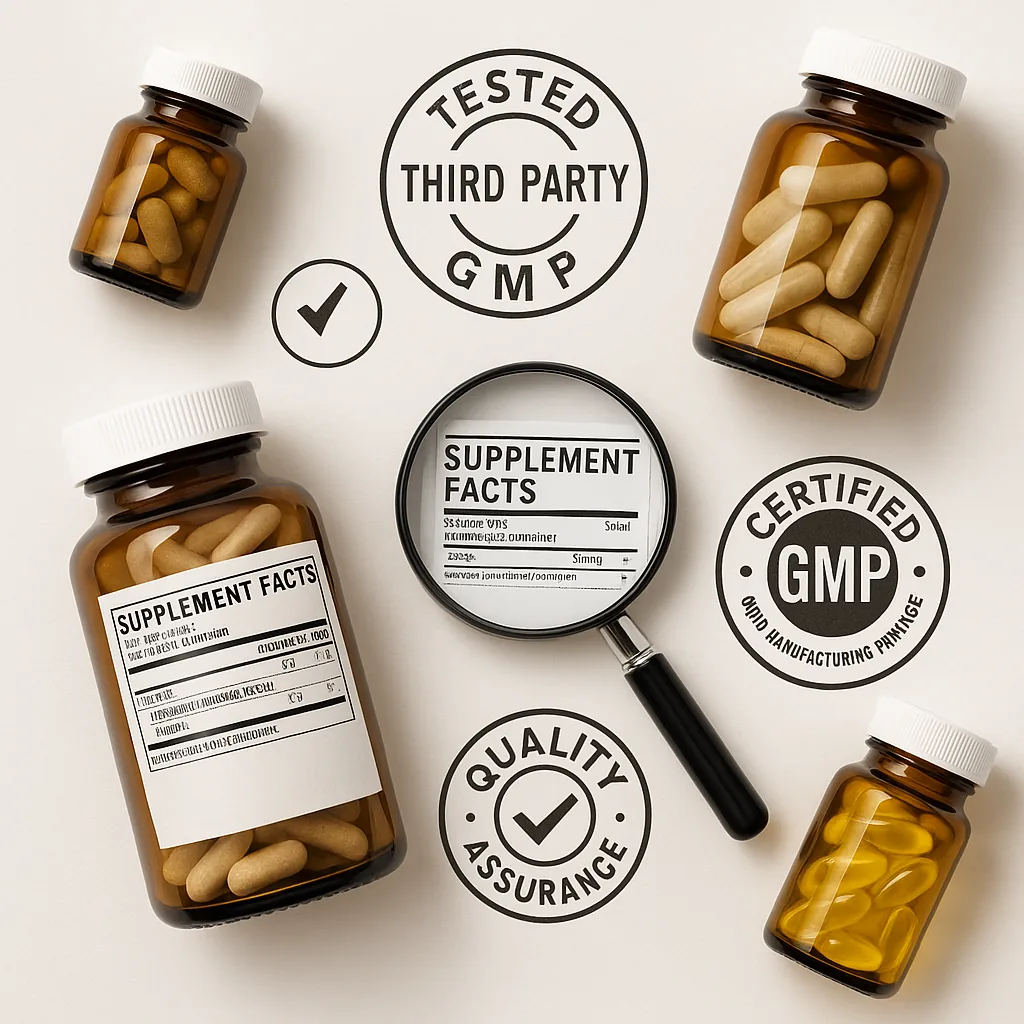
Quick Answer: Third-party testing (NSF, USP, Informed Sport, ConsumerLab) is the most reliable quality signal for supplements. These programs verify that products contain what’s on the label, at the stated amounts, free of contaminants and undisclosed ingredients. Without testing, supplement label claims are unverified.
The supplement industry operates largely on the honor system. Unlike pharmaceuticals, the FDA doesn’t require supplement manufacturers to prove safety, efficacy, or even that the product contains what’s on the label before going to market. The burden of proof shifts to the FDA to show something is harmful before removing it. The result: a market with products ranging from excellent to fraudulent, with consumers unable to easily distinguish between them.
This guide covers the verification systems that exist, how to read a supplement label intelligently, and the red flags that should give you pause.
The Regulatory Gap: Why Third-Party Testing Matters
FDA oversight of supplements: Under DSHEA (Dietary Supplement Health and Education Act, 1994), dietary supplements don’t require pre-market approval. Manufacturers must follow GMP (Good Manufacturing Practice) regulations and may not make disease claims, but the bar for pre-market evidence is far lower than pharmaceuticals.
What this means practically:
Products can be sold without clinical evidence of efficacy
Label accuracy isn’t verified before sale
Contamination with heavy metals, pesticides, or undisclosed drug compounds isn’t prevented
The actual ingredient amounts may differ from label claims
ConsumerLab testing results: ConsumerLab, an independent testing organization, regularly evaluates supplements and publishes findings. Their historical testing has found:
Products with 0% of the labeled ingredient
Products with 3x the labeled amount
Heavy metal contamination above safe limits
Undisclosed pharmaceutical drugs in some supplements (particularly “weight loss,” “testosterone,” and “sexual enhancement” products)
The FDA action: The FDA does monitor and issue recalls for adulterated or mislabeled products, but reactive enforcement can’t protect consumers before purchase.
Third-Party Verification Programs: The Gold Standard
NSF International
NSF Certified for Sport: The most rigorous testing program for athletes subject to anti-doping testing. Verifies:
Product contains what the label says
No banned substances (WADA/USADA prohibited list)
No undisclosed prescription drugs or designer steroids
GMP compliance
Used by professional athletes and recommended by major sports organizations. More stringent than NSF non-Sport certification.
NSF Contents Certified: Verifies product contents and manufacturing, but doesn’t test for all WADA-banned substances. More accessible for general supplement brands.
USP (United States Pharmacopeia)
One of the oldest and most respected standards organizations. USP Verified mark means:
Contains the listed ingredients at the stated potency
Does not contain harmful levels of contaminants
Will dissolve properly (critical for tablets — some dissolve poorly)
Manufactured using good manufacturing practices
USP is widely used by mass-market brands (Nature Made, Kirkland/Costco). It’s reliable for basic quality assurance.
Informed Sport / Informed Choice
Informed Sport: Testing for WADA-prohibited substances (for athletes)
Informed Choice: More general quality testing, less stringent than Informed Sport
Both programs test each batch, not just an initial qualification
ConsumerLab
ConsumerLab tests products independently (not a paid certification program) and publishes results. Subscription to their database provides ongoing information about tested brands. Useful for research but not a producer-facing certification.
Banned Substances Control Group (BSCG)
Focuses on pharmaceutical drug and sports doping agent contamination. Used by some sports supplement brands.
How to Read a Supplement Label
Supplement Facts panel: The structured section listing ingredients, amounts, and % daily values (where established).
Key things to check:
Serving size and servings per container: An impressive mg amount may be per 3 capsules; if you’re only taking 1, you’re getting 1/3 the dose
“Proprietary blend”: A single weight is listed for a mixture of ingredients without individual amounts. This is a red flag — you don’t know if you’re getting 1 mg or 1,000 mg of any ingredient. Reputable products typically disclose individual amounts
Other ingredients: Fillers, binders, artificial colors. Not always problematic but worth noting if you have sensitivities
“As ”: E.g., “Magnesium (as magnesium oxide, 250 mg)” — this tells you the form, which matters for bioavailability
Standardization: “Ashwagandha root extract standardized to 5% withanolides” means the extract is potency-standardized — more reliable than unstandardized powders
What’s not on the label that matters:
Whether a third-party has verified the label claims
Where the ingredients were sourced from
Whether it was tested for heavy metals, pesticides, or adulterants
Red Flags to Avoid
Proprietary Blends Hiding Dosages
If a label says “Proprietary Energy Blend 500 mg” and lists 8 ingredients, each could contribute anywhere from 1 mg to 495 mg. You have no idea if any ingredient is at a therapeutic dose. This practice obscures under-dosing.
Unrealistic Disease Claims
Supplements can support “structure/function” (e.g., “supports bone health”) but cannot claim to treat, cure, or prevent diseases. Products claiming to “cure cancer,” “treat diabetes,” or “eliminate depression” are making illegal claims and are typically backed by no evidence.
“Miracle” or “Breakthrough” Language
Legitimate supplement research rarely produces miracles. Hyperbolic marketing (“burns fat instantly,” “10x your testosterone overnight,” “ancient secret discovered”) is a reliable signal of marketing over substance.
No Company Address or Contact Information
Legitimate companies are transparent about who they are. Brands with no address, no contact information, and only a PO box or overseas contact are higher risk.
Specific High-Risk Categories
Weight loss supplements: High rate of undisclosed pharmaceutical stimulants and ephedra analogs
Sexual enhancement supplements: Frequently adulterated with sildenafil (Viagra) analogs
Bodybuilding supplements: History of undisclosed anabolic steroids and stimulants
“Natural testosterone boosters” with extreme claims: Often contain banned substances
Too Good to Be True Claims
If a supplement claims to do everything — burn fat, build muscle, increase testosterone, improve sleep, fight cancer, AND extend lifespan — at a trivial dose, be skeptical.
Certificate of Analysis (COA)
Reputable manufacturers will provide a Certificate of Analysis (COA) upon request or published on their website. A COA from an independent third-party lab (not self-certified) should show:
Tested ingredient amounts matching label
Microbiological testing (mold, yeast, bacteria)
Heavy metals (lead, arsenic, mercury, cadmium)
Pesticide residues (especially for botanical products)
Date of testing and batch number
Asking for a COA before purchasing is reasonable for expensive or regularly used supplements. Quality brands are proud to share them; evasion is a red flag.
NIH Office of Dietary Supplements: Evidence-based fact sheets on specific supplements
Labdoor: Independent quality testing with grades (free)
Examine.com: Evidence-based supplement information
Natural Medicines Database: Professional clinical resource on efficacy and safety
Key Takeaways
Supplements are not FDA-approved before sale — label accuracy is not guaranteed without third-party verification
NSF Certified for Sport is the most rigorous standard; USP Verified is reliable for basic quality; Informed Sport provides good contamination testing
Avoid proprietary blends that hide individual ingredient amounts
Weight loss, sexual enhancement, and extreme bodybuilding supplements have the highest rate of adulteration with undisclosed drugs
Request or look for COAs (Certificate of Analysis) from independent labs
Price doesn’t guarantee quality; a USP-verified store brand can be more reliably tested than an expensive premium product
For any supplement you take regularly, periodically check it against ConsumerLab or verify third-party certification
Frequently Asked Questions
Are expensive supplements better quality than cheap ones?
Not necessarily. Price doesn’t correlate reliably with quality. A high price can reflect genuine quality (better ingredients, rigorous testing) or simply marketing and packaging costs. A USP-verified Kirkland (Costco) vitamin may be more reliably tested than an expensive premium brand with no third-party verification.
Should I trust supplements from major retailers (Walmart, Target, Amazon)?
Major retailers carry both verified and unverified products. Amazon in particular has challenges with third-party sellers who may sell counterfeit or substandard products. Buying directly from manufacturer websites or verified retailers reduces this risk. Check for third-party certification regardless of where you buy.
What does “natural” mean on a supplement label?
Nothing specific — “natural” is not a legally defined term in the supplement industry. A product can legally use “natural” on its label and contain synthetic ingredients. Focus on third-party testing rather than natural/organic marketing language.
Is it safe to take supplements from overseas manufacturers?
More risk. US, EU, Canadian, and Australian manufacturers are subject to more stringent GMP enforcement. Supplements from countries with less regulatory oversight carry higher risk of inconsistent quality and contamination. Look for products manufactured in facilities with NSF-registered, USP-verified, or equivalent quality marks.
How often should supplement companies retest their products?
Reputable brands test each batch (or at minimum each production run) rather than just an initial qualification. Some third-party programs (Informed Sport) require batch-by-batch testing. Ask brands about their testing frequency if this matters for your use case.







Leave a Reply