
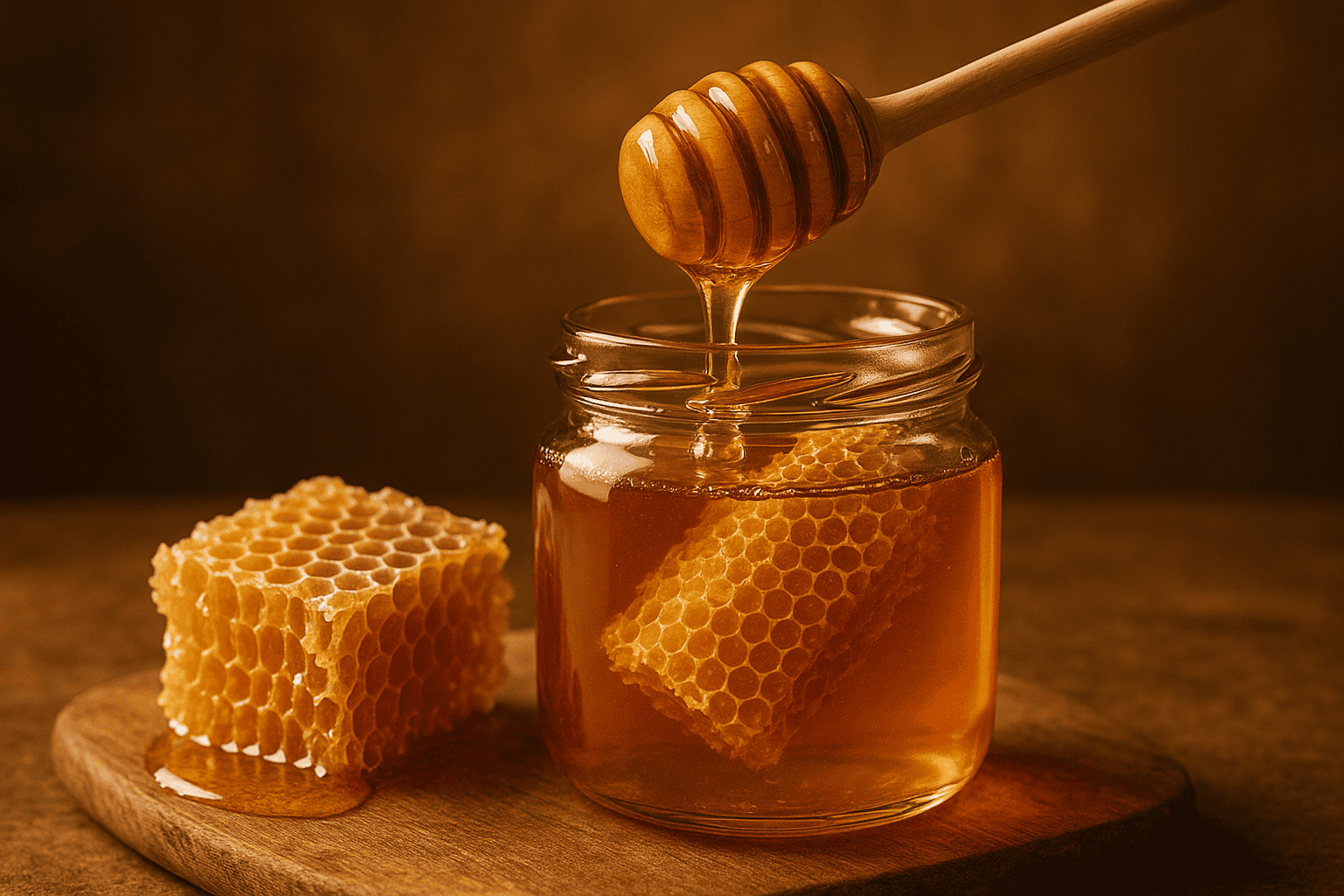
Quick Answer: Yes — honey is one of the best-evidenced natural cough remedies. A 2022 Cochrane Review found honey was superior to placebo and some over-the-counter cough medicines for reducing cough frequency and severity, especially in children. It should not be given to children under 12 months due to infant botulism risk.
Honey occupies a rare position in natural remedy research: it’s actually backed by a rigorous systematic review from the Cochrane Collaboration — the gold standard of evidence evaluation. While most “natural remedies” for cough struggle to find quality trial support, honey has accumulated enough evidence to be meaningfully compared to over-the-counter cough medications.
This guide covers what the evidence shows, who benefits, what types of honey matter, the important safety caveat for infants, and how honey compares to pharmaceutical cough suppressants.
The Cochrane Review: What It Actually Found
A 2022 Cochrane Review (Oduwole et al., updated from 2018) systematically analyzed randomized controlled trials comparing honey to placebo, no treatment, or active comparators (OTC cough medicines) for acute cough in children and adults.
Key findings:
- Compared to placebo: Honey improved cough frequency (low-certainty evidence) and cough severity, with most trials showing benefit
- Compared to diphenhydramine (Benadryl): Honey performed comparably or better
- Compared to dextromethorphan (DXM, common OTC cough suppressant): One study found no significant difference; another found honey superior for cough frequency
- Compared to no treatment: Three trials in 568 children found honey was associated with significantly better improvement in cough frequency, cough severity, and child/parent sleep quality over 2 nights
- Salbutamol (albuterol) comparison: One trial found honey performed similarly to salbutamol for upper respiratory infection-related cough
The review’s conclusion: “Honey probably relieves cough symptoms to a greater extent than no treatment, diphenhydramine, and placebo.” Evidence quality was rated as low-to-moderate, but consistently positive.
Why Honey Works: The Mechanisms
Several mechanisms have been proposed for honey’s antitussive (cough-suppressing) effects:
1. Demulcent effect: Honey’s thick, viscous consistency coats and soothes the pharyngeal mucosa (throat lining), reducing the sensory nerve stimulation that triggers cough reflex. This is likely the primary mechanism and explains why concentration matters.
2. Osmotic effect: Honey draws fluid to the throat mucosa, potentially providing a soothing, hydrating effect.
3. Antimicrobial properties: Honey has well-documented antimicrobial activity (hydrogen peroxide, low pH, methylglyoxal in Manuka, defensin-1 bee protein). While the relevance to cough specifically is unclear, reducing bacterial load in upper respiratory mucosa could theoretically benefit.
4. Antioxidant and anti-inflammatory properties: Honey contains flavonoids and phenolic compounds that reduce inflammation. Upper respiratory infection-associated inflammation can trigger cough; reducing it may provide indirect benefit.
5. Serotonin pathway modulation: Some research suggests honey may modulate serotonin in ways that affect cough reflex — this is theoretical and not well-established.
What Type of Honey Is Best?
Most studies used standard pasteurized honey from grocery stores. Several specific honeys have been studied or proposed:
Buckwheat honey: Multiple studies used buckwheat honey (dark, strong-flavored). The 2007 Penn State study by Paul et al. specifically used buckwheat honey and found it superior to DXM for nighttime cough in children.
Manuka honey (from New Zealand): Contains uniquely high levels of methylglyoxal (MGO), giving it superior antimicrobial activity. May be particularly useful for bacterial contribution to cough. More expensive; whether its superior antimicrobial properties translate to better cough relief vs. standard honey is not established.
Raw honey vs. pasteurized: Pasteurized honey is standard in most studies. Raw honey contains pollen, enzymes, and potentially beneficial bacteria — but also higher risk of contamination. For children (other than infants), raw honey from reputable sources is considered safe. For practical efficacy, standard grocery store honey is sufficient and well-studied.
Dosing and Timing
Standard protocol from trials:
- Adults and children over 12 months: ½ to 2 teaspoons (2.5-10 ml) of honey
- Timing: Before bedtime (most studies focused on nighttime cough relief)
- Can be given straight or diluted in warm water or herbal tea
- May be repeated during the day for persistent cough
Dose-response: Some evidence suggests darker, more concentrated honeys may be more effective. Standard honey at a teaspoon is the practical starting point.
The Infant Safety Warning
Honey must not be given to children under 12 months of age.
This is not a theoretical concern — it is a well-documented medical risk. Clostridium botulinum spores are present in some honey samples; adult intestinal flora prevents spore germination, but infant gut flora is not yet developed to prevent it. Ingestion of C. botulinum spores can cause infant botulism — a potentially fatal disease causing flaccid paralysis, poor feeding, weak cry, and respiratory failure.
Even small amounts of honey (in pacifiers, on nipples, in baby food) can cause infant botulism. The 12-month rule is absolute.
Honey vs. Over-the-Counter Cough Medicines: How Does It Compare?
This comparison is clinically important because honey performs better than expected:
Dextromethorphan (DXM — Robitussin, NyQuil): Has a complex evidence history. Works through NMDA receptor modulation and opioid receptor activity. Multiple studies show DXM not significantly better than placebo for children’s cough, which led the FDA and AAP to recommend against OTC cough medicines in children under 4 (and with caution in those under 12). Honey performs comparably or better than DXM in most head-to-head trials.
Diphenhydramine (Benadryl): Causes significant drowsiness; often used off-label for cough. Honey performs comparably in trials.
Codeine and hydrocodone (prescription): For adults with severe cough, these remain more effective than honey, but carry addiction risk and are inappropriate for children.
Honey’s practical advantage: It’s safe, inexpensive, widely available, and shown to actually work — unlike many OTC cough medicines in pediatric populations.
When Honey Is Not the Right Tool
- Persistent cough (>3 weeks): May indicate asthma, GERD, sinusitis, or other conditions requiring diagnosis
- Productive cough with significant infection: Bacterial pneumonia or bronchitis may require antibiotics; honey is adjunctive at best
- Diabetics: Honey raises blood glucose; portion-sized amounts (1-2 teaspoons) are modest but should be factored in
- Cough with fever, shortness of breath, or blood: Medical evaluation required
Key Takeaways
- Honey has the strongest natural evidence base of any cough remedy — supported by a 2022 Cochrane Review
- 1-2 teaspoons before bed reduces cough frequency and severity and improves sleep in both children and parents
- Works primarily through demulcent (coating/soothing) and possibly antimicrobial and anti-inflammatory mechanisms
- Buckwheat honey has the best specific trial data; any dark, thick honey is reasonable
- Never give honey to children under 12 months — infant botulism risk is real and potentially fatal
- Performs comparably or better than most OTC cough medicines in pediatric head-to-head studies
- Not a substitute for medical evaluation in persistent, severe, or concerning cough presentations
Frequently Asked Questions
Can honey cure a cough?
“Cure” is too strong — honey relieves and suppresses cough symptoms but doesn’t treat the underlying respiratory infection. Most upper respiratory infections resolve on their own in 7-10 days; honey helps make those days more comfortable and sleep more possible.
How does honey compare to prescription cough suppressants?
For upper respiratory infection-related cough in children, honey performs comparably to or better than many OTC medicines and has fewer side effects. Prescription codeine is more potent for severe cough in adults but has significant risks. Honey is not appropriate for severe, medically significant cough requiring pharmaceutical treatment.
Can adults with diabetes use honey for coughs?
Yes, in the small amounts used for cough relief (1-2 teaspoons = 5-10g carbohydrate), the glucose impact is modest. Diabetics should factor this into their daily carbohydrate tracking and monitor blood sugar if using multiple times daily.
Does hot honey water work the same as straight honey?
Warm honey water (honey dissolved in warm — not boiling — water) is used in many studies and appears effective. Avoid boiling water as it may degrade heat-sensitive compounds. Adding lemon provides some additional soothing benefit. The demulcent (coating) mechanism works best with straight honey; diluted honey may be slightly less effective for throat coating but more palatable.
What about elderberry plus honey for cough?
A reasonable combination — elderberry has evidence for shortening the duration of upper respiratory infections, while honey directly suppresses cough symptoms. Best Elderberry and Immune Support Supplements in 2026 covers elderberry’s clinical evidence in depth. The combination addresses different aspects of the illness.
Sources
- Effectiveness of honey for symptomatic relief in upper respiratory tract infections: a systematic review and meta-analysis. [PMID 32817011]
- Effectiveness of honey for symptomatic relief in upper respiratory tract infections: a systematic review and meta-analysis. [PMID 32817011]
- 10.1001/archpedi.161.12.1140″>https://doi.org/10.1001/archpedi.161.12.1140
- 10.1089/acm.2009.0331″>https://doi.org/10.1089/acm.2009.0311
- Stacking Guide 2026: What Combines Well, What Conflicts, and Timing Best Longevity Supplements in 2026 GlyNAC (Glycine + NAC): The Glutathione-Boosting Longevity Stack Best Anti-Inflammato [PMID 32817011]
[PMID 32817011]
[PMID 32817011]



Leave a Reply