DHEA Supplements in 2026: Adrenal Support, Aging, and Safety Review
Quick Answer: DHEA is a hormone produced by the adrenal glands that naturally declines with age — levels at 70 can be 80% lower than at 25. Supplementing with 25–50 mg/day is used by some adults for energy, libido, and hormonal support, but evidence is mixed and it requires medical oversight due to real risks including hormone-sensitive cancers, acne, hair loss, and drug interactions.
Dehydroepiandrosterone (DHEA) holds the title of the most abundant circulating steroid hormone in humans — yet most people have never heard of it. By your 70s, you’ll produce roughly 20% of what you did at your peak in your mid-20s. This age-related decline has fueled decades of interest in DHEA supplementation as an anti-aging intervention.
But the enthusiasm is warranted only with careful nuance. DHEA is a pro-hormone — the body converts it into sex hormones like estrogen and testosterone. That versatility makes it powerful and potentially risky without appropriate monitoring.
What Is DHEA and What Does It Do?
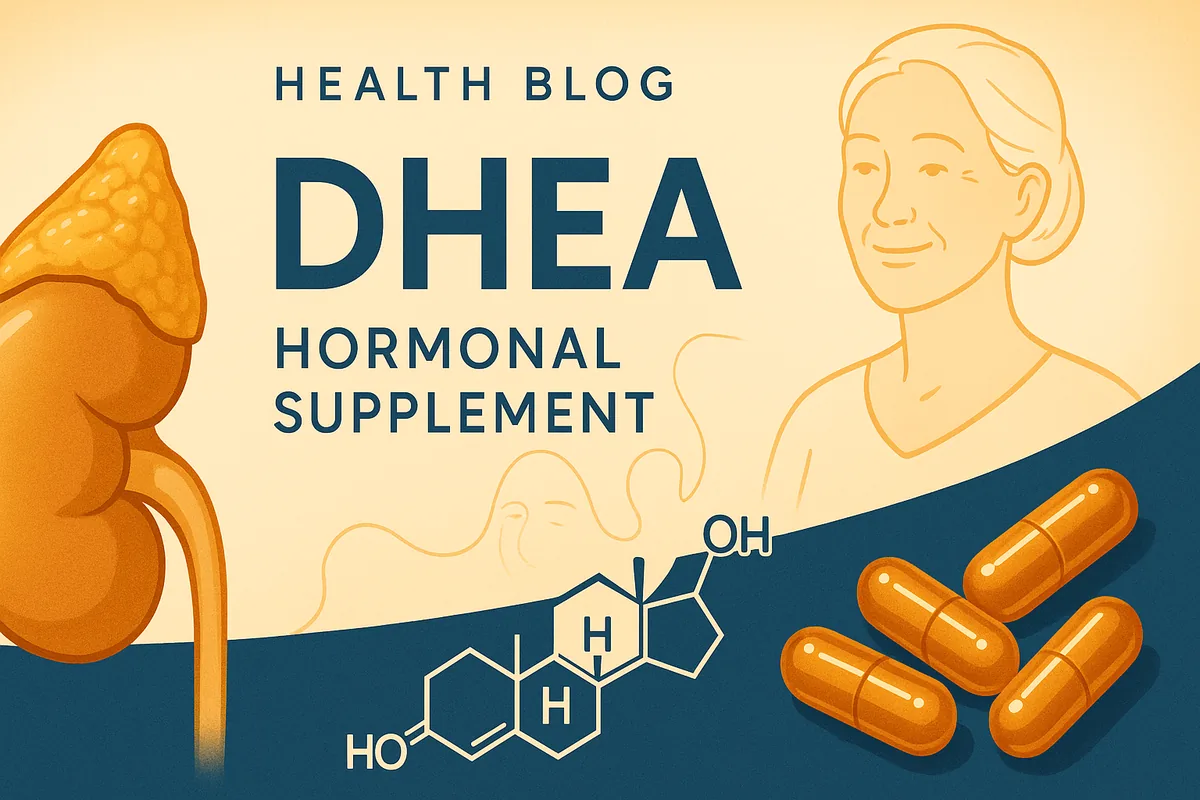
DHEA and its sulfate form (DHEA-S) are synthesized from cholesterol, primarily in the adrenal cortex. DHEA acts as a precursor for the production of:
Androgens (testosterone, androstenedione)
Estrogens (estradiol, estrone)
Beyond its role as a pro-hormone, DHEA appears to have direct effects as a neurosteroid — influencing the brain via GABA-A and NMDA receptor modulation, potentially affecting mood, memory, and stress resilience.
DHEA peaks in early adulthood (typically ages 25–30) and declines by roughly 2–3% per year. By age 70, most people have 10–20% of their peak levels.
Why DHEA Levels Decline: Adrenocortical Aging
The adrenal glands undergo a process called adrenopause (or adrenopause) — a gradual reduction in the zona reticularis cells responsible for DHEA synthesis. This is distinct from menopause or andropause, though all three overlap in midlife.
Low DHEA-S has been epidemiologically associated with:
Increased cardiovascular disease risk
Higher all-cause mortality in some cohorts
Lower bone density
Worse mood and cognition
Reduced lean muscle mass
However, correlation ≠ causation. Low DHEA-S may simply be a marker of poor overall health rather than a direct driver of aging.
What DHEA Supplementation Claims to Do
1. Energy and Fatigue
Some clinical trials — particularly in adrenal insufficiency patients — show significant improvements in energy and wellbeing with DHEA replacement. A 2000 RCT in JAMA (Arlt et al.) found marked improvements in fatigue and wellbeing in women with adrenal insufficiency taking 50 mg/day.
In otherwise healthy adults, the evidence for energy improvement is much weaker. Placebo-controlled trials often show modest or non-significant effects.
2. Libido and Sexual Function
DHEA has some of the strongest evidence here, particularly for women. Several trials show that DHEA supplementation (25–50 mg/day orally, or as intravaginal DHEA) improves sexual desire, arousal, and response in peri- and postmenopausal women.
The FDA-approved vaginal DHEA product (Intrarosa, prasterone) is specifically indicated for dyspareunia (painful intercourse) in postmenopausal women. This is one of the clearest clinical use cases for DHEA.
3. Bone Density
Results are mixed. Some trials in older women show modest improvements in bone mineral density, particularly at the femoral neck. The effect appears to be mediated through DHEA’s conversion to estrogen and direct androgen effects on bone.
A 2011 Cochrane review found marginal evidence for bone benefits in women with adrenal insufficiency but insufficient evidence in otherwise healthy populations.
4. Mood and Cognitive Function
As a neurosteroid, DHEA has theoretical advantages for mood and cognition. Some small RCTs have found improvements in depression scores with DHEA supplementation in middle-aged adults. A double-blind crossover trial in Biological Psychiatry (2005, Schmidt et al.) found DHEA improved depression scores significantly versus placebo.
Cognitive benefits are less well-established. DHEA-S is positively correlated with memory performance in epidemiological studies, but intervention studies have not consistently shown cognitive improvements.
5. Immune Function
DHEA has immunomodulatory properties. It appears to shift the immune response from Th2 (inflammation-promoting) to Th1. Animal studies are compelling, but human clinical evidence for immune enhancement in healthy adults is limited.
6. Body Composition
Some trials show modest reductions in abdominal fat and improvements in insulin sensitivity with DHEA, particularly in older men. A 2004 NEJM study (Villareal & Holloszy) found that 100 mg/day DHEA for 6 months reduced abdominal fat significantly in men and women aged 65–78.
However, 100 mg is a higher-than-typical dose, and those results haven’t been consistently replicated at 25–50 mg.
Who Is DHEA Supplementation Most Appropriate For?
Primary Use Cases
Adrenal insufficiency: DHEA is commonly prescribed as part of hormone replacement in confirmed primary or secondary adrenal insufficiency. This is the strongest evidence base.
Postmenopausal women with low libido or vaginal atrophy: Both oral and vaginal DHEA have demonstrated efficacy. Vaginal formulations provide local effect with minimal systemic absorption.
Adults with confirmed low DHEA-S (blood test): If testing confirms DHEA-S below the normal range for your age, supplementation with physician guidance is reasonable.
Less Compelling Use Cases
General “anti-aging” in adults with normal DHEA-S: The evidence for benefit in people with normal levels is weak. “Correcting” a level that isn’t low may carry risk without meaningful benefit.
Athletic performance: Despite being a DHEA (which is a banned substance under WADA and prohibited by most major athletic organizations), the performance benefit in trained athletes is modest and doesn’t justify the regulatory and health risk.
Dosing: What the Research Uses
Most clinical trials use 25–50 mg/day for general supplementation. Higher doses (50–100 mg) are occasionally used in specific therapeutic contexts but carry greater risk of androgenic side effects.
DHEA is best taken in the morning to mimic natural diurnal secretion patterns. Taking it at night may disrupt cortisol rhythms.
Blood monitoring: Ideally, test DHEA-S levels before starting and 6–8 weeks after. Many functional medicine physicians also check testosterone, estradiol, and SHBG.
Safety Concerns and Side Effects
This is where DHEA requires serious consideration.
Androgenic Side Effects
Because DHEA converts to testosterone, common androgenic side effects at higher doses include:
Acne (especially in women)
Oily skin
Facial hair in women (hirsutism)
Scalp hair thinning (androgenic alopecia)
Voice deepening in women (rare)
These are more common at doses above 25 mg in women.
Estrogenic Side Effects
In women, DHEA also converts to estrogen. Theoretically and potentially in practice, this could:
Stimulate estrogen-sensitive tissues
Potentially increase risk in women with hormone-receptor-positive breast cancer
Hormone-Sensitive Cancer Risk
This is the most serious concern. DHEA should not be taken by anyone with a history of or elevated risk for hormone-sensitive cancers (breast, ovarian, endometrial, prostate) without explicit medical supervision. The theoretical mechanism and some case reports suggest risk.
Cardiovascular Effects
DHEA can raise HDL in some studies and has neutral or mild effects on lipids. However, androgenic effects at higher doses can lower HDL and raise LDL in some individuals.
Manic Episodes and Insomnia
Rare but documented: some individuals experience increased anxiety, irritability, or sleep disruption — particularly those with mood disorders. DHEA’s neurosteroid activity on GABA-A receptors may be pro-excitatory at higher doses.
Drug Interactions
DHEA can interact with:
Insulin and diabetes medications (may affect glucose metabolism)
Aromatase inhibitors (may counteract their intended effect)
Anticoagulants (theoretical interaction)
Antidepressants (neurosteroid activity overlap)
7-Keto DHEA: A Different Animal
7-Keto DHEA is a metabolite of DHEA that does not convert to sex hormones. This makes it potentially useful for metabolic benefits (thermogenesis, body composition) without the androgenic/estrogenic concerns.
Studies on 7-Keto DHEA show some modest benefit for weight management and thyroid activity, particularly in combination with exercise. However, research is limited and largely industry-funded.
If the goal is avoiding hormonal effects, 7-Keto DHEA is worth exploring — though it is less studied than regular DHEA.
DHEA Is a Controlled or Prescription Substance in Many Countries
In the US, DHEA is classified as a dietary supplement and sold OTC. However, in many other countries, it is prescription-only. This regulatory distinction matters because it affects purity testing and labeling standards. Always buy from brands that provide third-party testing (USP, NSF, or independent COA available).
Key Takeaways
DHEA is a pro-hormone that declines sharply with age — levels at 70 can be 80% lower than peak
Best evidence supports use in adrenal insufficiency and for libido/vaginal dryness in postmenopausal women
Standard supplemental dose is 25–50 mg/day, taken in the morning
Side effects include acne, hair changes, and hormonal imbalances — more pronounced at higher doses
Not appropriate for those with hormone-sensitive cancer history without medical supervision
Test first: Check DHEA-S and sex hormone levels before and during supplementation
7-Keto DHEA is a non-hormonal alternative for metabolic support without sex hormone conversion
DHEA is banned by WADA and most athletic organizations
Frequently Asked Questions
What are DHEA supplements used for?
DHEA supplements are primarily used for low libido, fatigue, and hormonal support in aging adults, and as replacement therapy in people with adrenal insufficiency. Evidence is strongest for sexual function in postmenopausal women and women with adrenal insufficiency.
Is DHEA safe to take every day?
At 25–50 mg/day with medical monitoring, DHEA appears relatively safe for most adults. However, it should not be taken without first testing DHEA-S levels, and it is not appropriate for those with hormone-sensitive cancer history.
Should I get a blood test before taking DHEA?
Yes — strongly recommended. DHEA-S can be measured with a standard blood panel. Knowing your baseline prevents unnecessary supplementation and enables you to monitor effects.
Does DHEA raise testosterone levels?
In some individuals, yes — DHEA can convert to testosterone through the adrenal and gonadal pathways. The degree varies by individual, sex, and dose. This effect is more pronounced in women than men.
Can men take DHEA supplements?
Men can take DHEA, but evidence for benefit in healthy older men with normal levels is weaker than for women. Men with confirmed low DHEA-S may benefit from 25–50 mg/day with monitoring.
What’s the difference between DHEA and 7-Keto DHEA?
Regular DHEA converts to sex hormones (testosterone and estrogen). 7-Keto DHEA does not, making it a safer option for those seeking metabolic benefits without hormonal effects, though it has less overall research behind it.