


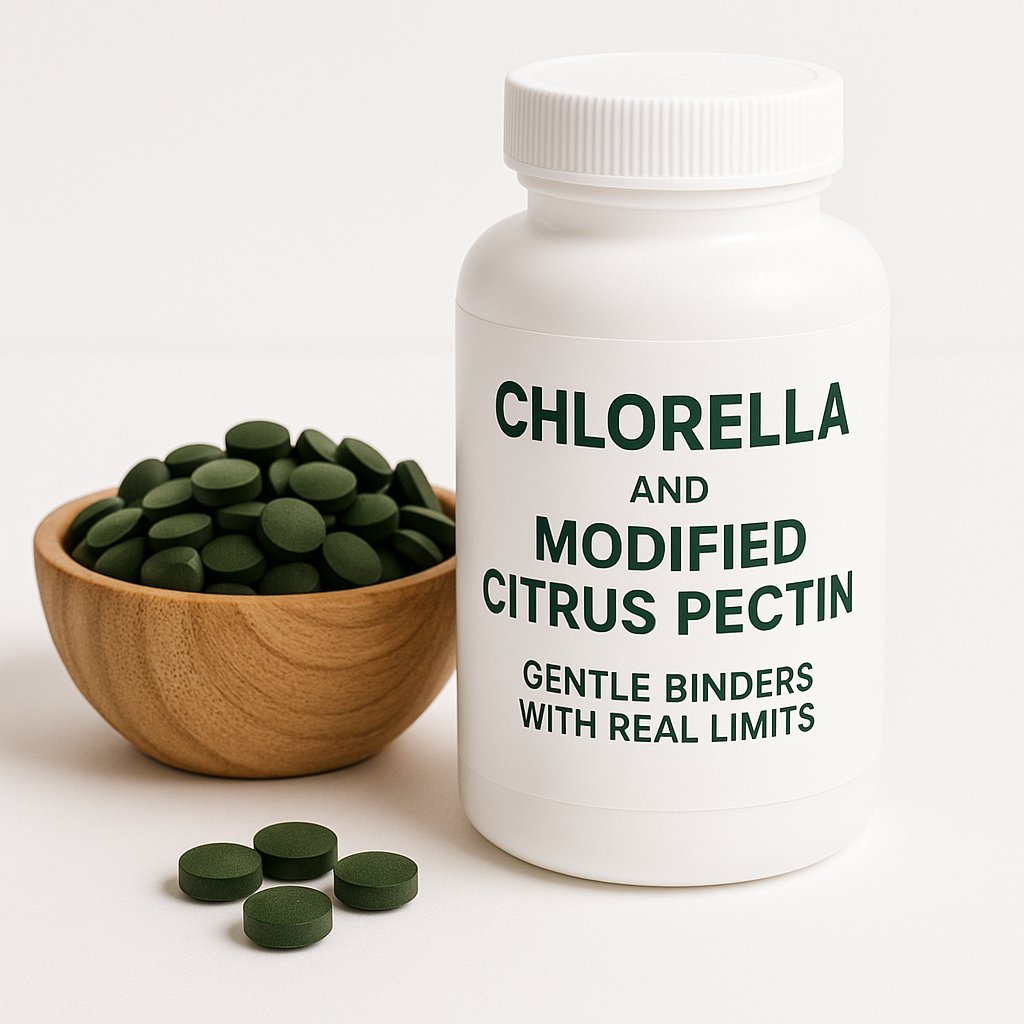
If activated charcoal and bentonite clay are the heavy artillery of binder supplements, chlorella and modified citrus pectin (MCP) are marketed as the gentler alternatives—substances that supposedly bind toxins and heavy metals without the aggressive nutrient depletion of stronger binders. There’s some truth to this framing, but also significant overpromise.
Quick Answer
Chlorella and modified citrus pectin are generally gentler than stronger binders, and both have early evidence for heavy-metal support, but the human data are still limited and not strong enough to justify broad detox promises. They may fit as adjuncts in low-risk situations, not as replacements for medical treatment.
Key Takeaways
- Chlorella offers real nutritional value and may provide modest metal-binding support.
- Modified citrus pectin has intriguing small studies, but large high-quality trials are still lacking.
- “Gentle” does not mean universally effective, and it does not replace clinical chelation when needed.
- Product quality and contaminant testing still matter, even for algae-derived products.
- For full binder context, review the parent binder guide plus bentonite vs zeolite and the binder timing guide.
Chlorella
What It Is
Chlorella is a single-celled green freshwater alga, sold as tablets, powder, or capsules. It’s genuinely nutritious—rich in protein (50–60% by weight), chlorophyll, B vitamins (including B12 analogs relevant for vegans), iron, and omega-3 fatty acids. It has legitimate value as a whole-food supplement independent of any detox claims.
The Heavy Metal Binding Claims
Chlorella’s cell wall contains substances that can bind metal ions. This is well-established in environmental science—chlorella and other microalgae are studied as biosorbents for water treatment (removing cadmium, lead, copper from contaminated water). The question is whether eating chlorella translates to meaningful metal binding in your gut or body.
Animal evidence:
- Huang et al. (2009) found chlorella increased urinary cadmium excretion in rats fed cadmium, possibly by upregulating metallothionein-like metal-binding proteins. This is an interesting mechanism—not direct gut binding, but influencing the body’s own metal-handling proteins.
- Multiple rat studies show reduced tissue accumulation of cadmium and lead with chlorella supplementation.
Human evidence:
- Merino et al. (2019, PMC6523211) studied chlorella plus fucus algae extract in dental implant patients with amalgam fillings. After 90 days of supplementation, mercury and tin levels in hair decreased. However, this was a small study, combined chlorella with another algae, and used hair mineral analysis (which has its own reliability questions).
- A small Japanese study (Uchikawa et al., 2010) found chlorella reduced dioxin levels in breast milk. Interesting but very preliminary.
The honest assessment: Chlorella likely has some metal-binding capacity, both directly in the gut and potentially through upregulating endogenous detox mechanisms. But “likely has some capacity” is very different from “effectively chelates heavy metals from your body.” The human evidence is small, preliminary, and not from randomized controlled trials.
What Chlorella Is Good For (With Better Evidence)
- Nutritional supplementation: Genuine whole-food nutrition source
- Cholesterol: Some evidence for modest LDL reduction (Ryu et al., 2014)
- Blood pressure: Small studies show modest improvement (Merchant et al., 2002)
- Immune function: Some evidence for enhanced NK cell activity (Kwak et al., 2012)
- Antioxidant status: Increases antioxidant enzyme activity in some studies
Risks
- Contamination: Like any algae product, chlorella can accumulate the very heavy metals it’s supposed to remove if grown in contaminated water. Source and third-party testing matter.
- GI side effects: Nausea, diarrhea, gas—especially when starting
- Iodine content: Can be significant; relevant for thyroid conditions
- B12 caveat: Contains B12 analogs that may not be bioactive; vegans shouldn’t rely solely on chlorella for B12
Modified Citrus Pectin (MCP)
What It Is
Regular citrus pectin is a large polysaccharide molecule found in citrus peels—the same pectin used to thicken jams. Modified citrus pectin has been processed (pH-adjusted and enzymatically treated) to create smaller, lower-molecular-weight fragments that can potentially be absorbed through the gut lining and bind metals in the bloodstream—a claim that distinguishes it from gut-only binders.
The Evidence
MCP has a small but interesting evidence base, largely driven by one research group (Dr. Isaac Eliaz and colleagues, who have commercial ties to the PectaSol brand):
Heavy metal studies:
- Eliaz et al. (2006, Phytotherapy Research): 15 g/day MCP for 5 days then 20 g/day for 1 day in healthy volunteers. Urinary excretion of arsenic increased 130%, mercury 150%, cadmium 230%, and lead 560% compared to baseline. Small study, no control group.
- Eliaz et al. (2008): Five case studies showing 74% average reduction in toxic heavy metals with MCP alone or with alginates. No adverse effects reported.
- Zhao et al. (2008): Pilot study in children hospitalized with toxic lead levels. MCP supplementation dramatically reduced blood lead levels. No control group, very small sample.
Other potential benefits:
- Galectin-3 inhibition: MCP binds galectin-3, a protein implicated in fibrosis and cancer progression. This is an active area of research separate from detox claims.
- Prostate cancer: Some preliminary evidence for slowing PSA doubling time (Guess et al., 2003).
Honest Limitations
- Small studies, mostly from one group with commercial interests
- No large randomized controlled trials for heavy metal chelation
- Increased urinary excretion ≠ proven benefit. Mobilizing metals and excreting them sounds good, but without controlled studies, we can’t confirm net benefit vs. just redistributing metals.
- Cost: MCP is significantly more expensive than other binders
- The “gentle binder” framing may lead people to use it instead of medical chelation when that’s what’s actually needed
Dosing
- Typical supplement doses: 5–15 g/day (powder) or 800 mg capsules 3x/day
- Study doses: 15–20 g/day (much higher than most supplements provide)
- The effective doses in studies are often higher than what’s in commercial capsules
Risks
- Generally well-tolerated in studies
- GI symptoms (bloating, loose stools) at higher doses
- Could theoretically bind essential minerals, though this hasn’t been documented as a significant problem in existing studies
- Drug interactions less studied than charcoal but theoretically possible
Chlorella vs. MCP: Different Tools
| Factor | Chlorella | Modified Citrus Pectin | |—|—|—| | Primary mechanism | Gut binding + possible metallothionein induction | Gut binding + possible systemic galectin-3 binding | | Nutritional value | High (protein, vitamins, minerals) | Low (it’s processed pectin) | | Human evidence | Very small studies | Small studies, mostly one research group | | Cost | Moderate ($15–30/month) | High ($40–80/month at study doses) | | Side effect profile | GI upset, contamination risk | Generally mild GI | | Additional benefits | Cholesterol, immune, nutrition | Galectin-3, potential anti-fibrotic |
Who Might Consider These
- People looking for a milder binder than charcoal or clay
- Those with confirmed low-level metal exposure wanting adjunctive support (not a replacement for medical treatment)
- People who want nutritional benefits alongside potential binding (chlorella)
- Those interested in galectin-3 modulation (MCP—separate from detox claims)
Who Should Look Elsewhere
- Anyone with acute or high-level heavy metal poisoning (needs medical chelation: DMSA, EDTA, etc.)
- People expecting dramatic detox results from gentle binders
- Anyone unwilling to accept that the evidence is preliminary
The Bottom Line
Chlorella is a genuinely nutritious supplement that may have modest metal-binding properties. Modified citrus pectin has intriguing small-study evidence but needs larger trials to confirm benefits. Both are gentler than charcoal or clay, but “gentle” also means “less potent.” Neither replaces medical treatment for confirmed toxicity, and both need more rigorous research before their detox claims can be considered established.
This article is for informational purposes only and does not constitute medical advice.
FAQ
Is chlorella a true heavy-metal chelator?
Not in the same way prescription chelators are. Chlorella may help with binding support, but evidence is still preliminary and effects are usually modest.
Does modified citrus pectin work systemically or only in the gut?
It is marketed for both gut and systemic effects, and some small studies suggest increased urinary excretion of metals, but robust confirmation is still limited.
Which is better for daily use: chlorella or MCP?
It depends on goals. Chlorella is often chosen for nutrition plus mild binding support; MCP is chosen for targeted protocols despite higher cost.
Can I use these instead of medical treatment for high heavy-metal levels?
No. Confirmed or high-level toxicity requires clinician-directed treatment and monitoring.
Do I need to separate chlorella or MCP from medications?
Yes. They are generally gentler than charcoal, but spacing from medications is still prudent to lower interaction risk.
References
- Huang Z, et al. Effect of Chlorella vulgaris intake on cadmium detoxification in rats. Environmental Toxicology and Pharmacology. 2009;28(1):135-140.
- Merino JJ, et al. Long-term algae extract supplementation modulates SOD-1 activity and decreases heavy metals. Antioxidants. 2019;8(5):138.
- Eliaz I, et al. The effect of modified citrus pectin on urinary excretion of toxic elements. Phytotherapy Research. 2006;20(10):859-864.
- Eliaz I, et al. Integrative medicine and the role of MCP/alginates in heavy metal chelation—five case reports. Forschende Komplementärmedizin. 2007;14(6):358-364.
- Zhao ZY, et al. The role of MCP as an effective chelator of lead in children. Alternative Therapies. 2008;14(4):34-38.
- Ryu NH, et al. Impact of daily Chlorella consumption on serum lipid and carotenoid profiles. Nutrition Journal. 2014;13:57.
- Kwak JH, et al. Beneficial immunostimulatory effect of short-term Chlorella supplementation. Nutrition Journal. 2012;11:53.
Related Articles
Sources
- Merchant RE, Andre CA. A review of recent clinical trials of the nutritional supplement Chlorella pyrenoidosa in the treatment of fibromyalgia, hypertension, and ulcerative colitis. Altern Ther Health Med. 2001;7(3):79-91.
- Eliaz I, Weil E, Wilk B. Integrative medicine and the role of modified citrus pectin/alginates in heavy metal chelation and detoxification. Forsch Komplementmed. 2007;14(6):358-364.
- Sears ME, Kerr KJ, Bray RI. Arsenic, cadmium, lead, and mercury in sweat: a systematic review. J Environ Public Health. 2012;2012:184745.
- Uchikawa T, Kumamoto Y, Maruyama I, et al. The enhanced elimination of tissue methylmercury in Parachlorella beijerinckii-fed mice. J Toxicol Sci. 2011;36(1):121-126.
- Zhao Y, Bi J, Yi J, et al. Pectin and modified pectin as promising candidates for heavy-metal detoxification: a review. Trends Food Sci Technol. 2020;99:83-94.
- Silbergeld EK, Patrick TE. Environmental exposures, toxicologic mechanisms, and adverse pregnancy outcomes. Am J Obstet Gynecol. 2005;192(5 Suppl):S11-S21.
- Sears ME, Kerr KJ, Bray RI. Arsenic, cadmium, lead, and mercury in sweat: a systematic review. J Environ Public Health. 2012;2012:184745.
- Zota AR, Shamasunder B. The environmental injustice of beauty: framing chemical exposures from beauty products as a health disparities concern. Am J Obstet Gynecol. 2017;217(4):418.e1-418.e6.
- Merchant RE, Andre CA. A review of recent clinical trials of the nutritional supplement Chlorella pyrenoidosa in the treatment of fibromyalgia, hypertension, and ulcerative colitis. Altern Ther Health Med. 2001;7(3):79-91.
- Panahi Y, Darvishi B, Jowzi N, Beiraghdar F, Sahebkar A. Chlorella vulgaris: a multifunctional dietary supplement with diverse medicinal properties. Curr Pharm Des. 2016;22(2):164-173.


Leave a Reply