

Hyaluronic Acid in Skincare: Layering & Climate Tips
Quick Answer: Hyaluronic acid (HA) is a humectant that draws water to skin. Apply it to damp skin and seal it with a moisturizer – in dry climates, HA without an occlusive layer can actually dehydrate skin by pulling moisture from deeper layers. Multi-weight HA formulas hydrate at multiple depths.
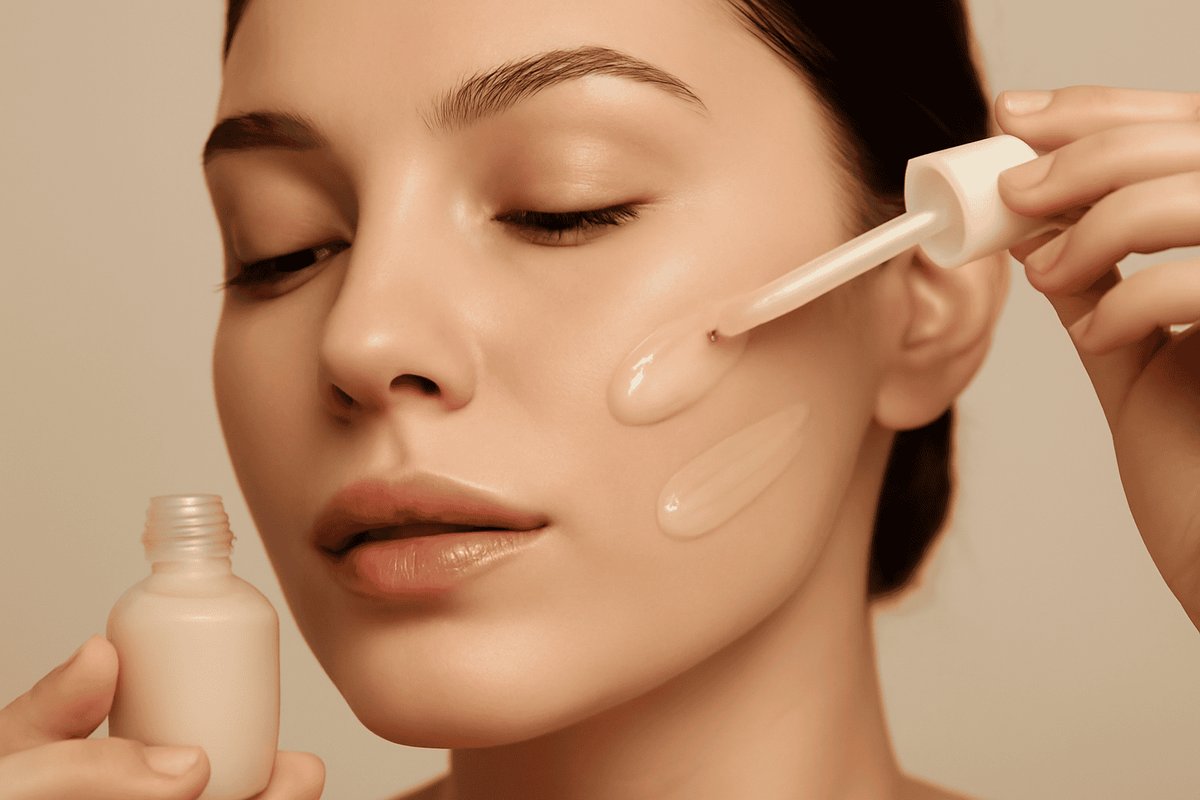
Hyaluronic acid (HA) is simultaneously one of the most beloved and most misunderstood skincare ingredients. It’s naturally present in the skin, joints, and connective tissue, holding up to 1,000 times its weight in water. In skincare, it’s marketed as a universal hydration hero — but without understanding molecular weight, application technique, and climate context, you may be unknowingly making your skin drier rather than more hydrated.
What Is Hyaluronic Acid?
Hyaluronic acid is a glycosaminoglycan — a long-chain polysaccharide found throughout the body. In skin, it’s concentrated in the dermis and the extracellular matrix, where it helps maintain structure, elasticity, and hydration by attracting and binding water molecules. Natural HA in the dermis degrades with age (accelerated by UV exposure), contributing to the volume loss and dullness associated with aging.
Topical HA doesn’t replace what’s lost in the dermis (the molecule is too large to penetrate that deeply in most standard forms). What topical HA does is function as a humectant — attracting moisture to the skin surface and upper layers, temporarily plumping and smoothing texture, and supporting the skin barrier’s moisture-retention function.
Molecular Weight: The Most Important Variable Nobody Talks About

Not all hyaluronic acid in skincare is the same. Molecular weight — measured in Daltons (Da) — determines how deep the HA penetrates and how it functions.
High Molecular Weight HA (>1,000 kDa)
Remains on the skin surface. Creates a film that physically traps moisture. Provides immediate visible plumping and smoothing. This is what most people “feel” when they describe HA as hydrating — it’s surface-level hydration. This form also has good anti-inflammatory properties and is less likely to cause irritation.
Medium Molecular Weight HA (100–1,000 kDa)
Penetrates slightly into the upper epidermis. Provides both surface and shallow-layer hydration. Less commonly used in isolation.
Low Molecular Weight HA (<100 kDa)
Penetrates more deeply into the epidermis. Some research suggests it can cause mild pro-inflammatory reactions in certain concentrations, but at cosmetic doses it contributes to deeper, longer-lasting hydration. Studies show it improves skin elasticity more meaningfully than high-MW HA alone.
Sodium Hyaluronate
The sodium salt of HA, smaller molecular weight that allows slightly better penetration than standard high-MW HA. This is the most common form in cosmetics and is often more stable in formulations.
Hydrolyzed HA
HA cleaved into smaller fragments, typically below 10 kDa. Penetrates deeply but may cause transient irritation in sensitive skin at high concentrations.
Multi-Weight/Cross-Linked HA
Many premium serums now use multiple molecular weights simultaneously to provide surface, mid-level, and deeper hydration simultaneously. This is the most sophisticated approach and generally produces the best results.
What to look for: A serum listing “sodium hyaluronate” plus “hydrolyzed hyaluronic acid” plus “hyaluronic acid” is using multiple weights — a more effective approach than a single-weight formula.
How to Apply Hyaluronic Acid Correctly
The biggest application mistake with HA is applying it to completely dry skin in a dry environment. This is counterintuitive and important:
HA is a humectant — it pulls moisture from wherever moisture is available. If the air around you is dry and you apply HA to dry skin, it will pull moisture from the deeper layers of your skin toward the surface, where it then evaporates. This can leave skin feeling tighter and drier than before application. This is called transepidermal water loss (TEWL) induction — essentially, HA applied incorrectly can accelerate moisture loss.
The Correct Application Method
- Apply to damp skin. After cleansing, pat skin until it’s slightly damp — not dripping, but not fully dried.
- Apply HA serum while skin is still damp. This gives the HA water to bind to at the surface rather than drawing from deeper layers.
- Immediately follow with a moisturizer or occlusive. This is critical. A moisturizer traps the water-rich HA layer against the skin, preventing evaporation. Without this step, particularly in dry climates, you’ve essentially just moved moisture from your dermis to your epidermis surface and then lost it to the air.
- Don’t over-apply. A few drops is sufficient for the face. Excess product doesn’t enhance results.
Humid vs Dry Climates: Why Context Matters
This is perhaps the most underappreciated variable in HA use:
In Humid Climates (Humidity >60%)
HA performs beautifully. With plenty of ambient moisture available, it draws water from both your skin layers and the environment, creating a genuinely hydrated, plump skin surface. In humid conditions, HA lives up to its full reputation.
In Dry Climates (Humidity <40%)
Standard topical HA can actively worsen dryness. Without moisture in the air to attract, it predominantly draws from the skin itself. This moisture then evaporates rapidly from the skin surface. People in dry climates — Arizona, Denver, heated indoor environments in winter — often find HA serums alone leave their skin feeling tight.
Adaptations for dry climates:
- Apply to very damp skin and lock immediately with a richer occlusive moisturizer (petrolatum, shea butter, squalane)
- Look for HA formulas that also contain film-forming agents or emollients built in
- Consider focusing more on occlusive moisturizers rather than HA serums as your primary hydration strategy in winter or low-humidity environments
- Layer HA beneath a facial oil or balm when humidity is very low
The Overuse Problem
“If some is good, more must be better” — a trap many skincare enthusiasts fall into with HA. In practice, excessive HA use can create problems:
Moisture buffering competition: Very high concentrations of HA can attract so much moisture that it begins to compete with the skin barrier’s own moisture retention, potentially disrupting natural regulation.
Formulation ingredient overload: Many HA-heavy products also contain fragrances, preservatives, or stabilizers at higher concentrations when HA is a primary ingredient. More applications means more potential exposures.
Feedback loop disruption: The skin has its own natural moisturizing factor (NMF) — a system of amino acids, PCA, urea, and other molecules that maintain hydration. Over-reliance on topical humectants may theoretically (though not definitively proven in humans) reduce the skin’s drive to maintain its own NMF. Use HA as a support tool, not a replacement for the skin’s natural systems.
Practical overuse: Applying multiple HA products (toner + serum + moisturizer + eye cream) is likely redundant past a certain point. Pick 1–2 well-formulated HA products and use the rest of your routine for functional actives.
HA Alternatives Worth Knowing
- Sodium PCA: The most abundant natural humectant in the skin’s NMF. Good for those with HA sensitivity.
- Glycerin: The most cost-effective humectant, clinically proven to perform comparably to HA at adequate concentrations. Many “HA” products perform well partly because of co-formulated glycerin.
- Polyglutamic Acid (PGA): A larger humectant molecule that creates a moisture-retaining film on the skin surface. Can hold more water than HA and helps prevent HA from evaporating. Often blended with HA.
- Beta-Glucan: From oats or yeast; a polysaccharide with humectant and anti-inflammatory properties. Excellent for sensitive skin.
Frequently Asked Questions
Should I use HA morning, evening, or both?
Both is ideal if hydration is a concern. AM application helps maintain skin plumpness and supports SPF application. PM application helps skin recover overnight when cell repair is most active.
Is HA safe for acne-prone skin?
Yes. HA is non-comedogenic and non-irritating. Acne-prone skin still needs hydration — under-moisturized skin can actually increase sebum production as the skin compensates. Lightweight HA serums are excellent for acne-prone skin.
Why does my HA serum make my skin feel tight?
Almost certainly a dry climate/dry skin application issue. You’re applying to too-dry skin in insufficient ambient humidity. Try applying immediately after washing to damp skin, then seal immediately with moisturizer.
Do HA serums replace drinking water?
No. Topical hydration and systemic hydration are different. Drinking adequate water is important for overall skin health but doesn’t directly translate to applying more topical HA.
What’s the difference between HA serum and HA moisturizer?
Serum delivers concentrated HA in a lightweight format for deeper layer targeting. Moisturizer combines HA (often at lower concentration) with occlusives and emollients that seal hydration in. Serums are often used first, moisturizers on top to lock in the hydration.
How do I know if my HA product is actually working?
Properly applied HA produces an immediate visible plumping effect (especially around fine lines), improved texture, and skin that stays comfortable throughout the day without feeling tight. If none of this is happening, revisit your application technique and check if you’re sealing with moisturizer.
Is HA appropriate for aging skin?
Absolutely. Skin loses HA naturally with age. Regular topical HA reduces the appearance of fine dehydration lines, improves skin elasticity, and supports the barrier — all of which are especially beneficial for mature skin.
Key Takeaways
- Apply HA to damp (not dry) skin and immediately layer a moisturizer or facial oil over it to trap the moisture – critical in low-humidity environments.
- High molecular weight HA (100kDa+) stays on the skin surface providing a moisture barrier; low molecular weight HA penetrates deeper but has some inflammation concerns at very low weights.
- In dry climates, HA without occlusive layering can draw moisture from skin instead of the air, worsening dryness.
- HA is safe for all skin types, pregnancy, and is non-comedogenic – one of the lowest irritation potential skincare actives.
- Results are temporary (lasting hours to days) – HA improves immediate skin texture but does not regenerate skin long-term the way retinol does.
Conclusion
Hyaluronic acid is genuinely one of skincare’s most valuable ingredients — but only when used correctly. Understanding molecular weight helps you choose smarter products. Applying to damp skin and sealing immediately with moisturizer is the technique that unlocks its full potential. Adjusting your approach for climate prevents the counterproductive moisture loss that dry-climate users often experience. Used right, HA provides real, visible hydration benefits for virtually every skin type. The key is knowing what you’re working with and giving it the conditions to do its job.
Sources
- Papakonstantinou E, et al. (2012). Hyaluronic acid: a key molecule in skin aging. Dermatoendocrinol, 4(3):253-258.
- Brandt FS, Cazzaniga A. (2008). Hyaluronic acid fillers: Restylane and Perlane. Facial Plast Surg Clin North Am, 15(1):63-76.
- Litwiniuk M, et al. (2016). Hyaluronic acid in inflammation and tissue regeneration. Wounds, 28(3):78-88.
- Jegasothy SM, et al. (2014). Efficacy of a new topical nano-hyaluronic acid in humans. J Clin Aesthet Dermatol, 7(3):27-29.
- Keen MA. (2014). Hyaluronic acid in dermatology. Skinmed, 12(2):91-96.
Related Articles
- How to Build a Skincare Routine: AM/PM Guide by Skin Type
- Best Skincare for Eczema and Atopic Dermatitis in 2026
- Niacinamide Skincare Guide 2026: Concentration, Barrier Repair, and Combinations
- Body Skincare Guide 2026: KP Treatments, Body Retinol, and Dry Skin
📚 Part of our How to Build a Skincare Routine hub. Explore all our skincare routine guides.



Leave a Reply