
Red Light vs Blue Light for Skin
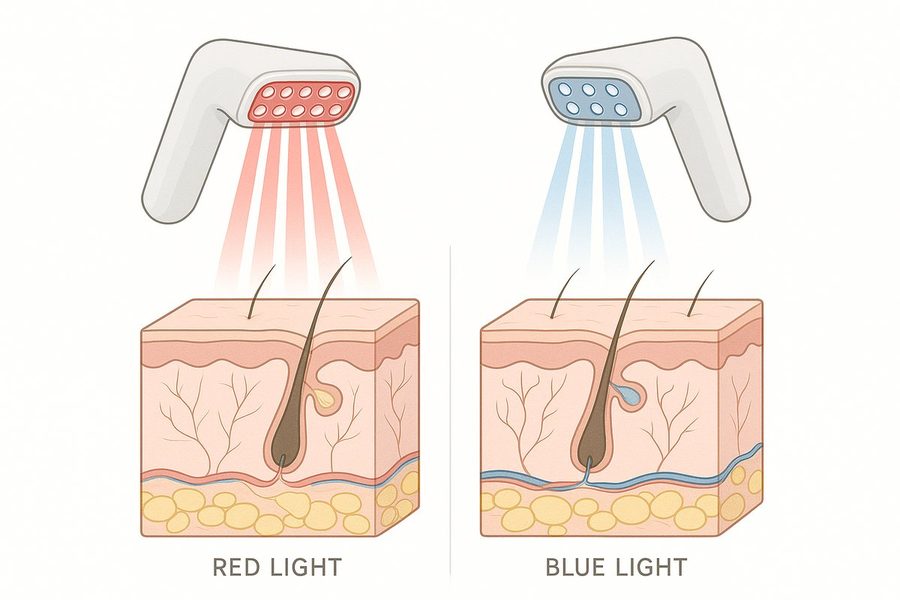
If you are comparing red light vs blue light for skin, here is the simple answer: blue light is mainly for acne, while red light is mainly for inflammation support, recovery, and visible signs of aging.
Red light (630–660 nm) and blue light (415–430 nm) are the two best-studied wavelengths for skin, but they work in completely different ways. Red light penetrates 2–3 mm into the dermis and stimulates cytochrome c oxidase in mitochondria, increasing ATP production, collagen synthesis by fibroblasts, and reducing inflammatory cytokines — making it useful for anti-aging, wound healing, and reducing inflammation. Blue light penetrates only the epidermis and generates reactive oxygen species that are toxic to Cutibacterium acnes (formerly P. acnes), the bacteria that drives inflammatory acne — making it useful for acne treatment, not collagen or anti-aging. They are complementary tools for different goals, not interchangeable.
- Red light’s mechanism (photobiomodulation via cytochrome c oxidase in mitochondria) is fundamentally different from blue light’s mechanism (photodynamic ROS generation) — using the wrong wavelength for the goal doesn’t provide benefit; red light doesn’t kill P. acnes meaningfully; blue light doesn’t reach dermal fibroblasts.
- Near-infrared light (810–850 nm) extends red light’s benefits deeper — at 830 nm, photons penetrate 5–7 mm into tissue, reaching subcutaneous structures and making NIR relevant for deeper inflammation, nerve repair, and joint-adjacent skin aging.
- Combination LED devices (red + blue or red + NIR) are useful for patients with concurrent acne and post-acne scarring — blue light treats active acne bacteria while red/NIR supports healing and reduces PIH; sequential or simultaneous use is common in clinical settings.
- Blue light safety concern: extended and repeated blue light exposure at the intensities used in LED therapy may contribute to retinal stress over time — devices should be used with appropriate eye protection; this is well-established with blue light in ophthalmology if not yet definitively proven for skin devices.
- Yellow light (590 nm) and green light (520 nm) are secondary wavelengths with more limited evidence: yellow/amber has shown benefit for rosacea and erythema reduction; green light has limited data but is included in some multi-wavelength panels without strong independent evidence.
Both can help skin, but they are not interchangeable. A lot of brands talk about LED like every color does everything. That is nonsense. The right choice depends on what you are trying to treat.

What Blue Light Does for Skin
Blue light used in acne devices is usually around 405-420 nm. It is mainly used because it can target acne-causing bacteria indirectly. Cutibacterium acnes produces porphyrins, and blue light can trigger a reaction that damages those bacteria.
That makes blue light most relevant for:
– Mild to moderate acne
– Frequent inflammatory breakouts
– Oily or congestion-prone skin
– Maintenance between acne treatments
A 2013 randomized controlled trial by Kwon et al. studied a home-use blue-red LED device for mild to moderate acne. Patients used 420 nm blue light and 660 nm red light twice daily for 4 weeks, and inflammatory lesions fell by 77% at the final 12-week visit.
A 2019 systematic review and meta-analysis by Scott et al. found that many acne studies were small, short, and methodologically limited. So the evidence is encouraging, but not airtight.
What Red Light Does for Skin
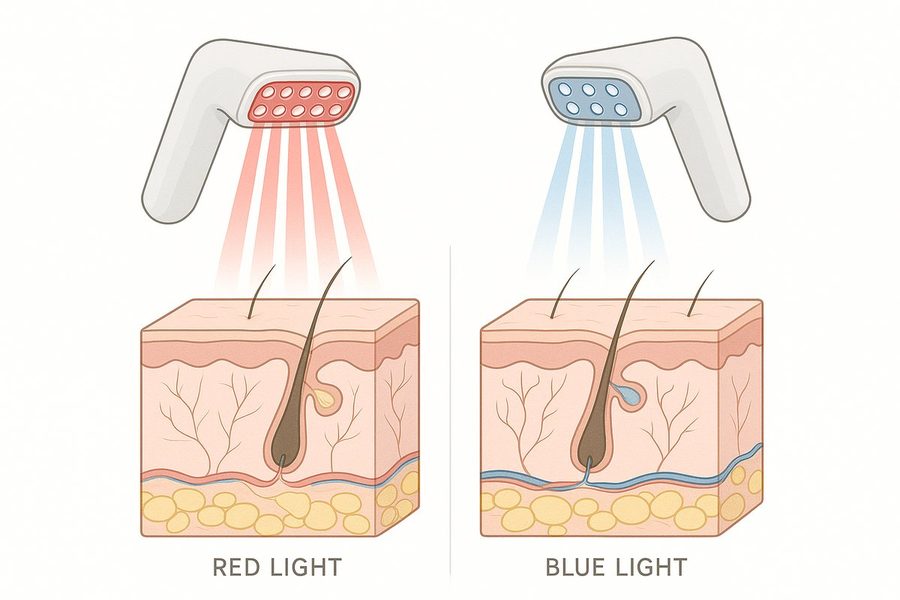
Red light in skincare usually sits around 620-660 nm, and it is often paired with near-infrared light around 800-850 nm.
Instead of targeting acne bacteria directly, red light is used for photobiomodulation. In plain English, that means it supports cellular activity linked with repair and visible skin rejuvenation.
Red light is most relevant for:
– Fine lines and wrinkles
– Dullness
– Mild redness and irritation
– Post-breakout recovery
– Overall texture and tone
A 2005 clinical trial by Russell et al. found that combined 633 nm and 830 nm LED therapy improved photoaged facial skin. A 2020 split-face pilot study also found that home-use 637 nm and 854 nm LED treatment improved elasticity and skin texture over 8 weeks.
The Biggest Differences Between Red and Blue Light
Blue light is more acne-specific
If your main issue is active breakouts, blue light has the more direct role.
Red light is more versatile
Red light is more useful for aging skin, visible recovery, and overall texture support.
Blue light may feel harsher for some users
If your skin barrier is already stressed from acne treatments, a blue-heavy routine can feel less comfortable.
Red light fits “healthy aging” goals better
If your target is wrinkles, dullness, or mild inflammation, red light is the better fit.
Which One Is Better for Acne?
If you have active acne, blue light has the more direct mechanism. But in real life, a blue + red combination device often makes more sense.
Why? Because acne is not only about bacteria. It also involves inflammation and healing. Blue light helps on the bacterial side, while red light may help calm the inflammatory side.
Which One Is Better for Anti-Aging?
This one is straightforward: red light wins.
Blue light is not the main anti-aging wavelength. If you want support for wrinkles, texture, and skin rejuvenation, red light, often paired with near-infrared, is the better option.
Do You Need Both?
Only if your goals overlap.
Choose blue light if:
– Your main concern is acne
– You are oily and breakout-prone
– You care more about blemish control than anti-aging
Choose red light if:
– Your main concern is wrinkles or texture
– You want calmer, more resilient-looking skin
– Your skin is sensitive or easily irritated
Choose a red + blue device if:
– You break out but also care about aging well
– You want one device for both blemishes and recovery
FAQ
Is red light or blue light better for acne?
Blue light is more directly linked to acne bacteria reduction, but blue-red combination devices may be more practical because they also address inflammation.
Is blue light good for wrinkles?
Not as a primary anti-aging tool. Red light and near-infrared are more relevant for wrinkle-focused routines.
Can I use red and blue light on the same day?
Usually yes, if your device is designed for it and your skin tolerates it well.
Which LED light is best for glowing skin?
Red light is usually the better choice for tone, texture, and overall rejuvenation.
Bottom Line
When it comes to red light vs blue light for skin, the right answer depends on your target:
– Blue light: better for acne-focused routines
– Red light: better for anti-aging, recovery, and inflammation support
– Blue + red together: often best for acne-prone adults who want broader benefits
If I had to choose only one for most adults, I would lean red light because it is more versatile. But if your skin is constantly breaking out, blue light deserves serious consideration.
References
– Kwon HH, Lee JB, Yoon JY, et al. The clinical and histological effect of home-use, combination blue-red LED phototherapy for mild-to-moderate acne vulgaris in Korean patients: a double-blind, randomized controlled trial. Br J Dermatol. 2013;168(5):1088-1094. doi:10.1111/bjd.12186.
– Scott AM, et al. Blue-Light Therapy for Acne Vulgaris: A Systematic Review and Meta-Analysis. Ann Fam Med. 2019;17(6):545-553. doi:10.1370/afm.2445.
– Russell BA, Kellett N, Reilly LR. A study to determine the efficacy of combination LED light therapy (633 nm and 830 nm) in facial skin rejuvenation. J Cosmet Laser Ther. 2005;7(3-4):196-200. doi:10.1080/14764170500370059.
– Ng JNC, et al. Efficacy of home-use light-emitting diode device at 637 and 854-nm for facial rejuvenation: A split-face pilot study. J Cosmet Dermatol. 2020;19(9):2288-2294. doi:10.1111/jocd.13613.
Related Articles
- Effectiveness of photodynamic therapy against Escherichia coli: Influence of light dose fractionation in the presence of porphyrins, methylene blue and zinc phthalocyanine disulfonate. Journal of photochemistry and photobiology. B, Biology. 2026. PMID: 41833221.
- How Often Should You Use LED Light Therapy?
- Are At-Home LED Devices Worth It?
- Sunscreen Habits That Prevent Early Aging
- Best Ceramide Creams for Barrier Repair
Sources
- DermNet NZ, Phototherapy
- Cleveland Clinic, Red Light Therapy
- LED Therapy for Acne Scars: What It Can Do
- How Often Should You Use LED Light Therapy?
- Are At-Home LED Devices Worth It?
📝 Cite This Article
Richard Shoemake. “Red Light vs Blue Light for Skin.” New Online Products, 2026-03-27. https://newonlineproducts.com/2026/03/27/red-light-vs-blue-light-for-skin-what-each-one-actually-does/