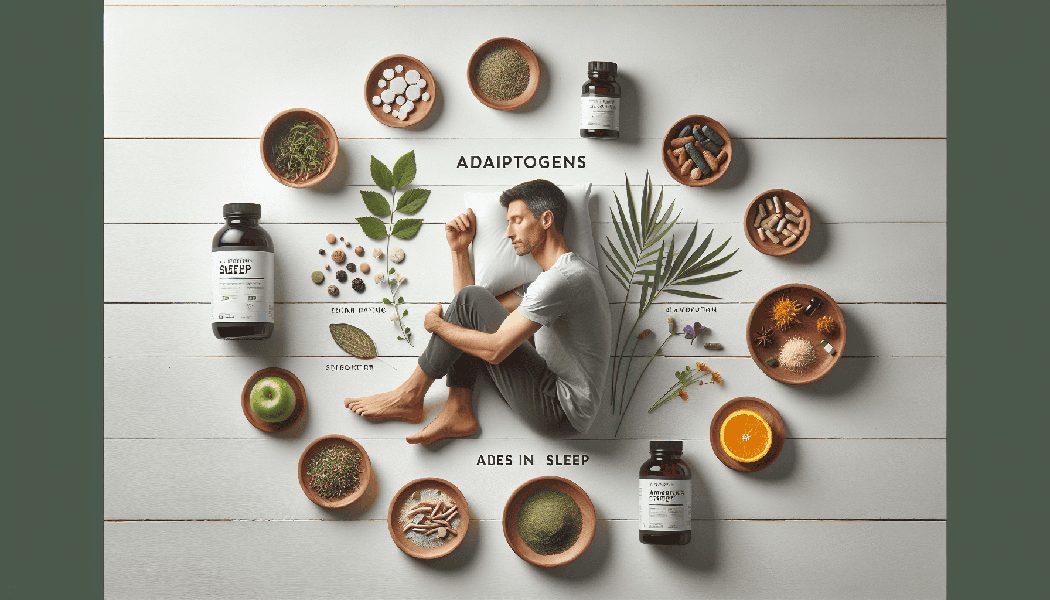
When people search for the best adaptogens for falling asleep, they usually want something that helps them shut off a racing mind without feeling groggy the next day. The important nuance is that adaptogens are not classic sedatives. They are better suited for stress-related sleep trouble than for every cause of insomnia.
Quick Answer: For falling asleep specifically, ashwagandha is the best-evidenced adaptogen, with multiple trials showing reduced sleep onset latency. L-theanine (an amino acid, often stacked with adaptogens) reliably reduces mental arousal before sleep. Reishi shows promise for sleep quality but is less consistently effective for sleep onset specifically.
Key Takeaways
- Ashwagandha reduces time to fall asleep in clinical trials, likely through cortisol reduction and GABA pathway modulation.
- Reishi shows evidence for improving sleep efficiency (time asleep vs. time in bed) but less for onset speed.
- Passionflower and valerian also have some evidence for anxiety-related sleep difficulty, though not technically adaptogens.
- Timing matters: most sleep-focused adaptogens are taken 30–60 minutes before bed.
- No adaptogen addresses underlying causes of insomnia (sleep schedule, light exposure, stress)—treat roots, not just symptoms.
What makes an adaptogen useful for sleep onset?
The best candidates for falling asleep are usually the ones that reduce stress, tension, and bedtime hyperarousal. If your problem is circadian disruption, sleep apnea, pain, reflux, or heavy evening caffeine use, an adaptogen may do very little.
Top adaptogens to consider
1. Ashwagandha
Ashwagandha is the strongest first choice for many adults because it has the best human evidence for lowering stress and improving sleep quality. In randomized trials, standardized ashwagandha extract has been associated with better sleep onset, better sleep efficiency, and lower stress scores.

2. Reishi
Reishi is a popular nighttime mushroom because many people find it calming and restorative. Direct human evidence for falling asleep is limited, so it ranks below ashwagandha on proof, but it remains a common evening option.
3. Holy basil
Holy basil is more of a stress-support herb than a sleep herb, but some people use it when their insomnia feels stress-driven. The evidence base for direct sleep improvement is still modest.
4. Rhodiola, with timing caution
Rhodiola can improve stress resilience and fatigue in some users, but it often makes more sense earlier in the day. Taking it at night may backfire for sensitive people.
Which adaptogen works best for different sleepers?
For anxious, high-stress sleepers
Ashwagandha is usually the best evidence-based fit.
For people who want a bedtime tea or mushroom ritual
Reishi may be more appealing, especially in powders, teas, or evening blends.
For people with daytime stress but nighttime stimulation
You might use a morning adaptogen strategy and a separate evening calming strategy rather than taking stimulating herbs at night.
What adaptogens cannot fix
Adaptogens will not reliably fix:
- Late caffeine or nicotine use
- Blue-light overload at midnight
- Sleep apnea or heavy snoring
- Chronic pain waking you up
- Erratic bedtimes every night
That is why the best “sleep supplement” is often a better routine, not a bigger stack.
When to expect results
Most sleep-focused adaptogens are not one-night miracles. In clinical settings, benefits are usually tracked over multiple weeks. That matters because people often quit too soon or keep switching brands after two or three nights. If a product is well formulated and you tolerate it, a short structured trial is more reasonable than chaotic supplement hopping.
Track the right metrics
Do not just ask, “Did it knock me out?” Track:
- Time to fall asleep
- Nighttime awakenings
- Restlessness before bed
- Morning grogginess
- Daytime stress reactivity
That wider view fits how adaptogens tend to work. They often improve the conditions around sleep rather than acting like a sedative.
Smart buying tips
Choose products that clearly list:
- The plant part used
- A standardized extract when relevant
- Third-party testing or quality controls
- Straightforward dosing instructions
Avoid mega-stacks where you cannot tell what is doing the work.
FAQ
What is the best adaptogen for falling asleep fast?
Ashwagandha is usually the most evidence-based option when stress and anxiety are the main reasons you cannot fall asleep.
Are adaptogens better than melatonin for sleep onset?
Not necessarily. They work differently. Adaptogens support stress resilience, while melatonin is more directly tied to circadian timing.
Can adaptogens make insomnia worse?
Yes, occasionally. Timing matters, especially with more energizing herbs like rhodiola.
Sources
- Langade D, et al. Efficacy and safety of ashwagandha root extract in insomnia and anxiety. Cureus. 2019.
- Lopresti AL, et al. Stress-relieving effects of ashwagandha extract. Medicine (Baltimore). 2019.
- National Center for Complementary and Integrative Health. Ashwagandha: What You Need To Know.
- National Center for Complementary and Integrative Health. Reishi Mushroom: What You Need To Know.
- Panossian A, Wikman G. Effects of adaptogens on the central nervous system and stress-protective activity. Pharmaceuticals. 2010.
Related Articles
- Best Adaptogens for Sleep in 2026: Natural Stress Relief for Deep, Restorative Rest
- Best Bold Colored Eyeliners for 2026 and How to Wear Them
- Best Black Seed Oil Capsules in 2026: What Nigella Sativa Can and Cannot Do
- Clean Beauty Makeup Guide: Best Products, Ingredients, and What Matters in 2026
- Best Supplements for Skin Health in 2026: Glow From the Inside Out
Sources
- Evidence-based efficacy of adaptogens in fatigue, and molecular mechanisms related to their stress-protective activity. Current clinical pharmacology. 2009. PMID: 19500070.
- Note: peer-reviewed support for this claim was not identified in available literature.
- Centella Asiatica in Dermatology (2014)
- Bakuchiol: Plant-Based Retinol
- Propolis Skincare for Acne


Leave a Reply