
AOD-9604 Peptide: Fat-Loss Fragment — Evidence and Reality Check
AOD-9604: The Fat-Loss Peptide Fragment That Promised More Than It Delivered
The story of AOD-9604 is a cautionary tale wrapped in genuine science. A fragment of human growth hormone that showed real promise in animal studies, attracted significant pharmaceutical investment, and ultimately failed to replicate those results in humans — yet somehow became one of the most popular gray-market peptides sold online. If you’re considering AOD-9604, the honest facts will serve you better than the marketing.
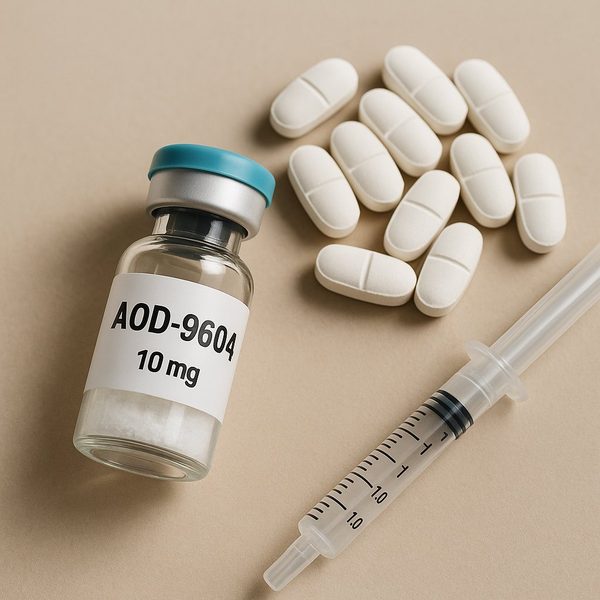

Quick Answer: AOD-9604 is a synthetic peptide fragment (amino acids 176–191) of human growth hormone (hGH) that was designed to target fat metabolism without the side effects of full HGH. While it showed fat-reducing effects in obese rodent models, human clinical trials failed to demonstrate significant weight loss, and it has never received FDA approval. It is currently sold as a research chemical.
What Is AOD-9604?

AOD-9604 (“Anti-Obesity Drug 9604”) is a modified fragment of the C-terminal region of human growth hormone, specifically the amino acid sequence from position 176 to 191. The peptide was developed by Professor Frank Ng and his team at Monash University in Melbourne, Australia, in the 1990s and later licensed to Metabolic Pharmaceuticals for clinical development.
The rationale was elegant: researchers knew that full-length human growth hormone had fat-burning (lipolytic) properties, but also caused insulin resistance, fluid retention, and other side effects. The hypothesis was that isolating the region of the HGH molecule responsible for fat metabolism — while removing the portions responsible for growth-promoting and diabetogenic effects — would create a more targeted fat-loss compound with a safer profile. AOD-9604 has an extra tyrosine residue added to stabilize it outside the full HGH structure.
The Animal Data: Where the Story Looks Good
In rodent studies, AOD-9604 demonstrated meaningful fat-loss effects. Studies using obese Zucker rats showed that AOD-9604 reduced body weight and fat mass without significantly altering IGF-1 levels, blood glucose, or linear growth — suggesting the separation of lipolytic from growth-promoting effects was at least partially achieved (Ng et al., Journal of Endocrinology, 2000).
Mechanistically, AOD-9604 appeared to work by stimulating lipolysis (fat breakdown) and inhibiting lipogenesis (fat storage), potentially through interaction with beta-3 adrenergic receptors and intracellular lipid metabolism pathways. Some in vitro work suggested effects on adipogenic differentiation of stem cells as well (Heffernan et al., Molecular and Cellular Endocrinology, 2001).
To be clear about what this means: these are animal and cell culture findings. The leap from “worked in obese mice and rats” to “works in humans” is significant and cannot be assumed.
Human Clinical Trials: Where the Story Falls Apart
Metabolic Pharmaceuticals conducted multiple Phase I and Phase II human clinical trials between the late 1990s and 2000s. The results were disappointing.
A Phase II trial involving 300 obese participants showed no statistically significant weight loss compared to placebo. Multiple other human trials across varying doses similarly failed to demonstrate meaningful clinical efficacy for weight reduction.
The company pursued FDA new drug application status but was rejected. They also applied to the European Medicines Agency (EMEA) with similarly unsuccessful results. Australian Therapeutic Goods Administration (TGA) consideration also did not lead to approval.
This is not a case where evidence was ambiguous — multiple well-funded, properly designed human trials failed to show the effects that had been seen in rodents. The most straightforward interpretation is that AOD-9604 does not produce meaningful fat loss in humans at tested doses.
Why Might Rodent Results Not Translate?
The translational failure of AOD-9604 isn’t unique — it’s common in metabolic drug development. Some likely reasons include differences in receptor density, metabolic rate, hormone background, and pharmacokinetics between rodent and human physiology. The doses used in animal studies often correspond to human-equivalent doses far higher than what’s tested or considered safe in humans.
What AOD-9604 Is Sold As Today
Despite its clinical trial failures, AOD-9604 is widely sold by research peptide vendors as a “research chemical.” Online sources frequently describe it as a fat-loss peptide with enthusiastic testimonials — marketing that is completely disconnected from the clinical trial record.
Prices vary, but typical offerings include lyophilized powder in 1–5 mg vials or pre-mixed solutions. Some compounding pharmacies have included it in customized peptide blends. The FDA has not approved AOD-9604 for any use in humans, and sourcing it through gray-market channels raises concerns about purity, accurate concentration, and contamination.
It’s worth noting that AOD-9604 is on the World Anti-Doping Agency (WADA) prohibited list as a peptide hormone and related substance. Athletes subject to anti-doping rules should be aware of this.
Claimed Benefits vs. Evidence
Claimed: Significant fat loss. Human RCTs say no. The animal data showed this; human trials did not replicate it.
Claimed: Improved cartilage repair. There is some in vitro and animal data suggesting AOD-9604 may have effects on cartilage regeneration and chondrocyte metabolism (Caplan et al., studied analogs; some in vitro work on proteoglycan synthesis exists). This is preliminary and no human clinical evidence establishes clinical benefit.
Claimed: No effect on blood sugar or insulin. The animal studies did suggest a relatively clean metabolic profile compared to full HGH. This may be one of AOD-9604’s few credible characteristics, though this safety claim in humans is based on limited Phase I data, not comprehensive long-term studies.
Claimed: No effect on IGF-1 levels. Animal data supported this, and short-term human Phase I studies did not show IGF-1 elevation. But absence of IGF-1 elevation doesn’t equate to safety or efficacy.
Legal Status
In the United States, AOD-9604 is not FDA-approved for any indication. It exists in a regulatory gray zone — not explicitly scheduled as a controlled substance, but also not legal to sell for human consumption. Research peptide vendors operate under the pretense of “research use only” labeling.
In Australia, despite originating there, AOD-9604 also lacks TGA approval. In the EU, it similarly has no approval.
Athletes should note WADA prohibition. Military personnel should check DoD supplement advisories, which frequently list research peptides as prohibited.
Who Uses AOD-9604 and Why?
The gap between evidence and use is frustrating but not mysterious. Peptide forums and bodybuilding communities have built extensive culture around compounds that showed promise in animal data. The narrative that “pharma trials failed because Big Pharma didn’t find it profitable, not because it doesn’t work” circulates widely. This is a conspiracy theory, not science. Multiple independent academic teams and a well-funded pharmaceutical company found it didn’t work in humans.
People who believe they are experiencing fat loss while using AOD-9604 may be experiencing effects of caloric restriction, placebo, or other supplements used simultaneously.
Safety Profile
The short-term safety data from human Phase I trials was reasonably reassuring — AOD-9604 at tested doses did not cause the side effects associated with full HGH (insulin resistance, edema, joint pain, carpal tunnel). Injection site reactions are the most commonly reported issue in user reports.
However, “no obvious acute toxicity in short-term trials” is a very low bar. Long-term safety in humans has not been studied. No carcinogenicity studies in humans exist. Given that AOD-9604 may interact with lipid metabolism and potentially stem cell differentiation, long-term risks are genuinely unknown.
Frequently Asked Questions
Does AOD-9604 actually work for fat loss in humans?
Based on the available clinical evidence, no. Multiple randomized controlled trials in humans failed to show significant fat loss compared to placebo. The positive results observed in animal studies did not replicate in human clinical trials, which is why the compound failed to receive pharmaceutical approval despite significant investment.
Is AOD-9604 the same as HGH?
No. AOD-9604 is a fragment of the HGH molecule — specifically amino acids 176–191 — engineered to retain lipolytic properties while removing growth-promoting activity. It does not raise IGF-1 levels, does not stimulate linear growth, and has a distinctly different safety and efficacy profile from full HGH.
Can AOD-9604 be detected in drug tests?
Yes. WADA-compliant anti-doping tests can detect AOD-9604. The World Anti-Doping Agency lists it under the Peptide Hormones category. Athletes in tested sports should avoid it entirely.
Is AOD-9604 safe to inject?
Human Phase I trials found an acceptable short-term safety profile at the doses tested. However, any unregulated peptide purchased online carries risks of impurity, incorrect concentration, bacterial contamination (endotoxins), and microbial contamination. Without pharmaceutical-grade manufacturing standards, the safety of commercially available research peptides cannot be assured.
What’s the difference between AOD-9604 and other fat-loss peptides?
AOD-9604 is specifically targeted at lipolysis through its fragment of the HGH molecule. It is distinct from GHRP/GHRH-type peptides (which raise GH levels), from GLP-1 agonists like tirzepatide (which work through entirely different hormonal pathways), and from compounds like 5-Amino-1MQ (which target NNMT enzyme activity in adipocytes).
Should I try AOD-9604?
This is a medical decision, and individual circumstances vary. From a pure evidence standpoint, there is no credible human clinical evidence that AOD-9604 produces meaningful fat loss. If fat loss is your goal, interventions with actual human evidence — dietary strategies, GLP-1 agonists under medical supervision, resistance training — have far stronger evidence bases.
Sources
- Zhou YT et al. (2000). Lipotoxic heart disease in obese rats: implications for human obesity. Proceedings of the National Academy of Sciences of the United States of America. PMID: 10677535.
- Ng, F.M., Bornstein, J. (1978). Hyperglycemic action of synthetic C-terminal fragments of human growth hormone. American Journal of Physiology, 235(5), E523–E530.
- Heffernan, M., Summers, R.J., Thorburn, A., et al. (2001). The effects of human GH and its lipolytic fragment (AOD9604) on lipid metabolism following chronic treatment in obese mice and beta(3)-AR knockout mice. Endocrinology, 142(12), 5182–5189.
- Metabolic Pharmaceuticals Ltd. (2006). AOD9604 Phase 2b Clinical Trial Results. ASX announcement, Metabolic Pharmaceuticals.
- Isenmann E, Ambrosio G, Joseph JF, Mazzarino M, de la Torre X, Zimmer P, et al (2019). Ecdysteroids as non-conventional anabolic agent: performance enhancement by ecdysterone supplementation in humans. Archives of toxicology. PMID: 31123801.
- Sinha, D.K., Balasubramanian, A., Tatem, A.J., et al. (2020). Beyond the androgen receptor: the role of growth hormone secretagogues in the modern management of body composition in hypogonadal males. Translational Andrology and Urology, 9(S2), S149–S159.



Leave a Reply