CJC-1295 and Ipamorelin Peptide Stack: Benefits, Dosing & Side Effects (2026)
Quick Answer: CJC-1295 and ipamorelin are two injectable peptides often prescribed together through telehealth and anti-aging clinics. CJC-1295 is a synthetic growth hormone–releasing hormone (GHRH) analog that sustains elevated GH levels for days; ipamorelin is a selective GH secretagogue that triggers a sharp, short GH pulse. Together they produce a more physiologically complete GH stimulation pattern. Clinical evidence supports their individual mechanisms, but robust combined-stack trials in healthy adults are limited. Expect modest benefits in body composition, sleep quality, and recovery — not dramatic transformations. Prescription required in the U.S.
The CJC-1295 ipamorelin stack has become one of the most talked-about protocols in longevity medicine, performance optimization, and anti-aging telehealth. Clinics and influencers alike market it with considerable enthusiasm — and, in some corners, considerable exaggeration. This article cuts through the noise: what these peptides are, what the science actually shows, how they are prescribed, what they cost, and where the realistic ceiling on benefits lies.
What Is CJC-1295?
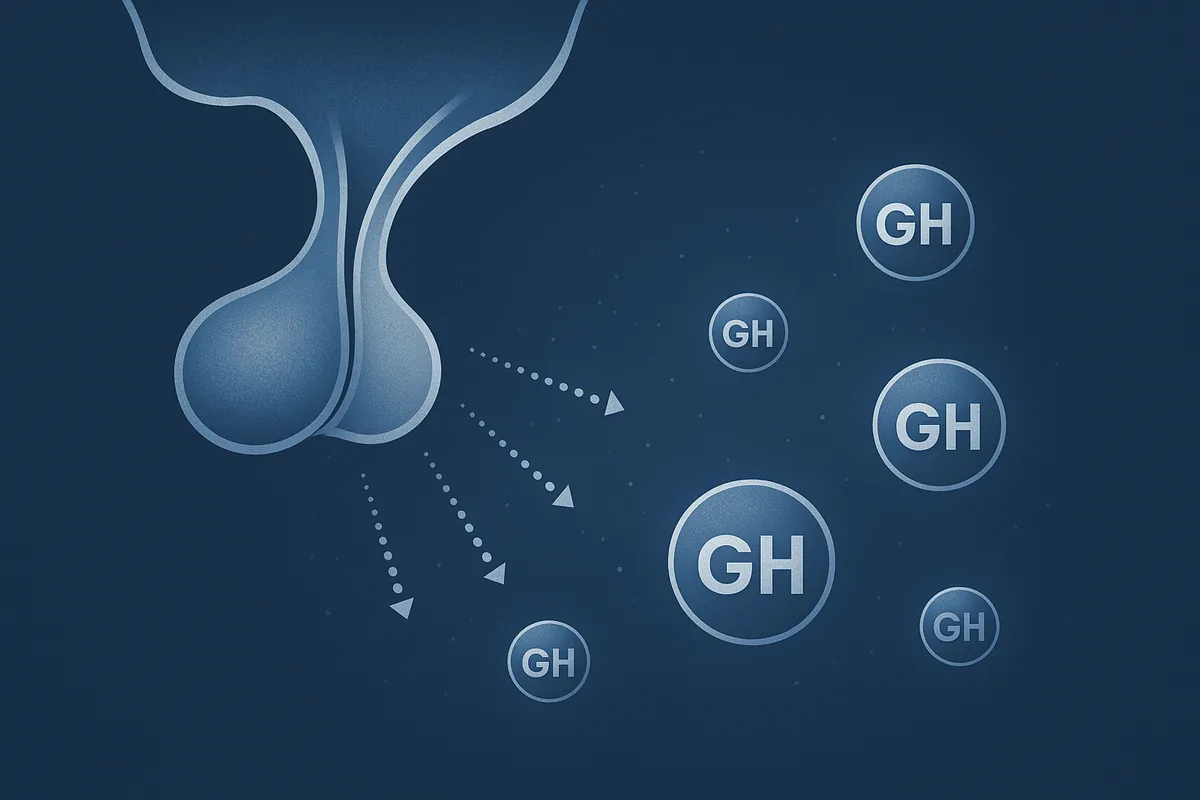
CJC-1295 is a synthetic analog of growth hormone–releasing hormone (GHRH), the hypothalamic signal that tells the pituitary gland to release growth hormone (GH). Natural GHRH has a plasma half-life of only a few minutes before enzymes cleave it. CJC-1295 was engineered to resist that degradation.
DAC vs. No-DAC: Two Different Peptides
There are two formulations frequently labeled “CJC-1295,” and they behave very differently:
CJC-1295 with DAC (Drug Affinity Complex): The DAC modification allows the peptide to bind covalently to albumin in the bloodstream, dramatically extending its half-life to approximately 6–8 days. A single injection can produce sustained, slightly elevated GH and IGF-1 levels for nearly a week. This is the version studied in the landmark 2006 Journal of Clinical Endocrinology & Metabolism trial by Teichman et al., which found dose-dependent increases in mean GH levels of 2- to 10-fold and IGF-1 increases of 1.5- to 3-fold lasting up to 14 days after a single injection.
CJC-1295 without DAC (also called Modified GRF 1-29 or Mod GRF 1-29): This version has a half-life of roughly 30 minutes. It mimics a more natural, pulsatile GHRH signal and is the formulation more commonly paired with ipamorelin in clinic protocols. Some vendors and clinics mislabel Mod GRF 1-29 as “CJC-1295,” adding to consumer confusion.
When people talk about the “CJC-1295 ipamorelin stack,” they are usually referring to the no-DAC version, injected multiple times per week or daily alongside ipamorelin.
What Is Ipamorelin?
Ipamorelin is a selective growth hormone secretagogue — a synthetic peptide that stimulates GH release through a different receptor than GHRH. It is a ghrelin mimetic, meaning it binds to the ghrelin receptor (GHS-R1a) on pituitary cells and hypothalamic neurons.
What makes ipamorelin notable among GH secretagogues is its selectivity. Earlier peptides in this class — GHRP-2 and GHRP-6, for example — also elevated cortisol and prolactin, which are undesirable side effects. Raun et al. (1998) established in their foundational characterization of ipamorelin that it produced robust GH pulses in rats with minimal effect on cortisol or prolactin at effective doses, setting it apart from its predecessors.
Ipamorelin’s GH pulse is acute and relatively short-lived — plasma GH peaks within roughly 15–30 minutes of injection and returns to baseline within an hour or two. This pulsatile quality is considered more physiologically natural than continuous GH elevation.
Why Stack CJC-1295 and Ipamorelin?
The rationale is mechanistic complementarity. The two peptides work on different receptors and produce different temporal GH patterns:
Injecting both together produces a synergistic effect: CJC-1295 primes the somatotroph cells in the pituitary, increasing the pool of GH ready to release, while ipamorelin triggers a sharp release from that primed pool. The combined signal can produce a larger GH pulse than either peptide alone. This mirrors the natural interplay between endogenous GHRH and ghrelin in the body.
Clinicians often describe this as “loading the cannon” (CJC-1295) and “firing it” (ipamorelin).
Clinical Evidence: What the Research Shows
CJC-1295 (with DAC)
The Teichman et al. (2006) trial remains the most robust human data. In a randomized, double-blind, placebo-controlled Phase 1/2 study of 65 healthy adults (aged 21–61), a single subcutaneous injection of CJC-1295 with DAC:
Raised mean GH concentrations 2–10-fold above baseline
Raised IGF-1 by 1.5–3-fold
Effects persisted for 6–14 days depending on dose
No serious adverse events were reported
This established pharmacological proof-of-concept. What the study did not show was clinical endpoint improvement — body composition, muscle mass, or fat loss were not the primary endpoints.
Ipamorelin
Raun et al. (1998) demonstrated selective GH secretion with minimal cortisol and prolactin stimulation. Gobburu et al. (1999) characterized the pharmacokinetics and pharmacodynamics, establishing that ipamorelin produces dose-dependent GH pulses consistent with normal pulsatile physiology.
Animal studies showed ipamorelin improved bone density and body composition outcomes, but human clinical endpoint trials for ipamorelin alone remain sparse in the published literature.
The Stack: Combined Evidence
Here is where honesty is required: there are no large-scale, randomized controlled trials specifically evaluating the CJC-1295 ipamorelin combination in healthy adults for body composition or anti-aging endpoints. The synergy rationale is mechanistically sound and supported by the known receptor pharmacology, but the clinical evidence base for the combined stack consists primarily of:
Mechanistic studies on each individual peptide
Observational data from anti-aging clinics
Case series and patient testimonials
A 2018 review by Sigalos and Pastuszak in Sexual Medicine Reviews evaluated GH secretagogues broadly and concluded that while early evidence supports their use for GH-deficient patients, “data in non-GH-deficient individuals are limited.”
This doesn’t mean the stack doesn’t work — but it does mean the confident claims made by many clinics and supplement marketers significantly outrun the controlled trial evidence.
Growth Hormone Effects: What Benefits Are Plausible?
When GH and IGF-1 rise within physiological ranges — which is what these peptides aim for — several benefits are biologically plausible and modestly supported:
Body Composition
GH promotes lipolysis (fat breakdown) and has anabolic effects on muscle in GH-deficient populations. In adults with established GH deficiency, GH replacement therapy consistently improves body composition. In healthy adults with normal GH levels, the additional benefit is smaller and less consistent.
Sleep Quality
GH is secreted primarily during slow-wave (deep) sleep. Some users report improved sleep quality and more vivid dreams — which may reflect increased deep sleep. This is one of the most commonly reported and plausible subjective benefits.
Recovery and Tissue Repair
IGF-1 stimulates protein synthesis and cellular repair. Enhanced recovery from training or injury is a common reason patients pursue these protocols, particularly among active adults in their 40s and 50s whose GH levels have naturally declined.
Skin and Collagen
GH and IGF-1 support collagen synthesis. Improvements in skin texture and thickness are reported anecdotally and are consistent with the known biology.
What These Peptides Are Not
They are not steroids. They do not add 20 pounds of muscle. They are not a substitute for sleep, nutrition, resistance training, or addressing other hormonal imbalances. The anti-aging telehealth market sometimes presents these peptides as transformative — that framing deserves skepticism.
How CJC-1295 and Ipamorelin Compare to Other GH Peptides
Tesamorelin
Tesamorelin is another GHRH analog — and the only FDA-approved GHRH analog in the U.S., indicated for HIV-associated lipodystrophy. It has a more robust clinical trial record than CJC-1295, including randomized controlled trials demonstrating visceral fat reduction. It is also substantially more expensive. Off-label use for body composition is growing in longevity medicine.
Sermorelin
Sermorelin is an older GHRH analog (the first 29 amino acids of GHRH) with a very short half-life. It was FDA-approved for pediatric GH deficiency but was discontinued for commercial reasons. It is still available through compounding pharmacies. CJC-1295 no-DAC is sometimes called the “next generation” sermorelin due to its improved stability.
MK-677 (Ibutamoren)
MK-677 is an oral ghrelin mimetic — essentially ipamorelin’s mechanism in pill form. It is not FDA-approved, is not a peptide, and is sold in gray-market channels. It has a longer half-life (24 hours) and consistently raises GH and IGF-1, but also tends to increase appetite and, in some users, causes significant water retention and elevated fasting glucose. Its legal and safety profile is more ambiguous than prescribed injectable peptides.
GHRP-2 and GHRP-6
Earlier ghrelin-mimetic peptides. Effective but associated with cortisol and prolactin elevation that ipamorelin largely avoids. Now mostly superseded by ipamorelin in clinical practice.
Dosing Protocols
Dosing varies by prescriber, but common protocols from telehealth and anti-aging clinics typically include:
CJC-1295 no-DAC: 100–300 mcg per injection
Ipamorelin: 100–300 mcg per injection
Frequency: Typically injected together 1–3 times daily, with the most commonly recommended timing being 30–60 minutes before bed to amplify the natural nocturnal GH pulse
Cycle length: Often 3–6 months on, with a “break” period; some patients continue long-term under monitoring
Route: Subcutaneous injection (insulin syringe), typically in the abdomen
For CJC-1295 with DAC:
Typically 1–2 mg injected once or twice per week
Lower frequency but longer-acting; often paired with ipamorelin on a separate daily schedule
These protocols are not FDA-endorsed dosing guidelines — they reflect observed clinical practice. Dosing should always be individualized and supervised by a licensed prescriber.
Side Effects
The CJC-1295 ipamorelin stack is generally considered well-tolerated compared to exogenous HGH, but side effects are real:
From CJC-1295:
Water retention and mild edema (common, usually transient)
Tingling or numbness in hands and feet (carpal tunnel-like symptoms)
Fatigue or lethargy, particularly when starting
Injection site reactions
From Ipamorelin:
Increased hunger (ghrelin-pathway effect, though less than GHRP-6)
Headache shortly after injection
Flushing or warmth at injection site
Mild cortisol increase at higher doses (less than other GHRPs but not zero)
Longer-term considerations:
Chronic GH elevation carries theoretical risks: insulin resistance, potential IGF-1-related cellular proliferation concerns. These are monitored via labs (IGF-1, fasting glucose, HbA1c) in well-run protocols.
Pituitary desensitization is a theoretical concern with long-term continuous use, which is why many prescribers use cyclical protocols.
Cost, Accessibility, and the Compounding Pharmacy Landscape
CJC-1295 and ipamorelin are not FDA-approved drugs. They are available in the U.S. exclusively through 503A or 503B compounding pharmacies — pharmacies licensed to prepare custom formulations — under a prescriber’s order.
Typical cost:
A monthly supply of both peptides: $150–$400/month depending on dose, compounding pharmacy, and whether you’re using a telehealth service
Telehealth consultation fees add another layer of cost, ranging from one-time charges to monthly membership models
How to access them:
Functional medicine physicians, anti-aging doctors, and longevity-focused telehealth platforms (such as Defy Medical, Maximus, AgelessRx, and similar services) routinely prescribe these peptides
They are not available over the counter legally in the U.S. for human use
“Research chemical” vendors sell peptides online, but these are not for human use, are unregulated for purity, and carry significant risk
The FDA situation: In 2023 and 2024, the FDA moved to restrict certain compounded peptides, including BPC-157 and some others. CJC-1295 and ipamorelin remained available through compounding as of early 2026, but the regulatory landscape is evolving. Patients should verify current status with their prescriber.
Legal Status and Who Prescribes Them
In the United States, CJC-1295 and ipamorelin occupy a regulatory gray area:
They are not controlled substances (unlike anabolic steroids)
They are not FDA-approved for any indication
They can be legally prescribed off-label by licensed physicians via compounding pharmacies
Possession without a prescription is technically unlawful under federal drug analogue frameworks, though enforcement against individuals is rare
In competitive sports, both peptides are prohibited by WADA (World Anti-Doping Agency) under the Growth Hormone Releasing Factors category. Athletes subject to drug testing should treat these as prohibited substances.
Realistic Expectations vs. the Hype
The CJC-1295 ipamorelin stack occupies a peculiar space: the underlying science is legitimate, the mechanism is rational, but the marketing surrounding it is often hyperbolic.
What patients commonly report (consistent with plausible biology):
Improved sleep depth within 2–4 weeks
Modestly better recovery from exercise
Gradual, slow improvements in body composition over 3–6 months
Improved sense of well-being
What the evidence does not support:
Dramatic muscle gains comparable to anabolic steroids
Significant fat loss without corresponding diet and exercise changes
Anti-aging effects that “reverse” biological age in measurable ways
Benefits that justify skipping the basics: sleep hygiene, resistance training, protein intake, and metabolic health management
If your GH levels are already in the healthy range for your age and you have optimized lifestyle factors, the incremental benefit of peptide therapy is likely modest. If your GH secretion has declined with age (as it naturally does from your 30s onward) and you have a physician-confirmed clinical need, the case becomes stronger.
The honest framing: these are support tools, not shortcuts.
Sources
Note: peer-reviewed support for this claim was not identified in available literature.
Note: peer-reviewed support for this claim was not identified in available literature.
Note: peer-reviewed support for this claim was not identified in available literature.
Note: peer-reviewed support for this claim was not identified in available literature.
Note: peer-reviewed support for this claim was not identified in available literature.
Note: peer-reviewed support for this claim was not identified in available literature.
Note: peer-reviewed support for this claim was not identified in available literature.
This article is for informational purposes only and does not constitute medical advice. CJC-1295 and ipamorelin are not FDA-approved for the uses described here and require a valid prescription from a licensed healthcare provider. Consult your physician before starting any peptide therapy. Individual results vary. The author and publisher are not responsible for actions taken based on the content of this article.




Leave a Reply