Prebiotics vs. Probiotics: The Difference and Which You Need
Quick Answer: Probiotics are live beneficial bacteria you consume, while prebiotics are the fiber compounds that feed those bacteria. They work together — probiotics reseed your microbiome and prebiotics fuel their growth — and research increasingly shows the combination (called synbiotics) often outperforms either alone. Most people benefit from both, but which to prioritize depends on your specific health goals.
Walk into any health food store and you’ll see the words “probiotic” and “prebiotic” within inches of each other, often on products shelved side by side. It’s easy to assume they’re interchangeable, or that one is simply the upgraded version of the other. In reality, they’re fundamentally different things that serve complementary roles — and understanding the difference is the key to spending your supplement budget wisely and actually getting results.
Here’s the simplest framing: your gut microbiome is like a garden. Probiotics are the seeds — living organisms you’re planting. Prebiotics are the fertilizer and soil amendments that help those seeds (and the plants already growing) thrive. You can plant seeds in poor soil, and some will survive. You can fertilize empty soil, and it’ll look healthier but remain barren. The best gardens do both.
What Are Probiotics?
Probiotics are live microorganisms — primarily bacteria, and some yeasts — that, when consumed in adequate amounts, confer a health benefit on the host. That definition, established by a joint FAO/WHO expert panel in 2001 and still used in research, emphasizes two key points: the organisms must be alive, and there must be a demonstrated benefit at the dose consumed.
The most common probiotic genera are Lactobacillus and Bifidobacterium, though the probiotic space also includes Saccharomyces boulardii (a beneficial yeast), Streptococcus thermophilus, Bacillus species, and newer entrants like Akkermansia muciniphila and Faecalibacterium prausnitzii (still in early research stages).
Probiotics are found naturally in fermented foods — yogurt, kefir, kimchi, sauerkraut, miso, tempeh, and traditional buttermilk among them. They’re also sold as supplements in capsule, powder, liquid, and gummy form. A 2022 meta-analysis by Sanders et al. in Nature Reviews Gastroenterology & Hepatology confirmed that fermented food sources can deliver meaningful probiotic benefits, though supplement forms allow for more precise strain selection and higher doses.
What probiotics do in the gut is complex: they compete with pathogens for adhesion sites on the gut wall, produce beneficial metabolites (including short-chain fatty acids), modulate immune signaling, and may help restore depleted native species after disruption events like antibiotic use. They don’t typically permanently colonize the gut — most transit through over days to weeks — but their transient presence appears sufficient to produce measurable benefits.
What Are Prebiotics?
Prebiotics are defined as substrates selectively utilized by host microorganisms, conferring a health benefit. In practice, they’re almost always specific types of dietary fiber, though some non-fiber compounds (including certain polyphenols) are emerging as prebiotic candidates.
The key word in that definition is “selectively” — a prebiotic isn’t just any fiber, it’s a fiber that specifically feeds beneficial bacteria. Your gut bacteria ferment prebiotic fibers in the large intestine, producing short-chain fatty acids (SCFAs) — primarily butyrate, propionate, and acetate — as metabolic byproducts. These SCFAs are deeply important to health: butyrate fuels colon epithelial cells, propionate influences glucose metabolism, and acetate participates in lipid regulation.
Research by Flint et al. in Nature Reviews Microbiology (2012) described the fermentation of dietary fiber by gut microbiota as one of the most consequential nutritional processes in human biology — with downstream effects reaching the immune system, brain, and metabolic organs via the SCFA pathway.
The Main Types of Prebiotic Fiber
Inulin is perhaps the most studied prebiotic. Found naturally in chicory root, Jerusalem artichokes, garlic, leeks, and onions, inulin is a fructan polymer that selectively feeds Bifidobacterium species. A 2010 randomized trial by Moshfegh et al. in Journal of Nutrition showed that chicory inulin supplementation significantly increased Bifidobacterium populations compared to placebo.
Fructooligosaccharides (FOS) are shorter-chain cousins of inulin, often found alongside it in the same foods. FOS are particularly well-tolerated at moderate doses (3–8g/day) and have a robust evidence base for Bifidobacterium promotion. Many probiotic supplements include FOS as a prebiotic co-ingredient.
Galactooligosaccharides (GOS) are derived from lactose and are particularly relevant for infant microbiome development — human breast milk is naturally rich in human milk oligosaccharides (HMOs), which function as prebiotics for the developing infant gut. In adults, GOS supplementation has been shown to increase Bifidobacterium and Lactobacillus while reducing Clostridium species, as demonstrated in a 2008 RCT by Moro et al. in British Journal of Nutrition.
Resistant starch behaves like a prebiotic despite being classified as a starch. When starch resists digestion in the small intestine and reaches the large intestine intact, it becomes highly fermentable by gut bacteria, particularly producing butyrate. Sources include cooled cooked potatoes, unripe bananas, high-amylose corn, and green plantains. Poole et al. in Gut (2017) found that resistant starch supplementation increased butyrate-producing bacteria including Ruminococcus bromii.
Beta-glucans are found in oats and barley (and also functional mushrooms like lion’s mane and reishi). They selectively feed Bifidobacterium and Lactobacillus species while also modulating immune function through direct interactions with gut-associated lymphoid tissue. For more on the immune-modulating properties of beta-glucans from mushrooms specifically, see our Functional Mushrooms Guide.
Pectin is found in apple skins, citrus pith, and berries. A 2022 study by Deehan et al. in Cell Host & Microbe showed that different prebiotic fibers feed different bacterial communities, with pectin promoting Bifidobacterium pseudocatenulatum specifically.
The Key Differences at a Glance
Feature
Prebiotics
Probiotics
What they are
Fiber/substrate
Live microorganisms
Primary source
Food (garlic, chicory, oats)
Fermented foods, supplements
What they do
Feed existing beneficial bacteria
Add new beneficial bacteria
Effect on microbiome
Shifts community composition by feeding selectively
Transiently adds organisms, may reseed
Stability
Highly stable; no refrigeration needed
Variable; many require refrigeration
Side effects
Gas, bloating at high doses
Rare; mild GI symptoms possible
Research maturity
Strong (fiber research decades old)
Strong but strain-specific
When most useful
Maintaining and feeding existing flora
After disruption, rebuilding diversity
When Do You Need Probiotics vs. Prebiotics?
Use Probiotics When:
You need to add or reintroduce beneficial organisms — typically after disruption. The clearest use cases are:
After antibiotic use: Antibiotics are the great equalizer of the gut — they kill bacteria broadly, beneficial and pathogenic alike. Probiotic supplementation during and after antibiotic courses has strong evidence for reducing antibiotic-associated diarrhea. A 2012 Cochrane review by Hempel et al. analyzing 63 RCTs found probiotics reduced antibiotic-associated diarrhea risk by approximately 42%.
Traveler’s diarrhea prevention:Saccharomyces boulardii and Lactobacillus rhamnosus GG have the strongest evidence for reducing traveler’s diarrhea risk and duration.
Active digestive symptoms: IBS symptoms, in particular, have shown responsiveness to probiotics in multiple trials. A 2019 meta-analysis by Ford et al. in The American Journal of Gastroenterology found probiotics were effective for global IBS symptoms and abdominal pain, though strain-specificity mattered.
After illness or stress: Both acute infection and psychological stress disrupt gut microbiome composition. Probiotic supplementation may help accelerate restoration.
You want to nurture and expand the beneficial bacteria already in your gut without needing to add new organisms.
For metabolic health: Prebiotic supplementation has a more consistent evidence base for metabolic improvements — blood glucose regulation, lipid profiles, and satiety — than probiotics. A 2017 meta-analysis by Rao et al. in Obesity Reviews found prebiotic fiber supplementation meaningfully reduced fasting glucose and insulin levels.
For general microbiome diversity: Most people in Western countries eat insufficient fiber — current estimates suggest average Americans consume roughly 15g/day against a recommended 25–38g. Simply increasing prebiotic fiber through food or supplements may do more for microbiome health than adding probiotic supplements.
For long-term maintenance: Unlike probiotics, which transit through, prebiotic effects are sustained as long as you continue consuming them. They’re a dietary habit, not a supplement course.
For immune baseline: Regular prebiotic fiber intake is associated with lower inflammatory markers, with a 2021 study by Dahl et al. in Gut Microbes showing that increasing prebiotic consumption reduced C-reactive protein in adults with metabolic risk factors.
Synbiotics: The Combination Approach
Synbiotics combine probiotics and prebiotics in a single product or regimen. The theoretical advantage is synergy — the prebiotic substrate is immediately available to support the introduced probiotic organisms, potentially improving survival and colonization.
The evidence is genuinely promising. A 2021 meta-analysis by Krumbeck et al. in Beneficial Microbes found that synbiotic combinations outperformed probiotic-alone or prebiotic-alone interventions for gut microbiome diversity outcomes. Separately, a clinical trial by Schiffrin et al. in Journal of Nutrition (2010) found that a synbiotic formula (containing both B. longum and inulin) produced more sustained microbiome changes than either component given alone.
You don’t need to buy a combination product to get synbiotic effects. Taking your probiotic supplement alongside prebiotic-rich foods or adding a separate prebiotic supplement to your probiotic routine effectively creates a synbiotic regimen. A bowl of oatmeal (beta-glucans) with your morning probiotic capsule is a practical example.
Food Sources for Both
Getting prebiotics and probiotics from food rather than supplements isn’t always convenient, but the food sources are worth knowing — both because they work and because they often come with additional nutritional benefits.
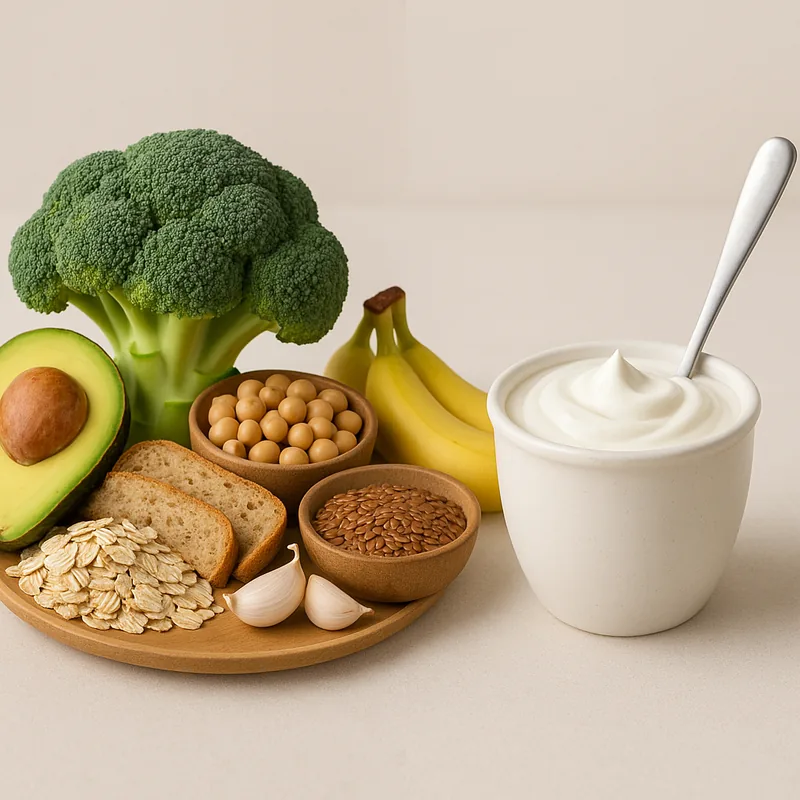
Best Food Sources of Prebiotics
Garlic: Contains inulin and FOS; also provides allicin with antimicrobial properties
Onions and leeks: Rich in FOS; much of the prebiotic content survives cooking
Jerusalem artichokes (sunchokes): Among the highest inulin content of any food — worth working up to if you’re not used to them
Chicory root: The commercial source of most inulin supplements; used in some coffee substitutes
Unripe/green bananas: High resistant starch content that decreases as the banana ripens
Oats: Beta-glucan content well-studied for both prebiotic and cholesterol-lowering effects
Cooked and cooled potatoes/rice: Resistant starch forms during cooling (reheating partially preserves it)
Legumes: Excellent source of multiple prebiotic fibers including GOS
Best Food Sources of Probiotics
Yogurt: Most widely consumed probiotic food; look for “live and active cultures” on the label
Kefir: More diverse culture than yogurt; may contain up to 61 different strains
Sauerkraut: Must be unpasteurized (the refrigerated kind, not shelf-stable) to contain live bacteria
Kimchi: Rich in Leuconostoc and Lactobacillus species; also provides prebiotic fiber from cabbage
Miso: Fermented soybean paste with diverse microbial content; avoid boiling it
Tempeh: Fermented soy product; also a complete protein source
Kombucha: Variable probiotic content; also contains some prebiotic compounds
Supplement Recommendations: What to Look For
For a Probiotic Supplement
Multiple strains, including Lactobacillus and Bifidobacterium species
CFU count verified at expiration (not manufacture)
Delayed-release or enteric-coated capsules for stomach acid protection
Strain-level identification on the label (e.g., L. rhamnosus GG, not just Lactobacillus rhamnosus)
Also, see our full Gut Health Supplements overview for how prebiotics and probiotics fit into a complete digestive health stack.
A Practical Guide to Getting Started
If you’re new to both: Start with food first. Add a daily serving of a fermented food (kefir, yogurt, or kimchi) and increase your prebiotic-rich vegetables (garlic, onions, oats). Assess your digestion for 2–4 weeks.
If you’re recovering from antibiotics: Prioritize a probiotic supplement — start during the antibiotic course (taken 2 hours apart from doses) and continue for 4 weeks post-course. Add prebiotic fiber from food or supplement to support the incoming bacteria.
If you have IBS or chronic digestive issues: Go slowly with prebiotics, as high-fermentable fiber (like inulin) can worsen symptoms in some IBS patients. Some people with IBS-D actually do better with a low-FODMAP approach, which restricts many prebiotic foods. Consult a registered dietitian or gastroenterologist before adding high-dose prebiotic supplements with IBS.
If your goal is metabolic health: Prebiotic fiber supplementation (particularly inulin or resistant starch) has stronger evidence for blood glucose and cholesterol improvements than probiotics. Prioritize this alongside dietary fiber increases.
If you want to do both: Take your probiotic in the morning with a prebiotic-rich breakfast. Evening doses also work. Consistency matters far more than timing.
FAQ
Can you take prebiotics and probiotics at the same time?
Yes — taking them together is actually beneficial and is the basis of the synbiotic concept. The prebiotic fiber can help the incoming probiotic organisms survive and establish more successfully. Some people prefer to take them together in the morning, though there’s no evidence that separating them provides additional benefit.
Will prebiotics help if I don’t also take probiotics?
Absolutely. Prebiotics feed the bacteria already living in your gut, regardless of whether you’re supplementing with additional organisms. If your existing gut flora is healthy and diverse, prebiotic fiber supplementation can meaningfully expand beneficial populations — particularly Bifidobacterium and butyrate-producing bacteria.
Do prebiotics cause gas and bloating? Is that normal?
Yes, some gas is a normal and expected result of bacterial fermentation of prebiotic fibers — it means the bacteria are working. Starting with a low dose (3–5g/day) and increasing gradually over 2–4 weeks usually reduces discomfort as your microbiome adapts. If bloating is severe or persistent, reduce the dose or try a different prebiotic fiber type.
Are all fibers prebiotic?
No. Prebiotic fibers are a subset of dietary fiber that are selectively fermented by beneficial bacteria. Psyllium husk, for example, is excellent fiber for bowel regularity but has limited prebiotic specificity. Inulin, FOS, GOS, and resistant starch have the strongest prebiotic evidence and selective fermentation profiles.
Do probiotics survive stomach acid?
Many do, particularly when delivered in delayed-release or enteric-coated capsules. Strains like L. rhamnosus GG and S. boulardii are naturally acid-tolerant. Others are more fragile. Taking probiotics with food buffers stomach acid somewhat. Look for products with encapsulation technology specifically designed for stomach acid protection.
Which is more important for gut health overall?
From a population standpoint, most research suggests that dietary fiber (prebiotic effect) has stronger, more consistent associations with long-term gut microbiome health and chronic disease prevention than probiotic supplementation. But for specific situations — after antibiotics, during GI illness, for specific conditions — targeted probiotic supplementation provides benefits that fiber alone can’t replicate. The most comprehensive approach is both.
Key Takeaways
Probiotics are live microorganisms; prebiotics are the fiber that feeds them — they’re not interchangeable.
Probiotics are most valuable when rebuilding gut flora after disruption (antibiotics, illness, travel).
Prebiotics are most valuable for sustaining and growing existing beneficial bacteria, particularly for metabolic health benefits.
Synbiotics (combining both) show additive or synergistic effects in multiple clinical trials.
Main prebiotic types: inulin, FOS, GOS, resistant starch, beta-glucans, pectin — each feeds slightly different bacterial communities.
Most Western adults are significantly under-eating prebiotic fiber; food sources come first, supplements second.
For IBS patients, high-FODMAP prebiotic fibers can worsen symptoms — get professional guidance before high-dose supplementation.
Consistency matters more than timing — pick a routine and stick with it for 4–8 weeks before evaluating results.
Sources
FAO/WHO, “Guidelines for the evaluation of probiotics in food,” Joint FAO/WHO Working Group Report, 2002.
Sanders, M.E., et al., “Probiotics and prebiotics in intestinal health and disease,” Nature Reviews Gastroenterology & Hepatology, 2022.
Flint, H.J., et al., “Microbial degradation of complex carbohydrates in the gut,” Nature Reviews Microbiology, 2012.
Moshfegh, A., et al., “Presence of inulin and oligofructose in the diets of Americans,” Journal of Nutrition, 2010.
Moro, G., et al., “A mixture of prebiotic oligosaccharides reduces the incidence of atopic dermatitis in formula-fed infants,” British Journal of Nutrition, 2008.
Poole, A.C., et al., “Human salivary amylase gene copy number impacts oral and gut microbiomes,” Gut, 2017.
Hempel, S., et al., “Probiotics for the prevention and treatment of antibiotic-associated diarrhea: A systematic review and meta-analysis,” JAMA, 2012.
Ford, A.C., et al., “Efficacy of prebiotics, probiotics, and synbiotics in irritable bowel syndrome and chronic idiopathic constipation,” The American Journal of Gastroenterology, 2019.
Rao, M., et al., “Effect of prebiotics on insulin resistance: A systematic review and meta-analysis,” Obesity Reviews, 2017.
Dahl, W.J., et al., “Dietary fiber and the gut microbiome,” Gut Microbes, 2021.
Krumbeck, J.A., et al., “Synbiotic consumption associated with the improved gut health,” Beneficial Microbes, 2021.
Schiffrin, E.J., et al., “Dietary fiber and specifically prebiotic fiber modulates the gut microbiota: Implications for health,” Journal of Nutrition, 2010.



Leave a Reply