
Quick Answer
Oral hyaluronic acid (HA) supplementation for skin hydration works through a different mechanism than topical HA serums: when ingested, HA is broken down into small fragments that are absorbed through the gut wall and stimulate CD44 and RHAMM receptor signaling in the dermis, prompting fibroblasts to produce new endogenous HA. This mechanism has been demonstrated in multiple placebo-controlled human trials — 120-240 mg/day of low-molecular-weight HA consistently improves skin moisture content, reduces transepidermal water loss, and improves self-reported skin dryness scores over 4-12 weeks.

Key Takeaways
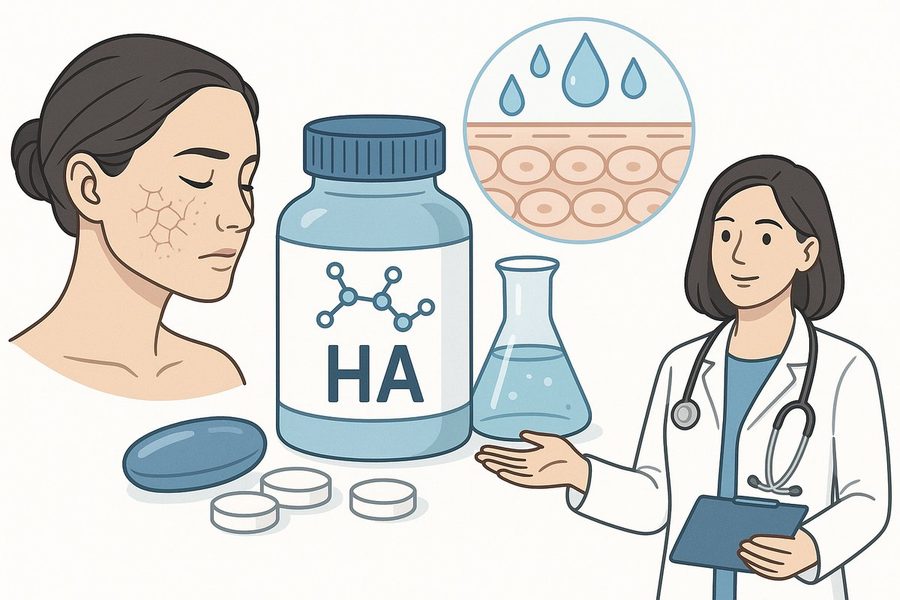
- Hyaluronic acid is a glycosaminoglycan capable of holding 1,000x its weight in water — the dermis of healthy young skin contains approximately 50% of the body’s total HA, and this concentration declines 50% by age 60, directly driving age-related skin dryness and loss of plumpness.
- Molecular weight matters for oral HA: high-MW HA (>1,000 kDa) is poorly absorbed; low-MW and enzymatically hydrolyzed HA (< 300 kDa) shows better intestinal absorption and more consistent dermal signaling effects in bioavailability studies.
- A 2014 Japanese RCT (Kawada et al.) found 120 mg/day oral HA vs. placebo for 12 weeks significantly improved skin moisture content, skin elasticity, and self-reported skin dryness scores — establishing the clinical foundation that multiple subsequent trials have replicated.
- Oral HA works synergistically with oral collagen peptides — HA provides the hydration matrix, collagen provides the structural scaffolding. Clinical trials using combination products (collagen + HA + vitamin C) tend to show larger effect sizes than individual components alone.
- Quality indicators for HA supplements: look for Hyabest(R) (Kewpie Corp), BioCell Collagen (which includes HA + collagen + chondroitin), or clearly specified low molecular weight (50-300 kDa) with third-party purity verification. Avoid products that only specify ‘hyaluronic acid’ without MW or patent designation.
Hyaluronic acid supplements for dry skin are popular because the logic is intuitive: hyaluronic acid helps hold water, so maybe taking it orally can improve skin hydration from the inside out. Unlike many beauty trends, this one actually has some useful human research behind it.
Oral hyaluronic acid will not replace moisturizer, ceramides, or sunscreen, but it may help people whose skin feels persistently dry, rough, or tight.
What hyaluronic acid does in the skin
Hyaluronic acid is a glycosaminoglycan naturally present in skin and connective tissue. Its main job is water binding. In youthful, healthy skin, it helps maintain hydration and plumpness. With aging and chronic environmental stress, skin water content and barrier quality tend to decline.
That is why hyaluronic acid shows up in so many serums, injectables, and now supplements.
Do oral hyaluronic acid supplements work?
Several clinical studies suggest that oral hyaluronic acid can improve skin moisture, dryness scores, and wrinkle appearance in some adults over periods such as 6 to 12 weeks. The effect size is not dramatic like an injectable procedure, but it appears meaningful for dryness-prone skin.
This makes it more reasonable than a lot of “beauty from within” claims.
Who may benefit most
Adults with chronically dry skin
If your skin feels dry even when you use decent topical skincare, oral hyaluronic acid may be worth trying.
Mature skin
Hydration and barrier support often become more important with age, especially after 40.
Dry indoor environments or seasonal dryness
People in winter climates or heavily air-conditioned environments often notice more benefit from hydration-support strategies.
What to pair with hyaluronic acid for better results
Oral ceramides
Ceramides help barrier function, while hyaluronic acid helps water retention. That is a logical combination.
Collagen peptides
If the goal is both hydration and firmness, collagen plus hyaluronic acid often makes more sense than either alone.

Omega-3s
Omega-3s can support barrier health and lower inflammatory stress.
What dose is commonly used?
Products vary, but many studies use 120 to 240 mg daily of oral hyaluronic acid. As usual, consistency matters more than chasing extreme doses.
How to judge whether it is working
The most useful outcomes are boring but concrete: less tightness after washing your face, reduced flaking around the cheeks or mouth, fewer rough patches, and skin that looks less dull by the end of the day. If someone expects instant plumping in three days, they will probably decide the supplement failed too early.
Taking baseline photos in the same lighting every two weeks is surprisingly helpful. Skin supplements work slowly, and memory is unreliable. Photos and a short note on dryness, tightness, and makeup or moisturizer wear time are much better than guessing.
When oral hyaluronic acid is probably not the answer
If dryness is really eczema, contact dermatitis, harsh cleanser overuse, retinoid irritation, or severe menopause-related symptoms, a supplement may help only a little. In those cases, barrier-repair skincare and medical evaluation matter more.
FAQ
How long do hyaluronic acid supplements take to work?
Most people who respond assess changes over 4 to 12 weeks, not a few days.
Are hyaluronic acid supplements better than topical hyaluronic acid?
They do different jobs. Topicals affect the skin surface directly, while oral supplements aim to support hydration more systemically.
Can I take hyaluronic acid every day?
Daily use is the usual approach in studies and commercial products, assuming the product is tolerated.
Sources
- Oe M, et al. Oral hyaluronan administration improves skin condition in humans. Clin Cosmet Investig Dermatol.
- Kawada C, et al. Oral supplementation approaches for skin hydration and barrier support. J Clin Biochem Nutr.
- Papakonstantinou E, et al. Hyaluronic acid: a key molecule in skin aging. Dermatoendocrinol.
- Boo YC. Mechanisms and evidence for nutricosmetics in skin hydration. Nutrients.
—
Disclaimer: This content is for informational purposes only and does not constitute medical advice. Severe dryness, rash, eczema, or sudden skin changes should be evaluated by a qualified clinician.
Related Articles
- Best Supplements for Skin Health in 2026: Glow From the Inside Out
- Collagen, Omega-3, and Ceramides: The Oral Skin Supplement Stack
- Oral Ceramides vs Collagen
- Skin Supplement Stack for Women Over 40: Complete Guide
- Best Astaxanthin Supplements in 2026
Sources
- The Effects of Dietary Supplementation with Collagen and Vitamin C and Their Combination with Hyaluronic Acid on Skin Density, Texture and Other Parameters: A Randomised, Double-Blind, Placebo-Controlled Trial. Nutrients. 2024. PMID: 38931263.
- Oral Hyaluronic Acid Supplement: Efficacy in Skin Hydration, Elasticity, and Wrinkle Depth Reduction. Nutrients. 2025.
- Oral Supplementation with a New Hyaluronic Acid Matrix Ingredient Improves Skin Brightness, Hydration, Smoothness, and Roughness. J Cosmet Dermatol. 2025.
- Oe M, et al. Oral Hyaluronan Relieves Wrinkles and Improves Dry Skin: A 12-Week Double-Blinded, Placebo-Controlled Study. Clin Cosmet Investig Dermatol. 2021.
- Oral administration of hyaluronic acid to improve skin conditions via a randomized double-blind clinical test. Food Sci Nutr. 2023.
📚 Part of our Best Supplements for Skin Health hub. Explore all our skin supplement guides.