

Hexarelin: What This Growth Hormone Secretagogue Actually Does (And Doesn’t Do)
Growth hormone secretagogues occupy an interesting middle ground in the peptide world — they don’t supply GH directly but instead signal your pituitary to release more of your own. Hexarelin is one of the oldest and most studied of this class, and the research on it is more nuanced than most peptide marketing suggests. There are genuine findings here, but also genuine limitations and safety questions that don’t get nearly enough attention.
Quick Answer: Hexarelin is a synthetic hexapeptide and potent ghrelin receptor agonist that stimulates growth hormone release from the pituitary. It also has direct cardiac receptor activity independent of GH. Clinical studies in humans exist, but it is not FDA-approved, is sold as a research chemical, and concerns about receptor desensitization and cardiac effects require serious consideration.
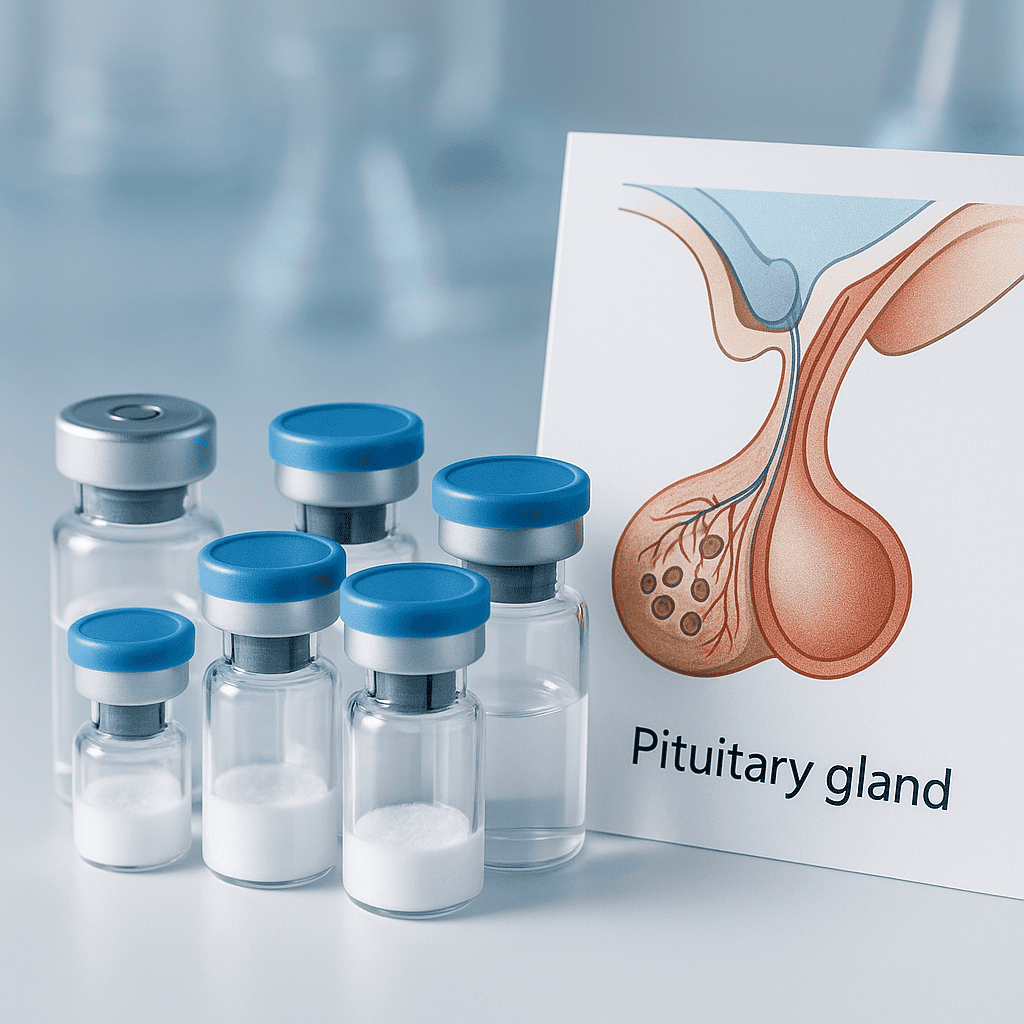
What Is Hexarelin?
Hexarelin (also written as examorelin, INN designation) is a synthetic hexapeptide with the sequence His-D-2-Methyl-Trp-Ala-Trp-D-Phe-Lys-NH2. It was developed in the early 1990s by research teams at Europeptides in collaboration with other groups, and was studied extensively as a potential pharmaceutical growth hormone secretagogue.
It belongs to the GHRP (growth hormone releasing peptide) class, which also includes GHRP-2, GHRP-6, and ipamorelin. Like all GHRPs, hexarelin activates the ghrelin receptor (GHS-R1a, or growth hormone secretagogue receptor type 1a), triggering pulsatile GH release from the pituitary gland.
Hexarelin is generally considered the most potent GH-releasing agent among the GHRP class, producing greater peak GH responses per unit dose than GHRP-2 or GHRP-6 in direct comparisons. However, potency is not always an advantage — it also desensitizes more aggressively.
How Hexarelin Stimulates Growth Hormone
When hexarelin binds to GHS-R1a receptors on pituitary somatotroph cells, it triggers intracellular signaling through phospholipase C activation, IP3 generation, and calcium mobilization. This leads to exocytosis of stored growth hormone within minutes of administration.
The GH response is substantially amplified when hexarelin is co-administered with a GHRH analog (like CJC-1295), because GHRH and hexarelin act on different receptors and their signaling pathways are additive. This is why GHRH+GHRP combinations are commonly discussed in the peptide community.
Hexarelin also stimulates GH release indirectly through the hypothalamus — it can stimulate GHRH release from hypothalamic neurons and suppress somatostatin (the GH-inhibiting hormone), adding to its overall GH-releasing effect.
The Cardiac Angle
What makes hexarelin scientifically unique among GHRPs is evidence for a GH-independent cardiovascular action. In vitro and animal studies identified what appear to be specific hexarelin binding sites in cardiac tissue that are distinct from GHS-R1a — now identified as the CD36 scavenger receptor (Bodart et al., Circulation Research, 1999).
Studies in rats with cardiac dysfunction showed hexarelin improved left ventricular function, reduced oxidative stress in cardiac tissue, and had anti-apoptotic effects on cardiomyocytes independent of GH elevation. A small human study in patients with growth hormone deficiency showed hexarelin improved cardiac performance as measured by echocardiography (Bisi et al., European Journal of Endocrinology, 1999). The mechanism appeared to involve CD36 receptor activation rather than GH-mediated effects.
This cardioprotective angle is fascinating and has driven some legitimate basic research, but it is far from established as a clinical application.
Human Clinical Studies: What Exists
Unlike many research peptides, hexarelin actually has a meaningful human clinical literature — though not for performance enhancement applications.
Studies were conducted primarily in the 1990s and early 2000s, largely by Italian and other European research groups. These trials established:
- Hexarelin reliably stimulates GH release in humans across multiple studies, with peak GH responses significantly exceeding those of other GHRPs in some comparisons (Laron et al., Acta Paediatrica, 1995)
- GH response is maintained with intravenous, subcutaneous, and intranasal administration
- The GH response is blunted in obese individuals (consistent with other GHRPs and the relationship between adiposity and somatotropic axis function)
- Desensitization is a real and significant problem with continuous or frequent dosing (see below)
There were early-stage clinical trials exploring hexarelin for growth hormone deficiency and heart failure, but none progressed to Phase III and no pharmaceutical product was approved.
Desensitization: A Critical Problem
Of all the practical concerns with hexarelin, receptor desensitization may be the most significant for anyone considering it for GH-related goals.
Studies show that repeated daily hexarelin administration leads to rapid and substantial attenuation of the GH response. Animal studies demonstrated near-complete loss of GH-releasing efficacy within 1–2 weeks of continuous dosing (Ghigo et al., Journal of Endocrinology, 1997). In humans, studies showed progressive blunting of the GH pulse with repeated dosing over days.
This is why even within the gray-market peptide community, recommendations typically involve cycling hexarelin on-and-off schedules to partially preserve receptor sensitivity. The practical implication is that whatever GH-releasing benefit hexarelin provides is significantly reduced with regular use, limiting its utility compared to slower-desensitizing peptides like ipamorelin.
Comparison to Other GHRPs
Versus GHRP-6: Hexarelin produces a stronger GH release per dose, but GHRP-6 has significant appetite-stimulating effects (via ghrelin receptor activity in the hypothalamus) that hexarelin shares but to a lesser degree. Both desensitize with regular use.
Versus GHRP-2: Similar potency comparisons vary across studies. GHRP-2 may be slightly less prone to desensitization than hexarelin in some protocols.
Versus Ipamorelin: Ipamorelin is considered more selective for GHS-R1a, produces less cortisol and prolactin elevation, and is generally less prone to rapid desensitization. For this reason, many practitioners favor ipamorelin for ongoing use despite its lower peak GH response per dose.
Side Effects
The side effects of hexarelin include:
- Cortisol and prolactin elevation: Hexarelin stimulates not just GH but also adrenocorticotropic hormone (ACTH) and thereby cortisol, and also prolactin. GHRP-2 and hexarelin both share this characteristic, which can be undesirable. Elevated cortisol chronically may have catabolic and immunosuppressive effects.
- Water retention: Via GH elevation and downstream IGF-1 increase.
- Hunger: Ghrelin receptor activation promotes appetite — this is more pronounced with GHRP-6 but is present with hexarelin.
- Tingling or pins-and-needles: Commonly reported with GHRPs, likely related to altered neural activity from GH pulses.
- Fatigue: Some users report fatigue following injections.
- Potential cardiovascular effects: While the cardiac research is mostly positive in disease states, the long-term effects of CD36 activation in healthy individuals are unknown.
Legal Status
Hexarelin is not FDA-approved for any indication. It is not a controlled substance in the US, but is sold as a research chemical without authorization for human use. It is prohibited by WADA under the growth hormone and growth hormone secretagogue category. Athletes in tested sports face doping violation risk.
Frequently Asked Questions
How does hexarelin compare to sermorelin for GH stimulation?
Sermorelin is a GHRH analog (rather than a ghrelin receptor agonist), meaning it works through a different receptor on pituitary cells. Sermorelin tends to produce a more physiological GH pulse pattern and does not desensitize as rapidly, making it preferable for ongoing anti-aging or GH-optimization protocols. Hexarelin produces higher peak GH levels acutely but suffers from faster desensitization with regular use. They are often stacked together to exploit both mechanisms.
Does hexarelin work for fat loss?
GH elevation from any secretagogue has some fat-mobilizing effects, primarily through stimulation of lipolysis in adipose tissue. However, the desensitization problem means sustained GH elevation from hexarelin alone is difficult to maintain. The fat-loss effects, if any, would be modest and require cycling protocols.
What is the typical dosing for hexarelin?
Gray-market dosing protocols (with no clinical backing) typically describe 100–200 mcg per injection, 1–3 times daily, with cycling recommendations of 4–6 weeks on followed by weeks off to allow receptor recovery. These figures come from community self-experimentation, not clinical pharmacology.
Is hexarelin safe to use long-term?
Long-term safety data in humans essentially does not exist. Known concerns include cortisol elevation, receptor desensitization, unknown effects of chronic CD36 activation, and the general risks of unregulated peptide preparations. This is not a compound with an established safety profile for long-term human use.
Can hexarelin be combined with CJC-1295?
The combination of a GHRH analog (CJC-1295) with a GHRP (hexarelin) is widely discussed in peptide forums for producing synergistic GH release. This is based on real pharmacology — the two receptors work additively. However, hexarelin’s desensitization issues remain relevant in a combination protocol, and CJC-1295 with ipamorelin is generally considered a better choice for sustained use due to ipamorelin’s more favorable receptor tolerance profile.
Sources
- Bodart, V., Bouchard, J.F., McNicoll, N., et al. (1999). Identification and characterization of a new growth hormone–releasing peptide receptor in the heart. Circulation Research, 85(9), 796–802.
- Bisi, G., Podio, V., Valetto, M.R., et al. (1999). Cardiac effects of hexarelin in hypopituitary adults. European Journal of Endocrinology, 140(5), 449–456.
- Ghigo, E., Arvat, E., Muccioli, G., Camanni, F. (1997). Growth hormone-releasing peptides. European Journal of Endocrinology, 136(5), 445–460.
- Laron, Z., Frenkel, J., Deghenghi, R., et al. (1995). Intranasal administration of the GHRP hexarelin accelerates growth in short children. Acta Paediatrica, 84(4), 414–417.
- Arvat, E., Ceda, G.P., Di Vito, L., et al. (1997). Age-related variations in the neuroendocrine control, more than impaired receptor sensitivity, cause the reduction in the GH-releasing activity of hexarelin in humans. Pituitary, 0(1–2), 51–58.
- Deghenghi, R., Cananzi, M.M., Torsello, A., et al. (1994). GH-releasing activity of hexarelin, a new growth hormone releasing peptide, in infant and adult rats. Life Sciences, 54(18), 1321–1328.



Leave a Reply