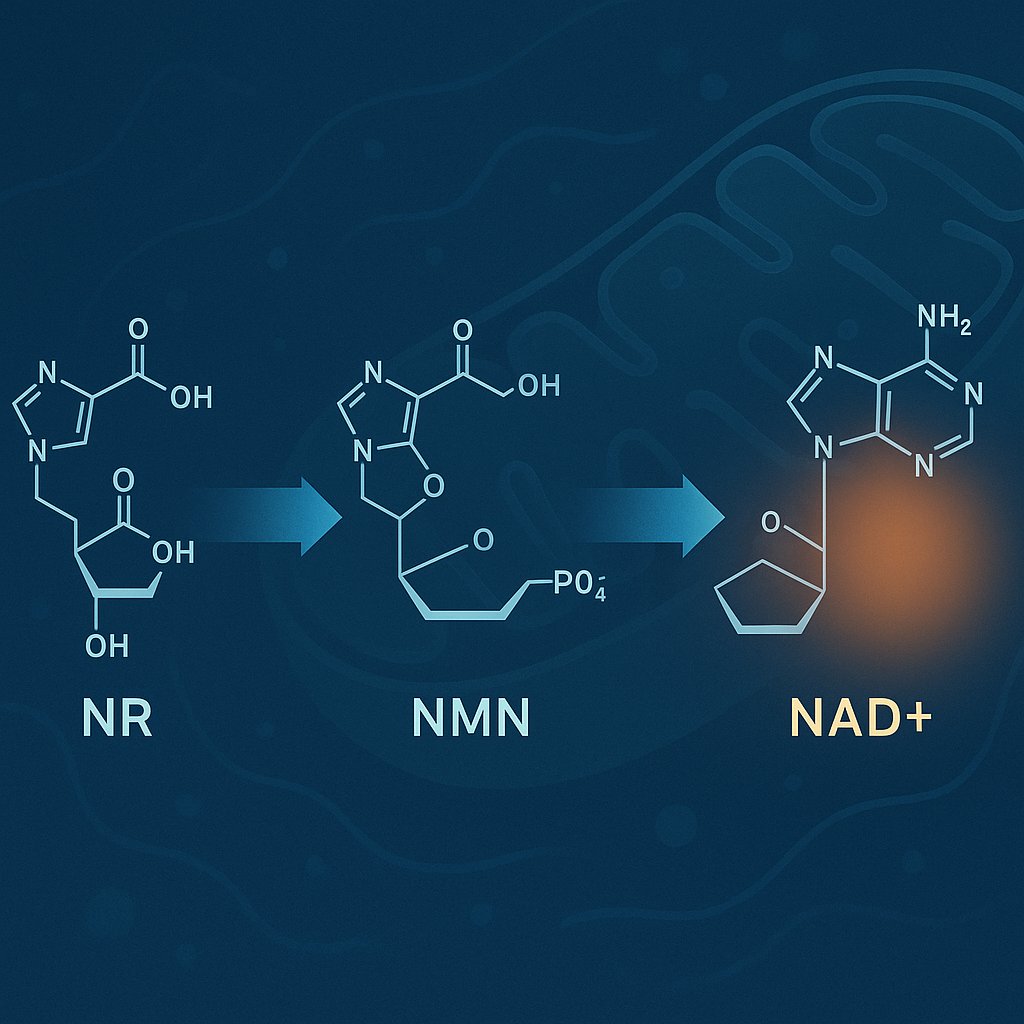
Nicotinamide riboside (NR) and nicotinamide mononucleotide (NMN) function as parallel precursors that enter the NAD+ salvage pathway at different points, with NR converted to NMN before forming NAD+. Human randomized controlled trials have examined NR supplementation for its ability to raise NAD+ levels and produce downstream functional or metabolic changes, while direct head-to-head comparisons between NR and NMN remain absent from the available evidence base. The six NR-specific trials and one multi-precursor meta-analysis reviewed here provide the only verified human data on dosage, tolerability, and outcomes.
NAD+ (nicotinamide adenine dinucleotide) is a coenzyme required for hundreds of redox reactions across cellular energy metabolism, and it also serves as a substrate consumed by sirtuins, PARPs, and CD38 enzymes involved in DNA repair, chromatin regulation, and inflammatory signaling. Because NAD+ itself is too large and charged to cross cell membranes efficiently, researchers have focused on smaller precursor molecules — like NR and NMN — that can be absorbed and converted intracellularly. NR is metabolized through the enzyme nicotinamide riboside kinase (NRK1/NRK2) to form NMN, which is then converted to NAD+ by NMN adenylyltransferase enzymes. This shared downstream step is why both compounds are often marketed interchangeably as "NAD+ boosters," even though the human RCT evidence bases for each are separate and, to date, have never been tested against one another in the same trial.
Effect Size Summary
Zhong et al. 2022 reported standardized mean differences from a meta-analysis of 40 randomized controlled trials covering multiple NAD+ precursors. Triglycerides showed SMD = -0.35 (95% CI -0.52 to -0.18, p<0.0001); total cholesterol SMD = -0.33 (95% CI -0.51 to -0.14, p=0.0005); LDL SMD = -0.38 (95% CI -0.50 to -0.27, p<0.00001); HDL SMD = +0.66 (95% CI 0.56 to 0.76, p<0.00001); and fasting plasma glucose SMD = +0.27 (95% CI 0.12 to 0.42, p=0.0004). Individual-trial-level effect sizes expressed as Cohen’s d are not reported in the abstracts of the six NR-specific randomized controlled trials, so those results are described using the original percentage changes and p-values rather than a standardized effect size. It’s worth stressing that the Zhong et al. pooled sample (14,750 participants) spans four different precursor compounds — NR, NMN, nicotinic acid (NA), and nicotinamide (NAM) — so these SMDs describe the precursor class as a whole, not NR in isolation.
Studies Included
Martens et al. 2018 conducted a randomized crossover trial of chronic NR supplementation in healthy middle-aged and older adults.
Dolopikou et al. 2020 performed a double-blind crossover study administering a single acute NR dose to 12 young and 12 older men.
Conze et al. 2019 ran an 8-week randomized double-blind placebo-controlled trial testing 100 mg, 300 mg, and 1000 mg daily NR in healthy overweight adults.
Elhassan et al. 2019 used a placebo-controlled randomized double-blind crossover design with 12 aged men receiving 1000 mg NR daily for 21 days.
Remie et al. 2020 completed a randomized double-blind placebo-controlled crossover trial of 1000 mg daily NR for 6 weeks in 13 healthy overweight or obese adults.
Dollerup et al. 2018 conducted a 12-week randomized placebo-controlled double-blinded parallel-group trial of 2000 mg daily NR in 40 obese sedentary men.
Zhong et al. 2022 performed a meta-analysis pooling 40 randomized controlled trials of various NAD+ precursors with a total of 14,750 participants.
Dosage Findings
Conze et al. 2019 demonstrated clear dose-dependent NAD+ elevation: 100 mg produced a 22% increase, 300 mg a 51% increase, and 1000 mg a 142% increase in whole-blood NAD+ within two weeks, with levels sustained through eight weeks. The remaining trials tested single acute doses (Dolopikou et al. 2020), 1000 mg daily for three or six weeks (Elhassan et al. 2019; Remie et al. 2020), or 2000 mg daily for 12 weeks (Dollerup et al. 2018). Study durations therefore ranged from one acute administration to a maximum of 12 weeks — none of the six NR-specific RCTs in this evidence base has tested continuous supplementation beyond three months.
| Dose (daily) | Whole-Blood NAD+ Increase |
|————–|—————————|
| 100 mg | 22% |
| 300 mg | 51% |
| 1000 mg | 142% |
What the Evidence Shows
NR enters the NAD+ salvage pathway and reliably elevates NAD+ and related metabolites. Conze et al. 2019 documented dose-dependent whole-blood NAD+ rises, while Elhassan et al. 2019 and Remie et al. 2020 confirmed increased muscle nicotinic acid adenine dinucleotide and methyl-nicotinamide after 1000 mg daily. Functional outcomes proved narrow: Dolopikou et al. 2020 reported that a single acute dose in older men raised NADH by 59%, NADPH by 38%, lowered F2-isoprostanes by 18%, improved isometric peak torque by 8%, and improved fatigue index by 15%, with no changes in young men or in VO2max. Notably, the same research group’s prior rodent work had found NR supplementation could actually impair exercise performance in young animals, and the human data mirror that pattern — benefits appeared only in older participants with lower baseline NAD(P)H and higher oxidative stress markers, consistent with the idea that redox-active supplementation may help most in those starting from a deficient baseline rather than in healthy young adults.
Remie et al. 2020 observed a 1.34% increase in fat-free mass and higher muscle acetylcarnitine after six weeks of 1000 mg, alongside an increase in sleeping metabolic rate — modest signals, but ones that did not translate into measurable improvements in insulin sensitivity, mitochondrial function, or cardiac parameters in the same trial. Metabolic endpoints remained unchanged elsewhere too: Dollerup et al. 2018 found no improvement in insulin sensitivity, endogenous glucose production, or lipid oxidation after 2000 mg daily for 12 weeks, and Elhassan et al. 2019 similarly found that despite elevating the muscle NAD+ metabolome, RNA sequencing showed a downregulation of energy-metabolism and mitochondrial pathways without any measured change in mitochondrial bioenergetics — alongside a reduction in circulating inflammatory cytokines, an anti-inflammatory signal independent of any metabolic-rate benefit.
Zhong et al. 2022 lipid improvements were driven primarily by nicotinic acid rather than NR; the NR and nicotinamide subgroups individually showed no significant lipid effects, and the same meta-analysis found an unfavorable increase in fasting glucose across the pooled precursor class. Martens et al. 2018, the earliest of the six trials, reported that NR was well tolerated and effectively raised NAD+, but explicitly framed its blood-pressure and arterial-stiffness observations as preliminary, recommending — rather than confirming — that future trials test those endpoints directly. No randomized controlled trial in the source set directly compared NR with NMN in humans, leaving any superiority claim unsupported by head-to-head data. Taken together, the six NR trials paint a consistent picture: NAD+ target engagement is robust and dose-dependent, but the translation into clinically meaningful metabolic or functional benefit is narrow, population-specific (mainly older or previously deficient adults), and — for glucose/lipid endpoints specifically — largely absent in trials that isolated NR from other precursors.
Limitations
Sample sizes ranged from 12 to 40 participants across the NR trials, limiting statistical power and generalizability. All interventions lasted 12 weeks or less, providing no information on long-term or lifespan outcomes — a critical gap given that most marketing claims around NAD+ precursors involve aging processes that unfold over years or decades. Conze et al. 2019 received industry funding from ChromaDex, with two authors employed by the company and one holding related intellectual property, introducing potential conflicts of interest that could bias reporting toward favorable safety and tolerability conclusions. No direct head-to-head human trial of NR versus NMN exists in this evidence base, so any comparative claims found elsewhere online are not backed by controlled human data. The Zhong et al. 2022 meta-analysis pools multiple precursors, so its effect sizes cannot be attributed to NR alone, and its own authors caution that conclusions require verification by more and higher-quality studies. Finally, several of the NR-specific trials used crossover designs with relatively short washout periods, which can leave open the possibility of carryover effects between treatment arms. This is a data synthesis, not a clinical trial and does not constitute medical advice.
Bottom Line / Practical Takeaway
NR at 300–1000 mg daily consistently raises NAD+ in a dose-dependent manner and produces limited functional changes in older adults, yet dedicated NR trials show no improvement in insulin sensitivity, glucose metabolism, or broad lipid profiles. Benefits observed in the broader precursor meta-analysis stem mainly from nicotinic acid, not NR. Without comparative human data, claims of NR superiority over NMN lack support from these sources, and anyone comparing the two supplements should treat marketing claims of one being "better absorbed" or "more effective" than the other as unproven by controlled human trials until a direct comparative RCT is published.
Frequently Asked Questions
Does NR reliably raise NAD+?
Conze et al. 2019 showed dose-dependent whole-blood NAD+ increases of 22% at 100 mg, 51% at 300 mg, and 142% at 1000 mg within two weeks, sustained through eight weeks. Elhassan et al. 2019 and Remie et al. 2020 further documented elevated muscle NAD+ metabolites after 1000 mg daily, confirming that oral NR supplementation reliably augments NAD+ pools in both blood and skeletal muscle across multiple independent trials and research groups.
What is the best NR dose?
Conze et al. 2019 provides the clearest dose-response data, with 1000 mg daily producing the largest NAD+ elevation (142%) while remaining well tolerated. Lower doses of 100 mg and 300 mg yielded smaller but still significant increases, and trials using 1000 mg or 2000 mg daily reported no serious adverse events, indicating that 1000 mg daily represents a commonly studied effective dose within the tested range — though no trial has directly compared long-term outcomes across these doses beyond 12 weeks.
Does NR help with metabolic health, blood sugar, or weight?
Dollerup et al. 2018 found no improvement in insulin sensitivity, endogenous glucose production, or glucose disposal after 2000 mg daily for 12 weeks in obese men. Remie et al. 2020 similarly reported no change in insulin sensitivity after 1000 mg daily for six weeks, although a modest 1.34% increase in fat-free mass occurred. Zhong et al. 2022 lipid benefits were driven by nicotinic acid rather than NR, indicating that NR-specific trials have not demonstrated meaningful metabolic or weight-related advantages in the populations studied so far.
Is NR safe long-term?
The longest NR trial in this set lasted 12 weeks at 2000 mg daily (Dollerup et al. 2018) and reported normal safety blood tests with no serious adverse events. Conze et al. 2019 found no difference in adverse events versus placebo across doses up to 1000 mg for eight weeks and no LDL elevation or one-carbon metabolism disruption. No data beyond 12 weeks are available in this evidence base, so long-term safety beyond three months cannot be assessed from the included sources — a meaningful gap for a supplement often taken indefinitely.
Is NR better than NMN?
No randomized controlled trial in the source set performed a direct head-to-head comparison of NR versus NMN in humans. While both compounds raise NAD+ through the salvage pathway — NR being converted to NMN as an intermediate step before forming NAD+ — the absence of comparative human data means any claim of superiority for one precursor over the other remains unsupported by the current evidence base, and consumers should be skeptical of marketing claims that assert otherwise.
Sources
Martens CR et al. (2018). "Chronic nicotinamide riboside supplementation is well-tolerated and elevates NAD+ in healthy middle-aged and older adults." Nature Communications 9:1286. PMID: 29599478.
Dolopikou CF et al. (2020). "Acute nicotinamide riboside supplementation improves redox homeostasis and exercise performance in old individuals: a double-blind cross-over study." European Journal of Nutrition 59(2):505-515. PMID: 30725213.
Conze D, Brenner C, Kruger CL (2019). "Safety and Metabolism of Long-term Administration of NIAGEN (Nicotinamide Riboside Chloride) in a Randomized, Double-Blind, Placebo-controlled Clinical Trial of Healthy Overweight Adults." Scientific Reports 9:9772. PMID: 31278280.
Elhassan YS et al. (2019). "Nicotinamide Riboside Augments the Aged Human Skeletal Muscle NAD+ Metabolome and Induces Transcriptomic and Anti-inflammatory Signatures." Cell Reports 28(7):1717-1728. PMID: 31412242.
Remie CME et al. (2020). "Nicotinamide riboside supplementation alters body composition and skeletal muscle acetylcarnitine concentrations in healthy obese humans." American Journal of Clinical Nutrition 112(2):413-426. PMID: 32320006.
Dollerup OL et al. (2018). "A randomized placebo-controlled clinical trial of nicotinamide riboside in obese men: safety, insulin-sensitivity, and lipid-mobilizing effects." American Journal of Clinical Nutrition 108(2):343-353. PMID: 29992272.
Zhong O, Wang J, Tan Y, Lei X, Tang Z (2022). "Effects of NAD+ precursor supplementation on glucose and lipid metabolism in humans: a meta-analysis." Nutrition & Metabolism 19:20. PMID: 35303905.