Tranexamic Acid for Skin: Melasma & Dark Spots
Quick Answer: Tranexamic acid inhibits UV-stimulated melanin production and is one of the most effective, well-tolerated brightening actives for melasma and PIH. At 2-5% topically, it rivals hydroquinone efficacy with fewer side effects and is safe during pregnancy when used topically at normal doses.
Tranexamic acid has had a remarkable journey from hospital pharmacy to bathroom shelf. Originally synthesized as a hemostatic drug — to stop excessive bleeding — it was discovered almost by accident to have powerful depigmenting effects when used topically. In 2026, it has become one of the most clinically respected brightening agents in dermatology, offering meaningful efficacy with a safety profile that hydroquinone cannot match.
What Is Tranexamic Acid?
Tranexamic acid (TXA) is a synthetic lysine derivative — an amino acid analog. Pharmacologically, it inhibits the activation of plasminogen to plasmin, which is why it’s used intravenously to reduce surgical bleeding. But its role in pigmentation involves a different pathway entirely.
How TXA was discovered for skin:
Japanese researchers in the 1980s and 1990s noticed that patients receiving oral tranexamic acid for medical conditions had unexpectedly improved skin tone and reduced pigmentation. This led to investigation of its topical application, and the mechanism was eventually elucidated: TXA interrupts the UV-induced signaling that triggers melanin production in skin.
How Tranexamic Acid Works on Skin
The primary mechanism: TXA inhibits the interaction between keratinocytes and melanocytes mediated by plasminogen/plasmin activation.
Here’s the simplified pathway:
UV radiation stimulates keratinocytes (skin cells) to release arachidonic acid and prostaglandins
These signals activate melanocytes to produce more melanin
The plasminogen-plasmin system is involved in this keratinocyte-melanocyte signaling
TXA blocks this step, reducing the UV-triggered melanin production signal
Additional mechanisms:
TXA inhibits the release of alpha-MSH (alpha-melanocyte stimulating hormone), a primary melanin production trigger
Some research suggests TXA reduces inflammatory prostaglandin E2, providing anti-inflammatory benefit that reduces PIH formation
TXA also appears to reduce neovascularization (abnormal blood vessel formation) associated with melasma — this addresses the vascular component of melasma that most brightening agents ignore
This multi-mechanism approach — targeting both melanocyte stimulation and the vascular component — is one reason TXA is particularly effective for melasma, which has both pigmentary and vascular elements.
Clinical Evidence for Topical Tranexamic Acid
The evidence base for TXA in topical skincare has grown substantially in the past decade:
Melasma studies:
A 2013 randomized controlled trial (J Cosmet Dermatol) showed topical TXA 3% produced statistically significant improvement in MASI (Melasma Area and Severity Index) scores over 12 weeks
A 2019 meta-analysis of multiple RCTs confirmed topical TXA significantly reduces melanin index and MASI scores with minimal adverse effects
Head-to-head comparison studies show 5% TXA produces comparable efficacy to 2% hydroquinone for melasma over 12 weeks, with significantly fewer side effects
Effective concentrations:
Most clinical studies use 2–5% topical TXA
Some studies show benefit at 2%; 5% appears to be the most commonly effective dose
Concentrations in commercial products range from 1–10%; the highest concentrations have less additional benefit and may increase transient irritation
Intradermal injections:
Dermatologists sometimes use TXA in microinjections directly into melasma patches — this route bypasses penetration challenges and shows excellent results. This is distinct from topical use and available as a professional treatment.
Oral tranexamic acid:
Low-dose oral TXA (250–750mg/day) is prescribed in some countries for recalcitrant melasma, showing high efficacy — but systemic use carries a risk of thromboembolic events that requires medical supervision.
Tranexamic Acid vs Hydroquinone
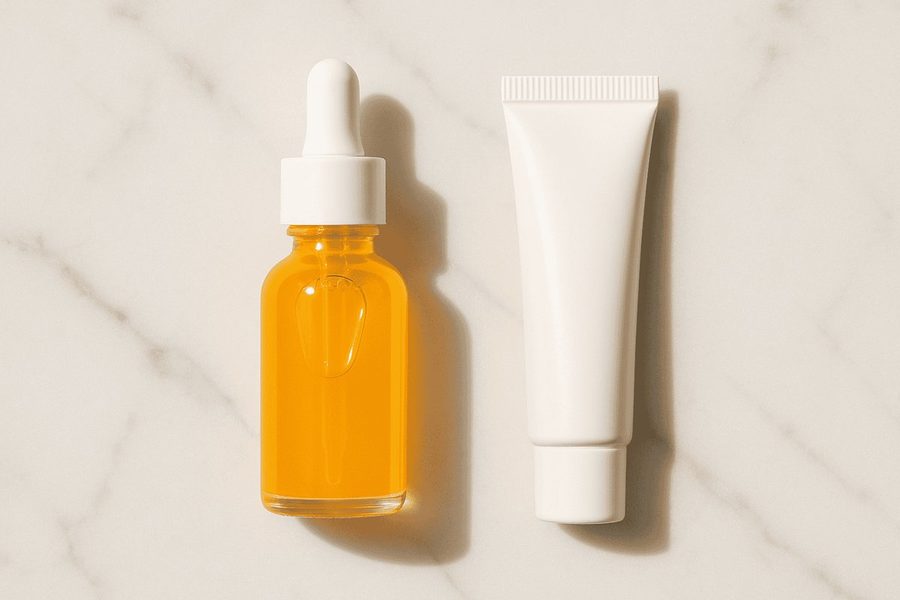
Tranexamic acid (left) vs. hydroquinone (right) — both brighten, but TXA wins on long-term safety and pregnancy compatibility.
This is the most important comparison for consumers choosing a brightening treatment:
Feature
Tranexamic Acid (5%)
Hydroquinone (2% OTC / 4% Rx)
Mechanism
AhR + plasminogen pathway
Direct tyrosinase inhibition
Speed of action
8–12 weeks
4–8 weeks (faster)
Efficacy for melasma
Comparable to 2% HQ
High
Vascular component
Yes — addresses this
No
Safety profile
Excellent
Good for short-term; risks with long-term
Long-term use
Safe for indefinite maintenance
Should be cycled (max 3–4 months continuous)
Ochronosis risk
None reported
Yes, with prolonged high-dose use
Pregnancy safety
Generally considered safe
Contraindicated
Darker skin tone safety
Excellent
Use with caution
OTC availability
Widely available at 2–5%
Available at 2% OTC
Cost
Low to moderate
Low
The verdict: Hydroquinone is faster and has a longer track record, but TXA wins on safety, maintenance suitability, and pregnancy compatibility. For most users with moderate hyperpigmentation or melasma, TXA is the superior long-term choice. For severe, recalcitrant melasma, a dermatologist-supervised course of 4% hydroquinone followed by TXA maintenance is a common and effective protocol.
Tranexamic Acid vs Other Brightening Agents
TXA vs Niacinamide:
Niacinamide inhibits melanosome transfer; TXA inhibits melanocyte stimulation. They work at different stages of the pigmentation cascade — making them excellent complements, not competitors. The combination of TXA + niacinamide is more effective than either alone.
TXA vs Vitamin C:
Vitamin C inhibits tyrosinase and provides antioxidant protection against UV-triggered melanin production. TXA targets the prostaglandin signaling pathway. Together, they’re synergistic — vitamin C in the AM, TXA in the PM is a well-regarded combination.
TXA vs Alpha-Arbutin:
Alpha-arbutin inhibits tyrosinase; TXA inhibits upstream signaling. Both are safe for all skin tones; combining them provides complementary brightening. Many premium brightening serums now include both.
TXA vs Kojic Acid:
Kojic acid inhibits tyrosinase and is somewhat more irritating than TXA. TXA is generally gentler and better tolerated, particularly for sensitive skin.
TXA vs Azelaic Acid:
Azelaic acid is broader — it addresses acne, rosacea, and pigmentation. TXA is more targeted to pigmentation and is particularly effective for melasma’s vascular component. For pure brightening, TXA often shows faster results; for multi-concern treatment, azelaic acid has broader utility.
How to Use Tranexamic Acid in Your Routine
Concentration: 2–5% for standard use; most commercial products fall in this range
Frequency: Once to twice daily
Application timing: Can be used AM or PM; PM is common to pair with retinol (on alternating nights) or in a dedicated brightening stack
AM Stack for Hyperpigmentation:
Gentle cleanser
Vitamin C serum (10–15%)
Tranexamic acid serum (2–5%) — optional AM use
Moisturizer
Tinted mineral SPF 50
PM Stack for Melasma/PIH:
Double cleanse
Tranexamic acid serum (2–5%)
Alpha-arbutin serum (1–2%)
Niacinamide moisturizer
Optional: azelaic acid 10% on stubborn patches
Combination warning:
TXA is compatible with essentially all common skincare actives. There are no significant incompatibility concerns — it’s one of the safest actives to layer. However, when layering multiple actives, give each time to absorb (60–90 seconds between layers) to avoid dilution.
Formulations and Products
Tranexamic acid is available in:
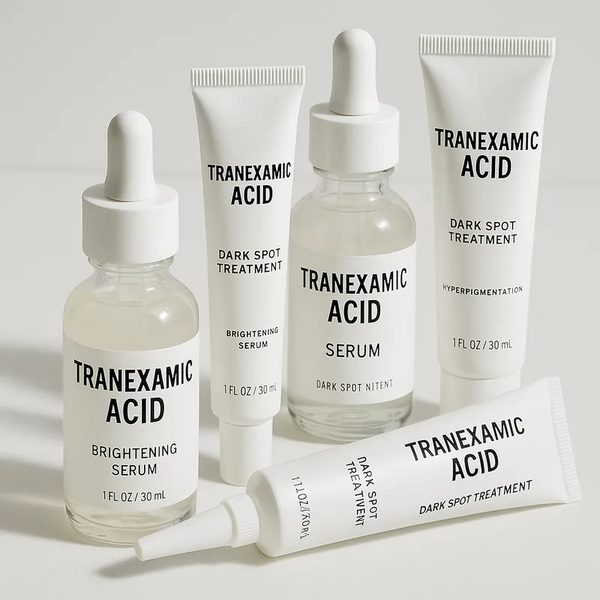
Serums: The most potent delivery format
Toners: Lower concentration, useful as a first step brightening toner
Moisturizers: Lower concentration, good for maintenance
Eye creams: Specifically for periorbital hyperpigmentation (a common and hard-to-treat concern)
Combination products: Many brightening products now combine TXA + niacinamide, TXA + arbutin, or TXA + vitamin C derivatives
Cost: TXA is relatively affordable as an ingredient — effective products exist from $15 to $100+, with cost primarily reflecting brand and additional actives rather than TXA concentration.
Special Populations
Darker skin tones:
TXA is one of the safest brightening agents for Fitzpatrick III–VI skin. Unlike glycolic acid or hydroquinone at high concentrations, it doesn’t risk over-lightening or causing reactive hyperpigmentation when used correctly.
Pregnant individuals:
Topical TXA is generally considered safe based on available data. Unlike hydroquinone (contraindicated) and retinoids (contraindicated), TXA is commonly recommended for pregnant patients with melasma. As always, consult your OB-GYN.
Post-procedure use:
After chemical peels, laser, or microneedling for pigmentation, TXA serum can be used (when skin barrier has recovered) for enhanced brightening in the weeks following treatment.
Frequently Asked Questions
Q: How long until tranexamic acid works?
A: Most users see initial brightening at 6–8 weeks with consistent use. Full results for established hyperpigmentation or melasma take 12–16 weeks. Maintenance use is necessary to prevent recurrence.
Q: Can tranexamic acid be used on fresh acne marks (PIH)?
A: Yes. TXA is effective for post-inflammatory hyperpigmentation and can be applied to recent marks. It won’t reduce the active pimple itself but helps prevent the mark from darkening and fades existing PIH faster.
Q: Is tranexamic acid the same as hyaluronic acid?
A: No — they are completely different ingredients with different mechanisms. Hyaluronic acid is a hydrating humectant; tranexamic acid is a depigmenting active. The “acid” in both names doesn’t indicate similar function.
Q: Can I use tranexamic acid with retinol on the same night?
A: Yes — TXA and retinol are compatible. Some people alternate nights; others layer them in the same PM routine. Applying TXA first, allowing it to absorb, then applying retinol is a common approach.
Q: Does tranexamic acid work for dark circles under the eyes?
A: For hyperpigmentation-type dark circles (brown, due to melanin excess), yes. TXA eye creams show evidence for periorbital pigmentation improvement. For vascular dark circles (blue-purple, from blood vessels), the anti-neovascularization effect of TXA may also provide some benefit. This is an area of ongoing research.
Q: Is TXA the same as the TXA used in hospitals?
A: Chemically identical, but topical skincare formulations are entirely different from intravenous or oral pharmaceutical TXA. The concentrations and delivery routes are completely different. Topical TXA does not have systemic blood-clotting effects at cosmetic use levels.
Q: Can men use tranexamic acid?
A: Absolutely. TXA is equally effective for male skin. Men with post-shave PIH, sun spots, or melasma (which can affect men, particularly those with sun exposure) will see the same brightening benefits.
Key Takeaways
Tranexamic acid works by blocking plasmin-mediated keratinocyte activation of melanocytes – a novel mechanism distinct from other brightening actives.
Multiple RCTs show 2-5% topical tranexamic acid rivals 4% hydroquinone for melasma with better tolerability and no ochronosis risk.
Unlike hydroquinone, tranexamic acid can be used long-term without restriction – no concerns about rebound hyperpigmentation.
Oral tranexamic acid (250-500 mg/day) is used in dermatology for stubborn melasma – requires physician guidance.
Pair with SPF (mandatory), niacinamide, and vitamin C for synergistic brightening that addresses multiple melanin pathways simultaneously.
Conclusion
Tranexamic acid has earned its place among the top-tier brightening actives in clinical dermatology. Its unique mechanism — targeting the upstream melanocyte signaling pathway rather than just the melanin synthesis enzyme — makes it particularly effective for melasma and UV-triggered pigmentation. Its superior safety profile, compatibility with all skin tones, suitability for long-term maintenance, and pregnancy safety give it advantages that hydroquinone can’t match in chronic management. In a well-designed hyperpigmentation routine, TXA paired with vitamin C, niacinamide, and daily SPF is the most evidence-backed and broadly safe brightening stack available in 2026.