
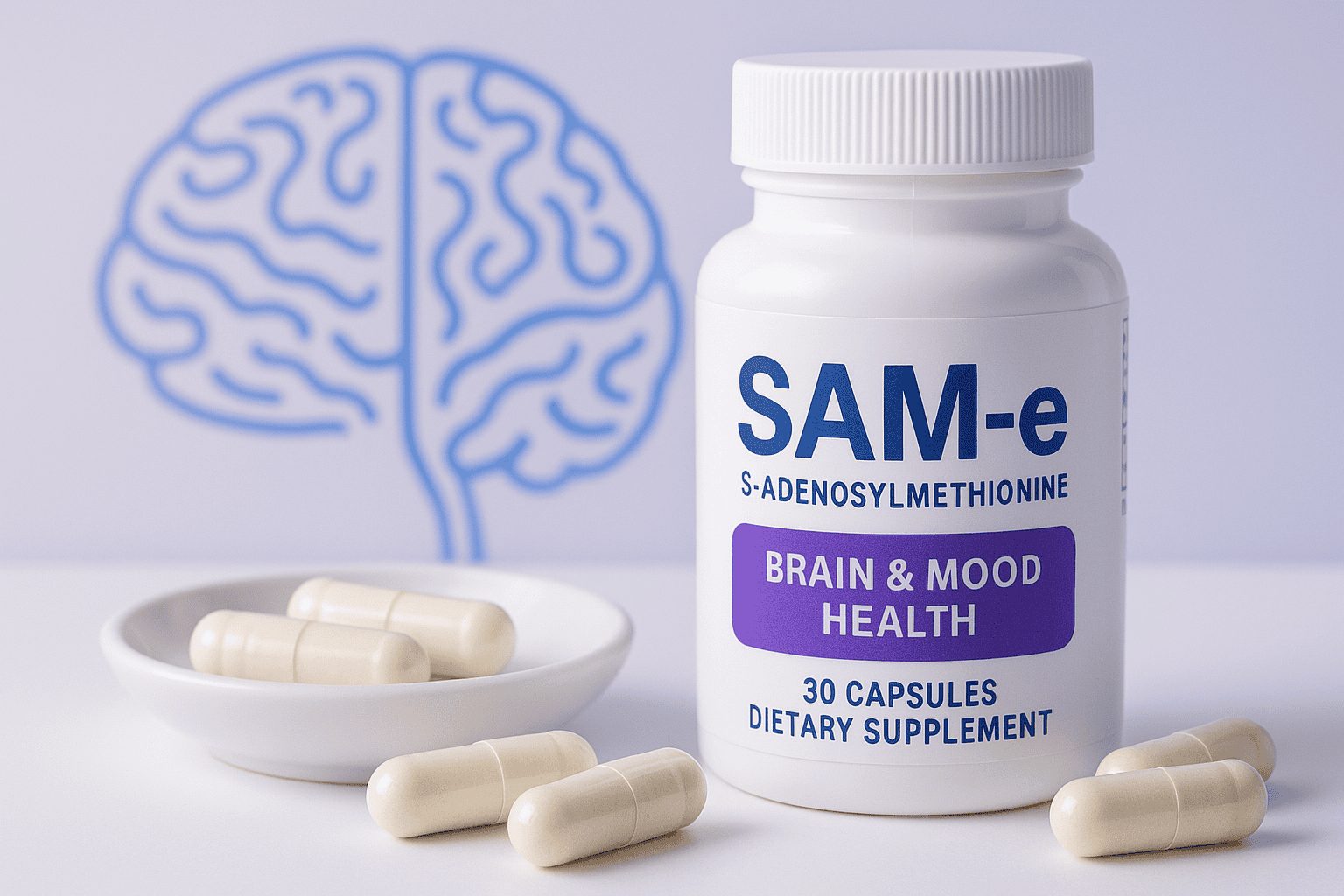
SAM-e for Depression & OCD: Evidence Review
Quick Answer: SAM-e (S-adenosylmethionine) has legitimate clinical evidence for depression — comparable to tricyclic antidepressants in some trials, with faster onset than SSRIs, and meaningful augmentation effects when added to antidepressants. It’s one of the more evidence-supported supplements for mood, but carries real drug interaction risks and bipolar disorder contraindications.
SAM-e is a fascinating compound that bridges biochemistry and psychiatry. As the body’s primary methyl donor — involved in over 100 methylation reactions including neurotransmitter synthesis, myelin formation, and DNA methylation — its influence on mental health is grounded in fundamental cellular chemistry rather than speculative mechanisms.
The clinical evidence for SAM-e in depression is more substantial than most natural remedies claim, including multiple European trials that compare it to pharmaceutical antidepressants. This guide covers what the evidence shows, who SAM-e is and isn’t appropriate for, and the critical safety considerations.
What Is SAM-e?
SAM-e (S-adenosyl-L-methionine) is synthesized in every cell of the body from the amino acid methionine and ATP. It’s the universal methyl donor in methylation reactions — transferring methyl groups (-CH3) to DNA, proteins, lipids, and neurotransmitters.
Key SAM-e-dependent processes:
- Methylation of monoamine neurotransmitters: Serotonin, dopamine, and norepinephrine metabolism involves SAM-e-dependent enzymes
- Phosphatidylcholine synthesis: Brain cell membrane fluidity
- Myelin synthesis: Critical for neuronal signal conduction
- Creatine synthesis: About 40% of SAM-e is used for creatine synthesis
- DNA and histone methylation: Gene expression regulation
SAM-e in the methylation cycle: SAM-e is tightly connected to folate and B12 metabolism (the methylation cycle). After donating its methyl group, SAM-e becomes S-adenosylhomocysteine (SAH) and then homocysteine. Homocysteine is either recycled back to methionine (requires B12 and methylfolate) or converted to cysteine (requires B6). This is why SAM-e, methylfolate, and B12 are often discussed together — they’re metabolically connected. Taking SAM-e long-term without adequate B vitamins can raise homocysteine.
Clinical Evidence for Depression
European pharmaceutical history: SAM-e has been used as a prescription antidepressant in several European countries (particularly Italy and Germany) since the 1970s. Over 40 clinical trials have been conducted.
Meta-analyses:
- A 1994 Acta Psychiatrica Scandinavica meta-analysis of 13 clinical trials found SAM-e superior to placebo with effect sizes comparable to tricyclic antidepressants (TCAs like imipramine, nortriptyline)
- A 2002 Journal of Psychiatric Research review concluded SAM-e was as effective as TCAs in most head-to-head comparisons
- A 2015 Cochrane review found overall positive evidence but noted heterogeneous study quality
Augmentation of antidepressants:
A landmark 2010 RCT from Massachusetts General Hospital (American Journal of Psychiatry, Papakostas et al.) enrolled 73 SSRI non-responders and added SAM-e (800 mg twice daily) or placebo. At 6 weeks:
- 36.1% remission rate in SAM-e group vs. 17.6% placebo
- 50% response rate in SAM-e group vs. 26.5% placebo
- Statistically significant improvement with excellent tolerability
This is one of the best-designed augmentation trials in the literature and positions SAM-e as a legitimate augmentation strategy for partial antidepressant responders.
Onset of action: Some studies report antidepressant effects beginning within 1-2 weeks of adequate dosing — notably faster than SSRIs/SNRIs (typically 4-6 weeks). This may reflect SAM-e’s direct role in neurotransmitter metabolism vs. SSRIs’ receptor adaptation mechanisms.
Evidence for OCD
The evidence for SAM-e in OCD is limited but suggestive:
- A 2000 case series and small open-label study reported OCD symptom improvement with SAM-e 200-1,600 mg/day
- Mechanistic rationale: SAM-e participates in the synthesis of glutathione and supports methylation of neurotransmitters involved in OCD pathways
The evidence here is insufficient to make strong clinical recommendations, but OCD patients who don’t respond to first-line treatments sometimes try SAM-e under psychiatric supervision.
Evidence for Other Conditions
Liver health: SAM-e is used as a hepatoprotective agent. Strong evidence for alcoholic liver disease (SAM-e replenishes methionine metabolism disrupted by alcohol). Also studied for non-alcoholic fatty liver and cholestatic liver conditions (intrahepatic cholestasis of pregnancy). This may be SAM-e’s most evidence-backed non-psychiatric application.
Osteoarthritis: Multiple RCTs show SAM-e 1,200 mg/day comparable to NSAIDs for OA pain with better GI tolerability. A 2002 meta-analysis in Journal of Family Practice confirmed this. SAM-e stimulates cartilage proteoglycan synthesis.
Fibromyalgia: Some trial evidence for pain reduction; most recent trials are negative. Currently not recommended for fibromyalgia specifically.
The Mechanism in Depression
Why would SAM-e work for depression? Multiple mechanisms are proposed:
Monoamine synthesis support: SAM-e is required for methylation reactions that affect the metabolism of serotonin, dopamine, and norepinephrine. Low SAM-e potentially impairs optimal monoamine neurotransmission.
Membrane phospholipid synthesis: SAM-e is needed to make phosphatidylcholine (the dominant phospholipid in neuronal membranes). Adequate PC improves membrane fluidity and receptor function.
Neurotrophin support: SAM-e may support BDNF (brain-derived neurotrophic factor) synthesis through methylation-related gene expression — BDNF is a key target of most antidepressants.
Direct relationship to methylation cycle: Methylfolate and B12 deficiency (both reduce SAM-e synthesis) are associated with depression and poor antidepressant response. SAM-e supplementation is, in effect, bypassing the conversion steps to directly provide the active methyl-donating compound.
Dosing
SAM-e requires careful dosing — starting too high causes GI distress and anxiety in many people:
Standard protocol:
- Start: 200-400 mg/day in the morning
- Titrate: Increase by 200-400 mg every 1-2 weeks based on response and tolerance
- Effective range for depression: 800-1,600 mg/day in divided doses
- OA: 1,200 mg/day
Timing: Take on an empty stomach (30-60 minutes before meals) for best absorption. Morning/midday dosing preferred — evening doses can cause insomnia.
Enteric-coated tablets: SAM-e is unstable and should be in enteric-coated or blister-pack form (protects from moisture, light, and stomach acid). Poor-quality SAM-e degrades before absorption.
Safety and Contraindications
Bipolar Disorder: A Major Contraindication
SAM-e can trigger manic episodes in individuals with bipolar disorder. This is one of the most important safety points. Several case reports document mania induction. SAM-e should not be used in bipolar disorder without close psychiatric supervision, and many psychiatrists advise against it entirely in this population.
Drug Interactions
MAOIs: Absolute contraindication. SAM-e + MAOIs can cause potentially fatal serotonin syndrome. Never combine.
SSRIs/SNRIs: Potential additive serotonergic effects. Clinical trials have combined them (with positive augmentation results), but physician oversight is essential. The risk of serotonin syndrome, while lower than with MAOIs, is real.
Levodopa: SAM-e may reduce levodopa efficacy (SAM-e methylates levodopa to 3-O-methyldopa). Not recommended with levodopa therapy.
Tramadol: Additive serotonergic risk.
Homocysteine
Long-term SAM-e supplementation can raise homocysteine if B vitamins (B12, methylfolate, B6) are inadequate. The methionine cycle depends on these vitamins for homocysteine recycling. Always take SAM-e with adequate B12 and methylfolate (a B-complex or targeted supplementation).
GI effects
Nausea, diarrhea, and GI discomfort are common at higher doses. Enteric-coated form and gradual dose escalation minimize this.
Key Takeaways
- SAM-e has comparable efficacy to tricyclic antidepressants in multiple European trials and shows 2-3x better remission rates vs. placebo when added to SSRIs in non-responders
- Onset may be faster than SSRIs (1-2 weeks vs. 4-6 weeks) — potentially useful for patients needing faster response
- Bipolar disorder is a major contraindication — SAM-e can trigger mania
- Never combine with MAOIs
- Discuss with your prescribing physician before adding to antidepressant therapy
- Take in enteric-coated form, morning/midday, on empty stomach; start low and titrate up
- Support the methylation cycle with B12 and methylfolate to prevent homocysteine elevation
Frequently Asked Questions
How quickly does SAM-e work for depression?
Many users and clinical studies report effects beginning in 1-2 weeks at effective doses. This is notably faster than SSRIs. However, optimal dose finding takes several weeks of titration, so the full benefit may take 4-6 weeks to assess.
Can I take SAM-e without a prescription?
In the US, SAM-e is available over-the-counter as a dietary supplement. In many European countries, it’s a prescription drug. OTC availability doesn’t mean it’s appropriate without medical awareness — given the drug interactions and bipolar contraindication, discussing SAM-e with your physician before use is strongly recommended if you’re on any psychiatric medications.
Is SAM-e the same as methionine?
No. Methionine is the precursor — your body converts methionine to SAM-e in a process requiring ATP. Supplementing methionine provides the building block but requires the conversion step. SAM-e supplementation bypasses this step, providing the active compound directly. For those with compromised SAM-e synthesis (B12 or folate deficiency, genetic MTHFR variants, liver disease), supplementing SAM-e directly may be more effective than methionine.
Should I take SAM-e with anything else?
Yes — take with an active B-complex (particularly methylcobalamin and methylfolate) to support homocysteine recycling and prevent elevation. Also ensure adequate magnesium (another methylation co-factor). The methylation cycle nutrients work as a team.
Does SAM-e help with anxiety?
Results are mixed. For some, SAM-e reduces anxiety as part of depression improvement. For others, it worsens anxiety — particularly at higher doses. Those with anxiety-predominant presentations may find SAM-e makes them feel activated or irritable. L-theanine, ashwagandha, and magnesium have better evidence specifically for anxiety without this activation risk.
Sources
- Systematic reviews on SAM-e and depression. PubMed search.
- Reviews on SAM-e and OCD. PubMed search.
- Reviews on S-adenosylmethionine and mood. PubMed search.
- Reviews on SAM-e safety and drug interactions. PubMed search.
- National Institutes of Health Office of Dietary Supplements. Dietary supplement fact sheets.
Related Articles
- Best Supplements for Anxiety in 2026
- Best Nootropic Supplements in 2026
- L-Theanine Stacks for Productivity
- Supplement Stacking Guide
- How to Buy Supplements
📚 Part of our Best Supplements for Depression hub. Explore all our mood and depression supplement guides.


Leave a Reply