
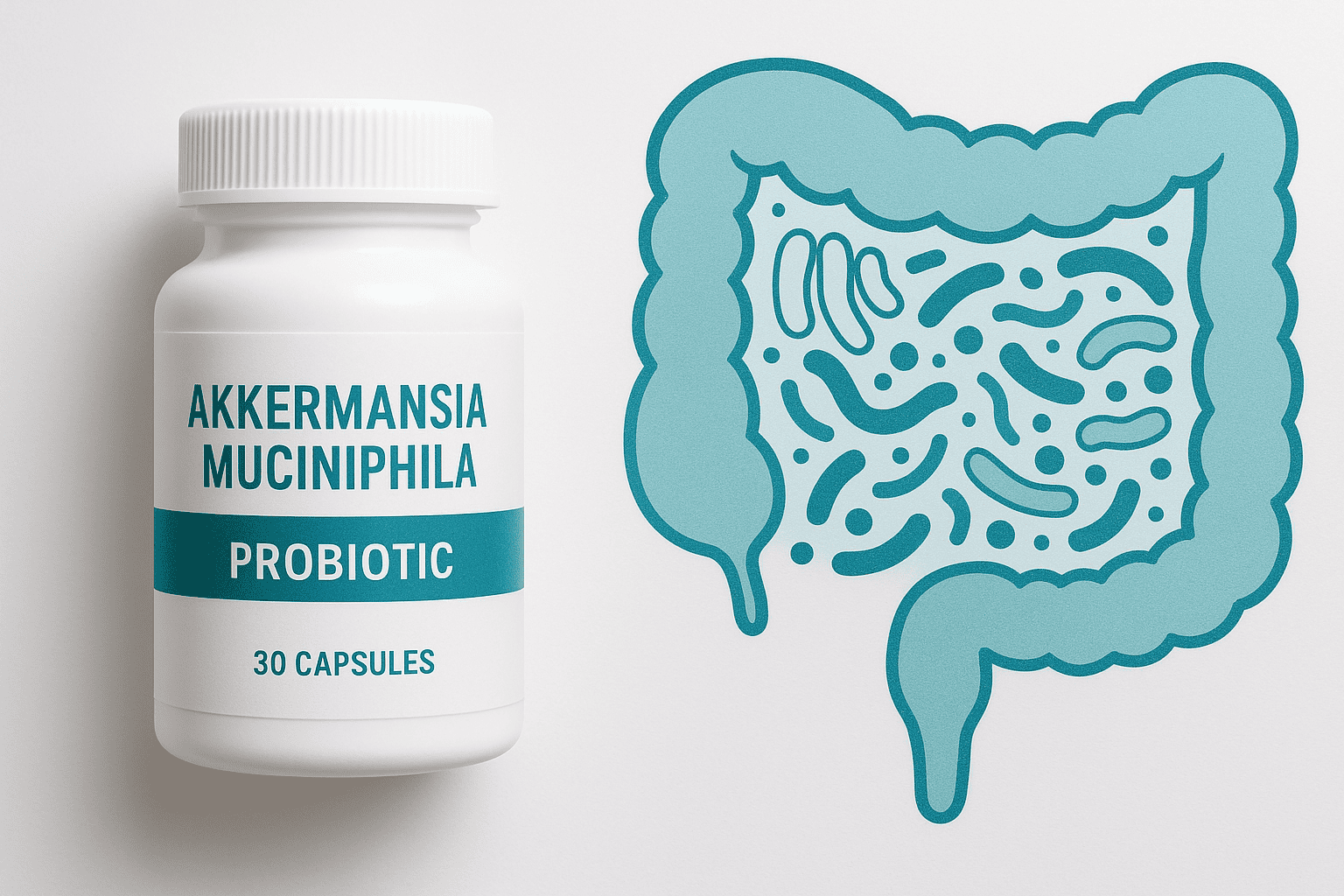
Quick Answer: Akkermansia muciniphila is a mucin-degrading gut bacterium that plays a key role in gut barrier integrity and metabolic health. People with metabolic syndrome, obesity, and type 2 diabetes consistently have lower Akkermansia levels. The first commercial Akkermansia supplement (pasteurized, not live) has cleared Phase 1 and Phase 2 human trials showing improvements in metabolic markers. It’s a genuinely novel probiotic category, but not yet a mainstream standard of care.

For most of the history of probiotic science, Lactobacillus and Bifidobacterium dominated the conversation. But a quiet revolution has been brewing in microbiome research, and Akkermansia muciniphila sits near its center.
Discovered in 2004 by a Dutch microbiologist, A. muciniphila has become one of the most-studied gut bacteria of the past decade — generating over 1,000 peer-reviewed publications and inspiring the first purposely commercialized “next-generation probiotic” that went through proper clinical trials before reaching consumers.
What Is Akkermansia muciniphila?
Akkermansia muciniphila (AM) is a gram-negative, anaerobic bacterium that lives in the mucus layer lining the gut. Its defining characteristic is mucin degradation — it uses mucin (the glycoprotein components of gut mucus) as its primary carbon and nitrogen source.
This might sound counterproductive (eating the gut lining doesn’t sound beneficial), but the relationship is mutualistic:
- AM’s degradation of mucin stimulates the host to produce more mucin, keeping the mucus layer continuously renewed and robust
- AM’s presence maintains tight junction integrity between gut epithelial cells, reducing “leaky gut” (intestinal permeability)
- AM produces short-chain fatty acids (SCFAs), particularly acetate and propionate, which fuel colonocytes and have systemic metabolic effects
- AM modulates the local immune environment, shifting from pro-inflammatory to more tolerogenic signaling
In healthy adults, Akkermansia typically represents 1–4% of the fecal microbiota. In people with metabolic disease, obesity, and type 2 diabetes, levels are consistently and significantly reduced.
The Metabolic Connection: Why Akkermansia Matters for Blood Sugar and Weight
The association between Akkermansia levels and metabolic health is one of the most replicated findings in microbiome science.
Low Akkermansia Is Associated With:
- Obesity and elevated BMI
- Insulin resistance and type 2 diabetes
- Metabolic syndrome
- Higher inflammatory markers (CRP, TNF-α, IL-6)
- Worse outcomes on caloric restriction diets
This association was established in landmark mouse studies by Cani et al. (2013) showing that supplementing obese mice with Akkermansia reversed high-fat-diet-induced metabolic syndrome — without changing caloric intake. Insulin sensitivity improved, fat mass decreased, gut barrier function normalized.
The mouse data was strikingly compelling. But mice aren’t humans.
Human Clinical Trials: What We Actually Know
The Plovier Phase 1/2 Trial (2019)
The most important human data comes from a Proof-of-Concept RCT published in Nature Medicine (Plovier et al. / Depommier et al., 2019). This Belgium study enrolled 32 overweight/obese adults with insulin resistance. Groups received:
- Placebo
- Live A. muciniphila (10^10 cells/day)
- Pasteurized A. muciniphila (10^10 cells/day)
After 3 months, both AM groups showed trends toward improvement, but pasteurized AM showed significantly better results than live AM:
- Significantly improved insulin sensitivity
- Reduced fasting insulin levels
- Significantly improved lipid profiles (reduced triglycerides, improved LDL/HDL ratio)
- Reduced cardiometabolic risk markers
- Reduced gut permeability markers
- Body weight trends trended downward (not statistically significant as primary endpoint)
The pasteurization finding was surprising and important. It turns out the key bioactive component is a surface protein called Amuc_1100, which survives pasteurization and is what drives the metabolic and gut barrier effects — not the live bacteria.
Why Pasteurized Is Better Than Live
This is a critical and counter-intuitive finding:
- Live Akkermansia is extremely oxygen-sensitive and difficult to keep viable during manufacturing and storage
- The key active component (Amuc_1100 surface protein) remains bioactive after pasteurization
- Pasteurized AM had fewer GI side effects and better tolerability
- Pasteurized AM is commercially scalable
The first commercial product (Akkermansia by Pendulum, and MucosaGen by Pendulum, and WEL-PSY by Winclove) are all pasteurized Akkermansia formulations based on this science.
Glucose Management Data (2022)
A 12-week RCT published in Nature Metabolism (Depommier et al. / Cani lab) followed people with metabolic syndrome. Groups receiving pasteurized Akkermansia showed:
- Significant reductions in HbA1c
- Improved fasting blood glucose
- Reduced visceral fat measured by MRI
- Improved liver enzyme profiles
GLP-1 Drug Enhancement (Emerging)
Early mechanistic research suggests Akkermansia may potentiate the effects of GLP-1 receptor agonists (semaglutide/Ozempic-class drugs). Some practitioners are beginning to recommend Akkermansia supplementation alongside these medications, though formal trial data is just emerging.
How Akkermansia Supports Gut Barrier Function
“Leaky gut” — or more accurately, increased intestinal permeability — is a real phenomenon where tight junctions between gut epithelial cells loosen, allowing bacterial lipopolysaccharides (LPS) and other endotoxins to enter circulation, driving systemic low-grade inflammation.
Akkermansia counters this through multiple mechanisms:
- Stimulates mucin production: A thicker mucus layer provides a physical barrier
- Enhances tight junction expression: Upregulates claudin-3, occludin, and ZO-1 proteins
- Reduces LPS translocation: Lower circulating LPS means lower metabolic endotoxemia
- Produces Amuc_1100: This surface protein directly interacts with TLR2 on immune cells, promoting anti-inflammatory signaling
The combination makes Akkermansia one of the most mechanistically understood “next-generation probiotics” — the research isn’t just observational; we know how it works.
How to Increase Akkermansia Naturally (Before Supplementing)
Several dietary and lifestyle factors reliably increase Akkermansia abundance:
Dietary Factors That Boost Akkermansia:
- Polyphenol-rich foods: Cranberries, pomegranate, red wine (moderate), green tea, dark chocolate — polyphenols are Akkermansia‘s favorite prebiotic substrates
- Omega-3 fatty acids: Fish oil and fatty fish consumption is associated with higher Akkermansia levels
- Berberine: The botanical compound shows Akkermansia-promoting effects in several studies
- Inulin and FOS: Traditional prebiotics also support Akkermansia modestly
- Caloric restriction: Intermittent fasting and caloric restriction consistently increase Akkermansia relative abundance
- Metformin: The diabetes drug is associated with significant Akkermansia increases — one proposed mechanism for its metabolic benefits
Factors That Reduce Akkermansia:
- High-fat/high-sugar Western diet
- Antibiotics
- Chronic stress
- Sedentary lifestyle
- PPI (proton pump inhibitor) use
Supplement Considerations in 2026
Commercial Products
Pendulum Akkermansia is the most widely available commercial pasteurized Akkermansia supplement in the US. It contains pasteurized A. muciniphila WB4-011 strain.
Other products:
- Visbiome High Potency (contains Akkermansia alongside other strains)
- Various European formulations through Winclove Probiotics
Dosing
Most commercial products deliver 100–500 mg pasteurized Akkermansia (roughly 10^9 – 10^10 cells equivalent). The Phase 2 trial used 10^10 cells/day.
Cost
Pasteurized Akkermansia supplements are significantly more expensive than conventional probiotics — typically $50–80/month. This reflects the challenging manufacturing requirements and smaller production scale.
What Akkermansia Cannot Do (Yet)
Important calibration:
- Not a weight loss supplement — the body composition effects in trials are modest and inconsistent
- Not a replacement for blood sugar medication — improvements in insulin sensitivity are meaningful but don’t replace pharmaceutical management of diabetes
- Limited long-term safety data — Phase 1/2 trials run 3 months; multi-year safety data doesn’t yet exist
- Not yet mainstream — most gastroenterologists and endocrinologists don’t yet routinely recommend it
Key Takeaways
- Akkermansia muciniphila is a mucin-degrading gut bacterium that maintains gut barrier integrity and metabolic health
- Low Akkermansia levels are consistently associated with obesity, insulin resistance, and metabolic syndrome
- Pasteurized Akkermansia outperforms live bacteria — the key bioactive is the Amuc_1100 surface protein, which survives pasteurization
- Phase 2 human trials show improvements in insulin sensitivity, lipid profiles, and gut permeability
- Polyphenols (cranberry, pomegranate, green tea), intermittent fasting, and fish oil all naturally increase Akkermansia — often a reasonable first step
- Supplements are significantly more expensive than conventional probiotics but have genuine science behind them
- Most useful for people with metabolic syndrome, insulin resistance, obesity, or leaky gut concerns
Frequently Asked Questions
What is Akkermansia muciniphila and why does it matter?
It’s a gut bacterium that lives in the mucus layer of the intestines, helping maintain gut barrier integrity and metabolic health. Lower levels are strongly associated with obesity, diabetes, and metabolic syndrome — making it one of the most health-relevant gut bacteria discovered in recent decades.
Should I take a live or pasteurized Akkermansia supplement?
Pasteurized is better. The key bioactive (Amuc_1100 surface protein) survives pasteurization, is more stable, is easier to manufacture, and showed better results in the landmark Phase 2 trial than live bacteria.
How do I know if my Akkermansia levels are low?
Comprehensive stool testing (Viome, Genova Diagnostics, Doctor’s Data, etc.) can measure Akkermansia relative abundance. However, these tests are not standardized and vary in accuracy. The presence of metabolic risk factors (insulin resistance, abdominal obesity) is the more actionable indicator.
Can I increase Akkermansia through diet alone?
Yes, meaningfully. Polyphenol-rich foods (berries, pomegranate, green tea), omega-3s, intermittent fasting, and reducing processed food intake all reliably increase Akkermansia abundance. For mild concerns, dietary modification is a reasonable first approach.
Is Akkermansia supplementation safe?
The Phase 1 and 2 trials found no significant adverse effects at 3 months. The long-term safety profile beyond 3 months hasn’t been formally established. It is not recommended during pregnancy or for immunocompromised individuals without medical supervision.
How long does it take for Akkermansia supplements to work?
The Phase 2 trial showed significant changes in metabolic markers at 3 months. Some changes in gut permeability markers were seen at 6–8 weeks. As with most microbiome interventions, patience is required.
Sources
- Plovier H / Depommier C, et al. (2019). Pasteurized Akkermansia muciniphila increases gut permeability and insulin sensitivity. Nature Medicine, 25(7):1096–1103.
- Cani PD, et al. (2013). Involvement of gut microbiota in the development of low-grade inflammation. Gut, 62(12):1805–1807.
- Plovier H, et al. (2017). A purified membrane protein from Akkermansia muciniphila improves metabolic syndrome. Nature Medicine, 23(1):107–113.
- Depommier C, et al. (2021). Supplementation with Akkermansia muciniphila in overweight adults: clinical trial. Nat Metab, 3(12):1547–1563.
- Cani PD & de Vos WM. (2017). Next-generation beneficial microbes: the case of Akkermansia muciniphila. Front Microbiol, 8:1765.
- Zhang T, et al. (2019). Akkermansia muciniphila is a promising probiotic. Microb Cell Fact, 18(1):206.
- Plovier H & Cani PD. (2020). Akkermansia muciniphila: untapped potential. Gut, 69(3):388.


Leave a Reply